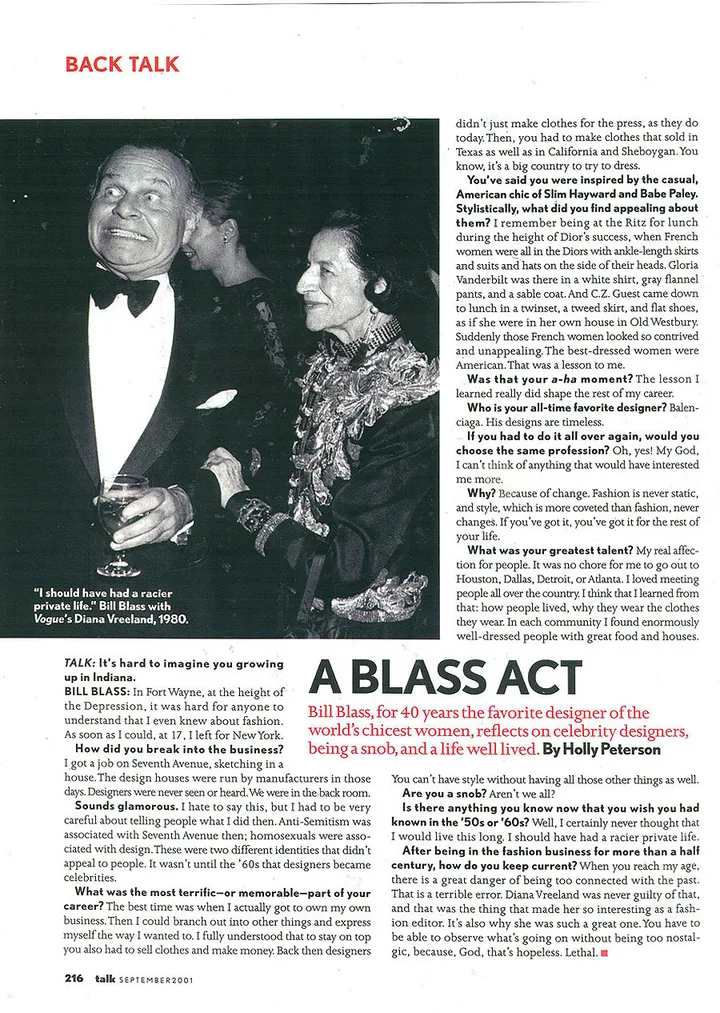
It’s hard to imagine you growing up in Indiana.
In Fort Wayne, at the height of the Depression, it was hard for anyone to understand that I even knew about fashion. As soon as I could, at 17, I left for New York.
How did you break into the business?
I got a job on Seventh Avenue, sketching in a house. The design houses were run by manufacturers in those days. Designers were never seen or heard. We were in the back room.
Sounds glamorous.
I hate to say this, but I had to be very careful about telling people what I did then. Anti-Semitism was associated with Seventh Avenue then; homosexuals were associated with design. These were two different identities that didn’t appeal to people. It wasn’t until the ’60s that designers became celebrities.
What was the most terrific—or memorable—part of your career?
The best time was when I actually got to own my own business. Then I could branch out into other things and express myself the way I wanted to. I fully understood that to stay on top you also had to sell clothes and make money. Back then designers didn’t just make clothes for the press, as they do today. Then, you had to make clothes that sold in Texas as well as in California and Sheboygan. You know, it’s a big country to try to dress.
You’ve said you were inspired by the casual, American chic of Slim Hayward and Babe Paley. Stylistically, what did you find appealing about them?
I remember being at the Ritz for lunch during the height of Dior’s success, when French women were all in the Diors with ankle-length skirts and suits and hats on the side of their heads. Gloria Vanderbilt was there in a white shirt, gray flannel pants, and a sable coat. And C.Z. Guest came down to lunch in a twinset, a tweed skirt, and flat shoes, as if she were in her own house in Old Westbury. Suddenly those French women looked so contrived and unappealing. The best-dressed women were American. That was a lesson to me.
Was that your a-ha moment?
The lesson I learned really did shape the rest of my career.
Who is your all-time favorite designer?
Balenciaga. His designs are timeless.
If you had to do it all over again, would you choose the same profession?
Oh, yes! My God, I can’t think of anything that would have interested me more.
Why?
Because of change. Fashion is never static, and style, which is more coveted than fashion, never changes. If you’ve got it, you’ve got it for the rest of your life.
What was your greatest talent?
My real affection for people. It was no chore for me to go out to Houston, Dallas, Detroit, or Atlanta. I loved meeting people all over the country. I think that I learned from that: how people lived, why they wear the clothes they wear. In each community I found enormously well-dressed people with great food and houses. You can’t have style without having all those other things as well.
Are you a snob?
Aren’t we all?
Is there anything you know now that you wish you had known in the ’50s or ’60s?
Well, I certainly never thought that I would live this long. I should have had a racier private life.
After being in the fashion business for more than a half century, how do you keep current?
When you reach my age, there is a great danger of being too connected with the past. That is a terrible error. Diana Vreeland was never guilty of that, and that was the thing that made her so interesting as a fashion editor. It’s also why she was such a great one. You have to be able to observe what’s going on without being too nostalgic, because, God, that’s hopeless. Lethal.