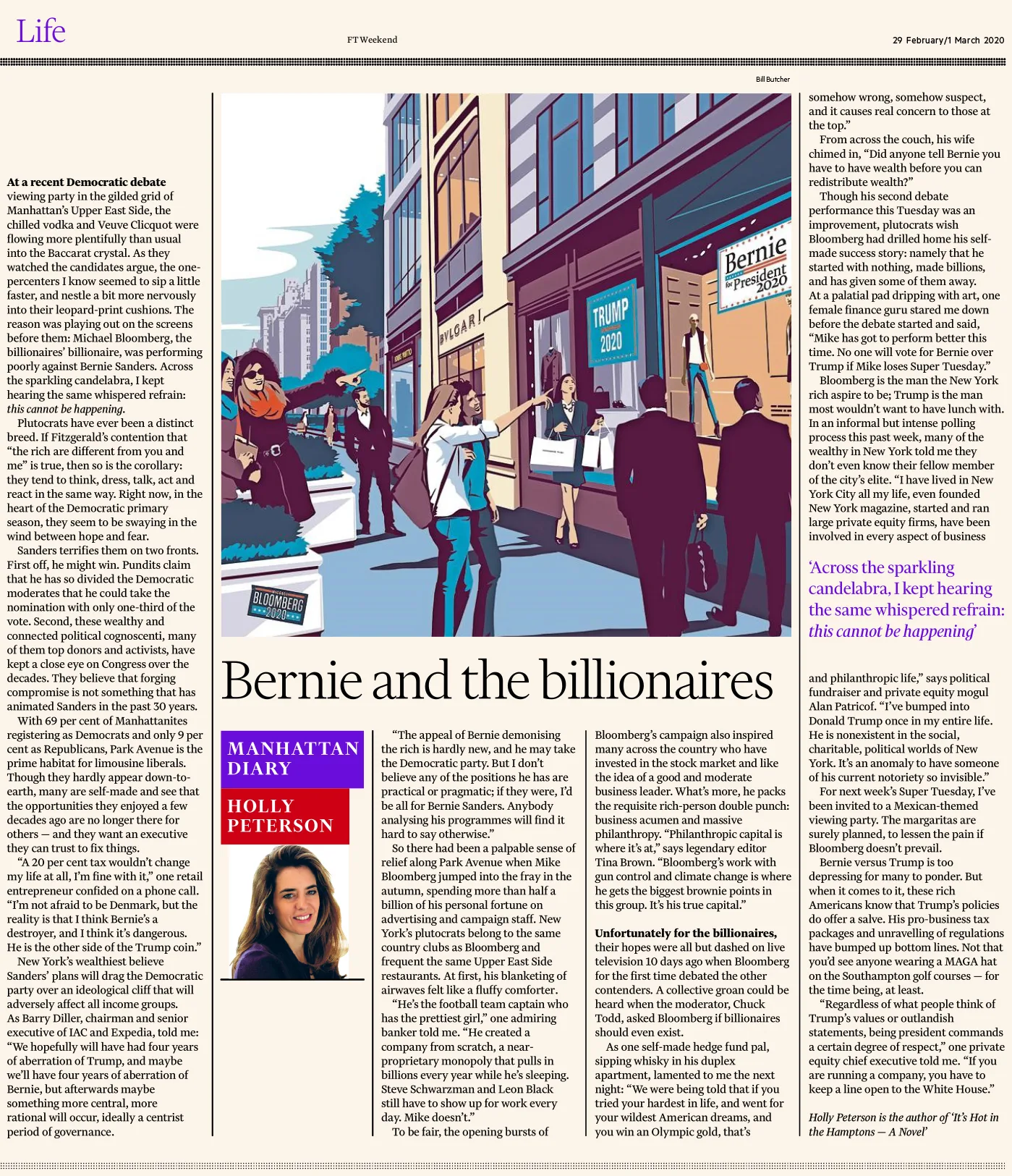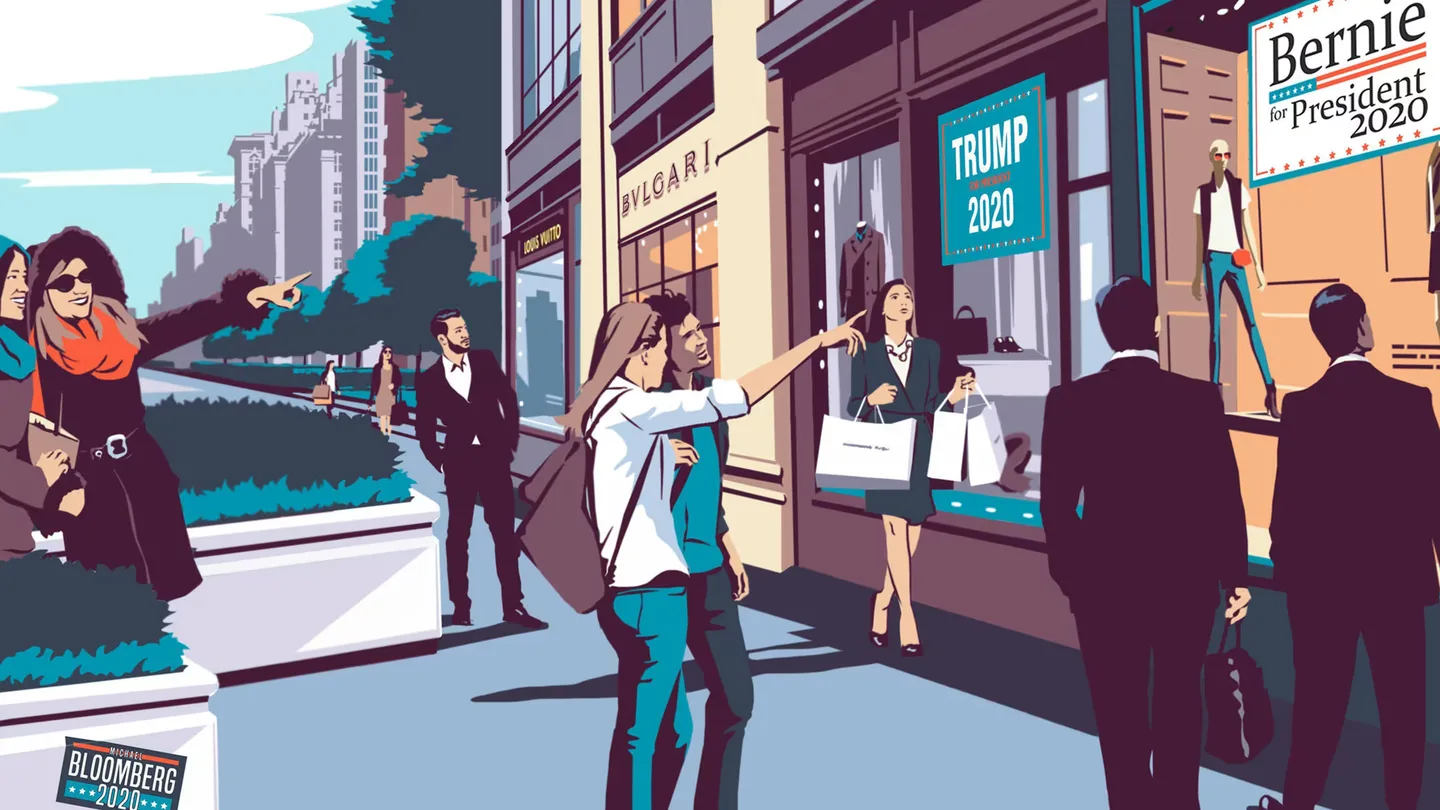
At a recent Democratic debate viewing party in the gilded grid of Manhattan’s Upper East Side, the chilled vodka and Veuve Clicquot were flowing more plentifully than usual into the Baccarat crystal. As they watched the candidates argue, the one-percenters I know seemed to sip a little faster, and nestle a bit more nervously into their leopard-print cushions. The reason was playing out on the screens before them: Michael Bloomberg, the billionaires’ billionaire, was performing poorly against Bernie Sanders. Across the sparkling candelabra, I kept hearing the same whispered refrain: this cannot be happening.
Plutocrats have ever been a distinct breed. If Fitzgerald’s contention that “the rich are different from you and me” is true, then so is the corollary: they tend to think, dress, talk, act and react in the same way. Right now, in the heart of the Democratic primary season, they seem to be swaying in the wind between hope and fear.
Sanders terrifies them on two fronts. First off, he might win. Pundits claim that he has so divided the Democratic moderates that he could take the nomination with only one-third of the vote. Second, these wealthy and connected political cognoscenti, many of them top donors and activists, have kept a close eye on Congress over the decades. They believe that forging compromise is not something that has animated Sanders in the past 30 years.
With 69 per cent of Manhattanites registering as Democrats and only 9 per cent as Republicans, Park Avenue is the prime habitat for limousine liberals. Though they hardly appear down-to-earth, many are self-made and see that the opportunities they enjoyed a few decades ago are no longer there for others — and they want an executive they can trust to fix things.
“A 20 per cent tax wouldn’t change my life at all, I’m fine with it,” one retail entrepreneur confided on a phone call. “I’m not afraid to be Denmark, but the reality is that I think Bernie’s a destroyer, and I think it’s dangerous. He is the other side of the Trump coin.”
New York’s wealthiest believe Sanders’ plans will drag the Democratic party over an ideological cliff that will adversely affect all income groups.
As Barry Diller, chairman and senior executive of IAC and Expedia, told me: “We hopefully will have had four years of aberration of Trump, and maybe we’ll have four years of aberration of Bernie, but afterwards maybe something more central, more rational will occur, ideally a centrist period of governance.
“The appeal of Bernie demonising the rich is hardly new, and he may take the Democratic party. But I don’t believe any of the positions he has are practical or pragmatic; if they were, I’d be all for Bernie Sanders. Anybody analysing his programmes will find it hard to say otherwise.”
So there had been a palpable sense of relief along Park Avenue when Mike Bloomberg jumped into the fray in the autumn, spending more than half a billion of his personal fortune on advertising and campaign staff. New York’s plutocrats belong to the same country clubs as Bloomberg and frequent the same Upper East Side restaurants. At first, his blanketing of airwaves felt like a fluffy comforter.
“He’s the football team captain who has the prettiest girl,” one admiring banker told me. “He created a company from scratch, a near-proprietary monopoly that pulls in billions every year while he’s sleeping. Steve Schwarzman and Leon Black still have to show up for work every day. Mike doesn’t.”
To be fair, the opening bursts of Bloomberg’s campaign also inspired many across the country who have invested in the stock market and like the idea of a good and moderate business leader. What’s more, he packs the requisite rich-person double punch: business acumen and massive philanthropy. “Philanthropic capital is where it’s at,” says legendary editor Tina Brown. “Bloomberg’s work with gun control and climate change is where he gets the biggest brownie points in this group. It’s his true capital.”
Unfortunately for the billionaires, their hopes were all but dashed on live television 10 days ago when Bloomberg for the first time debated the other contenders. A collective groan could be heard when the moderator, Chuck Todd, asked Bloomberg if billionaires should even exist.
As one self-made hedge fund pal, sipping whisky in his duplex apartment, lamented to me the next night: “We were being told that if you tried your hardest in life, and went for your wildest American dreams, and you win an Olympic gold, that’s somehow wrong, somehow suspect, and it causes real concern to those at the top.”
From across the couch, his wife chimed in, “Did anyone tell Bernie you have to have wealth before you can redistribute wealth?”
Though his second debate performance this Tuesday was an improvement, plutocrats wish Bloomberg had drilled home his self-made success story: namely that he started with nothing, made billions, and has given some of them away. At a palatial pad dripping with art, one female finance guru stared me down before the debate started and said, “Mike has got to perform better this time. No one will vote for Bernie over Trump if Mike loses Super Tuesday.”
Bloomberg is the man the New York rich aspire to be; Trump is the man most wouldn’t want to have lunch with. In an informal but intense polling process this past week, many of the wealthy in New York told me they don’t even know their fellow member of the city’s elite. “I have lived in New York City all my life, even founded New York magazine, started and ran large private equity firms, have been involved in every aspect of business and philanthropic life,” says political fundraiser and private equity mogul Alan Patricof. “I’ve bumped into Donald Trump once in my entire life. He is nonexistent in the social, charitable, political worlds of New York. It’s an anomaly to have someone of his current notoriety so invisible.”
For next week’s Super Tuesday, I’ve been invited to a Mexican-themed viewing party. The margaritas are surely planned, to lessen the pain if Bloomberg doesn’t prevail.
Bernie versus Trump is too depressing for many to ponder. But when it comes to it, these rich Americans know that Trump’s policies do offer a salve. His pro-business tax packages and unravelling of regulations have bumped up bottom lines. Not that you’d see anyone wearing a MAGA hat on the Southampton golf courses — for the time being, at least.
“Regardless of what people think of Trump’s values or outlandish statements, being president commands a certain degree of respect,” one private equity chief executive told me. “If you are running a company, you have to keep a line open to the White House.”