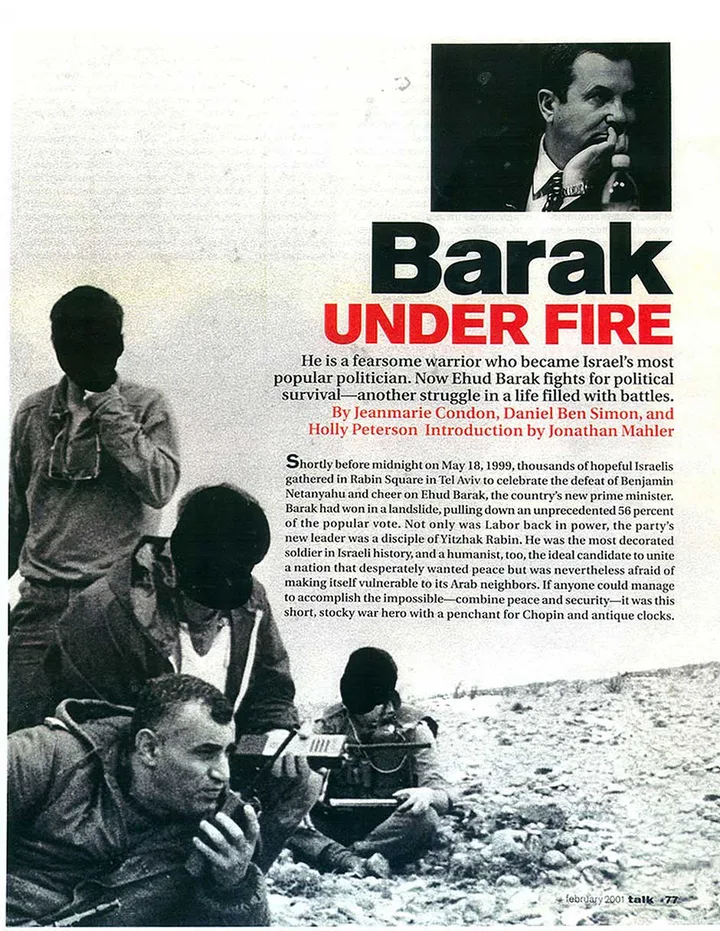
Shortly before midnight on May 18, 1999, thousands of hopeful Israelis gathered in Rabin Square in Tel Aviv to celebrate the defeat of Benjamin Netanyahu and cheer on Ehud Barak, the country’s new prime minister. Barak had won in a landslide, pulling down an unprecedented 56 percent of the popular vote. Not only was Labor back in power, the party’s new leader was a disciple of Yitzhak Rabin. He was the most decorated soldier in Israeli history, and a humanist, too, the ideal candidate to unite a nation that desperately wanted peace but was nevertheless afraid of making itself vulnerable to its Arab neighbors. If anyone could manage to accomplish the impossible—combine peace and security—it was this short, stocky war hero with a penchant for Chopin and antique clocks.
Not two years have passed since then, and Barak’s government stands in ruins. Rebuffed in a last-ditch effort to form a coalition with the Likud Party, the prime minister has had no choice but to resign from office in order to force a special election—in effect, to risk all in an attempt to salvage his political career. Even by the unforgiving, bare-knuckled standards of Israeli politics, Barak is taking one hell of a beating these days. His stubbornness and his often autocratic style have infuriated many on the left, who have taken to comparing him to none other than Benjamin Netanyahu. Leah Rabin, who campaigned with Barak in 1999, later turned on her husband’s protégé and denounced him from her deathbed. “This is our disaster,” she lamented. Israel’s hawks have been no more charitable, condemning Barak for not having been more skeptical of Yasir Arafat’s commitment to peace from the get-go. Consigned yet again to living in a state of constant fear and violence, Israelis are looking to assign blame, and Barak—the man upon whom they had once pinned so many hopes—has become the scapegoat.
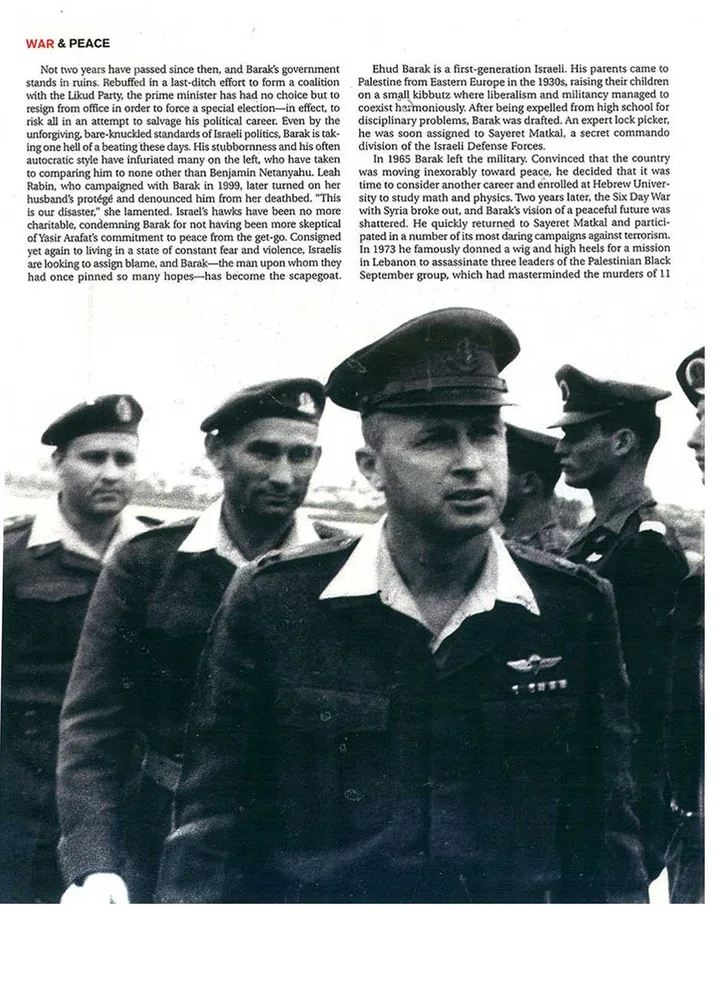
Ehud Barak is a first-generation Israeli. His parents came to Palestine from Eastern Europe in the 1930s, raising their children on a small kibbutz where liberalism and militancy managed to coexist harmoniously. After being expelled from high school for disciplinary problems, Barak was drafted. An expert lock picker, he was soon assigned to Sayeret Matkal, a secret commando division of the Israeli Defense Forces.
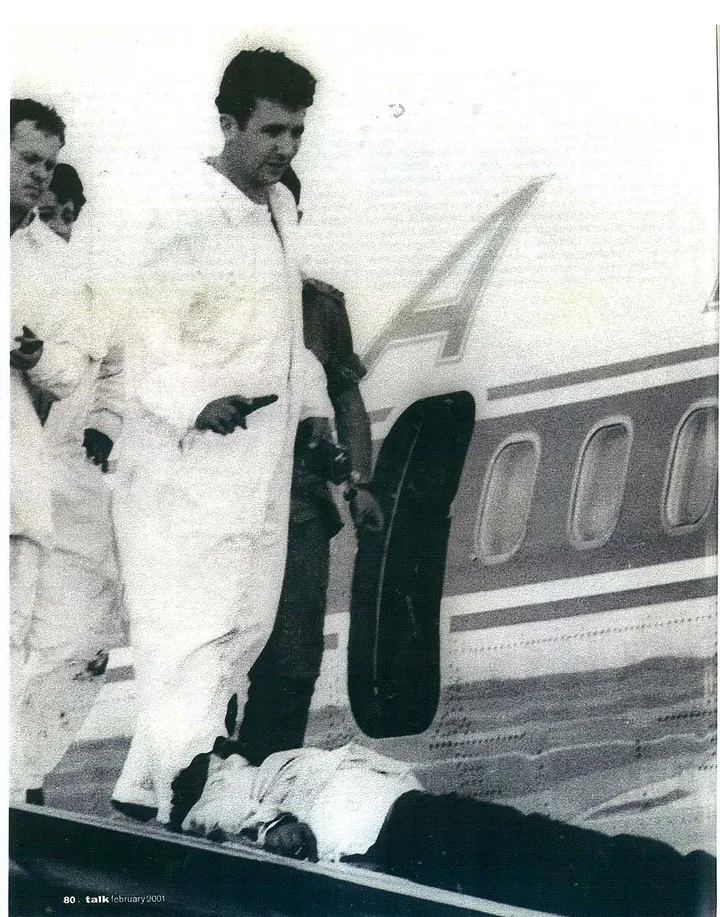
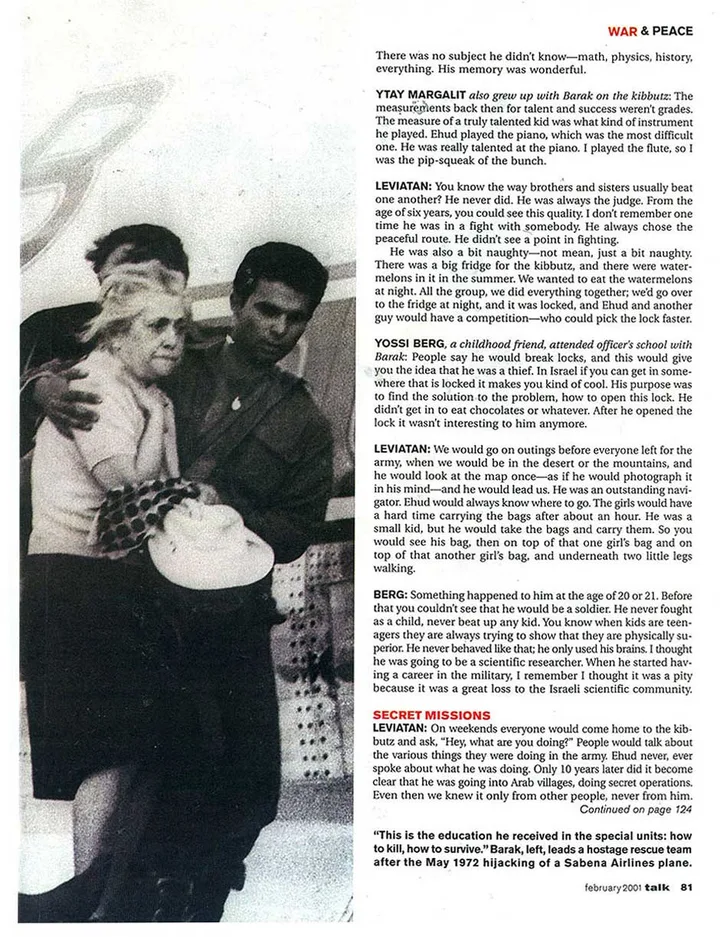
In 1965 Barak left the military. Convinced that the country was moving inexorably toward peace, he decided that it was time to consider another career and enrolled at Hebrew University to study math and physics. Two years later, the Six Day War with Syria broke out, and Barak’s vision of a peaceful future was shattered. He quickly returned to Sayeret Matkal and participated in a number of its most daring campaigns against terrorism. In 1973 he famously donned a wig and high heels for a mission in Lebanon to assassinate three leaders of the Palestinian Black September group, which had masterminded the murders of 11 Israeli athletes at the Munich Olympics the year before. In 1976 Barak planned the raid on Entebbe, the dramatic rescue of more than 100 passengers on an Air France plane that had been hijacked and diverted to a military airport in Uganda.
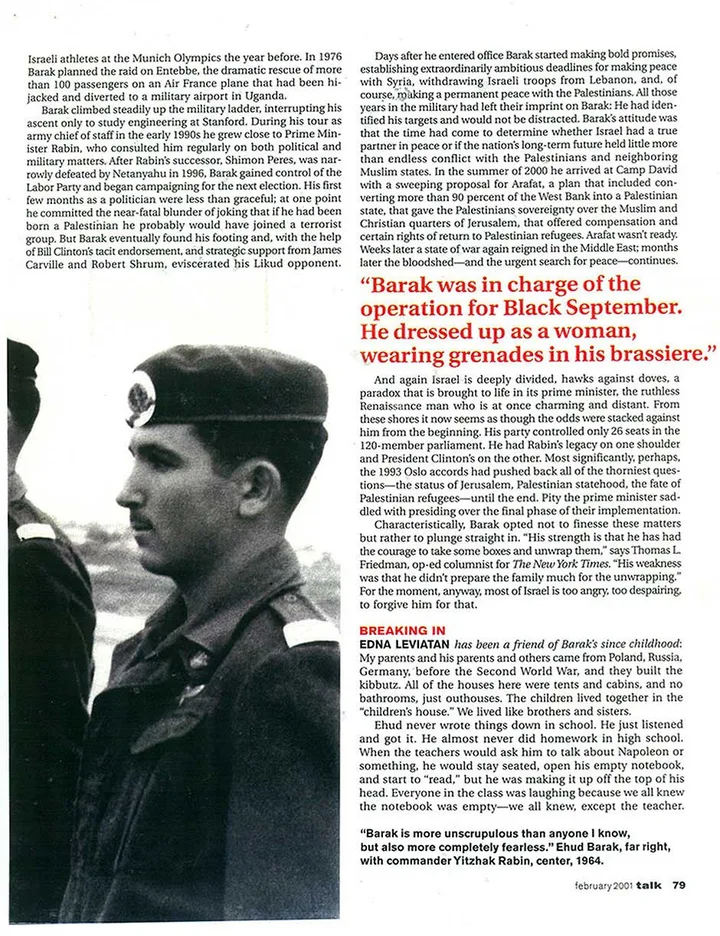
Barak climbed steadily up the military ladder, interrupting his ascent only to study engineering at Stanford. During his tour as army chief of staff in the early 1990s he grew close to Prime Minister Rabin, who consulted him regularly on both political and military matters. After Rabin’s successor, Shimon Peres, was narrowly defeated by Netanyahu in 1996, Barak gained control of the Labor Party and began campaigning for the next election. His first few months as a politician were less than graceful; at one point he committed the near-fatal blunder of joking that if he had been born a Palestinian he probably would have joined a terrorist group. But Barak eventually found his footing and, with the help of Bill Clinton’s tacit endorsement, and strategic support from James Carville and Robert Shrum, eviscerated his Likud opponent.
Days after he entered office Barak started making bold promises, establishing extraordinarily ambitious deadlines for making peace with Syria, withdrawing Israeli troops from Lebanon, and, of course, making a permanent peace with the Palestinians. All those years in the military had left their imprint on Barak: He had identified his targets and would not be distracted. Barak’s attitude was that the time had come to determine whether Israel had a true partner in peace or if the nation’s long-term future held little more than endless conflict with the Palestinians and neighboring Muslim states. In the summer of 2000 he arrived at Camp David with a sweeping proposal for Arafat, a plan that included converting more than 90 percent of the West Bank into a Palestinian state, that gave the Palestinians sovereignty over the Muslim and Christian quarters of Jerusalem, that offered compensation and certain rights of return to Palestinian refugees. Arafat wasn’t ready. Weeks later a state of war again reigned in the Middle East; months later the bloodshed—and the urgent search for peace—continues.
And again Israel is deeply divided, hawks against doves, a paradox that is brought to life in its prime minister, the ruthless Renaissance man who is at once charming and distant. From these shores it now seems as though the odds were stacked against him from the beginning. His party controlled only 26 seats in the 120-member parliament. He had Rabin’s legacy on one shoulder and President Clinton’s on the other. Most significantly, perhaps, the 1993 Oslo accords had pushed back all of the thorniest questions—the status of Jerusalem, Palestinian statehood, the fate of Palestinian refugees—until the end. Pity the prime minister saddled with presiding over the final phase of their implementation.
Characteristically, Barak opted not to finesse these matters but rather to plunge straight in. “His strength is that he has had the courage to take some boxes and unwrap them,” says Thomas L. Friedman, op-ed columnist for The New York Times. “His weakness was that he didn’t prepare the family much for the unwrapping.” For the moment, anyway, most of Israel is too angry, too despairing, to forgive him for that.
EDNA LEVIATAN has been a friend of Barak’s since childhood: My parents and his parents and others came from Poland, Russia, Germany, before the Second World War, and they built the kibbutz. All of the houses here were tents and cabins, and no bathrooms, just outhouses. The children lived together in the “children’s house.” We lived like brothers and sisters.
Ehud never wrote things down in school. He just listened and got it. He almost never did homework in high school. When the teachers would ask him to talk about Napoleon or something, he would stay seated, open his empty notebook, and start to “read,” but he was making it up off the top of his head. Everyone in the class was laughing because we all knew the notebook was empty—we all knew, except the teacher.
“Barak is more unscrupulous than anyone I know, but also more completely fearless.”
There was no subject he didn’t know—math, physics, history, everything. His memory was wonderful.
YITAY MARGALIT also grew up with Barak on the kibbutz: The measurements back then for talent and success weren’t grades. The measure of a truly talented kid was what kind of instrument he played. Ehud played the piano, which was the most difficult one. He was really talented at the piano. I played the flute, so I was the pip-squeak of the bunch.
LEVIATAN: You know the way brothers and sisters usually beat one another? He never did. He was always the judge. From the age of six years, you could see this quality. I don’t remember one time he was in a fight with somebody. He always chose the peaceful route. He didn’t see a point in fighting.
He was also a bit naughty—not mean, just a bit naughty. There was a big fridge for the kibbutz, and there were watermelons in it in the summer. We wanted to eat the watermelons at night. All the group, we did everything together; we’d go over to the fridge at night, and it was locked, and Ehud and another guy would have a competition—who could pick the lock faster.
YOSSI BERG, a childhood friend, attended officer’s school with Barak: People say he would break locks, and this would give you the idea that he was a thief. In Israel if you can get in somewhere that is locked it makes you kind of cool. His purpose was to find the solution to the problem, how to open this lock. He didn’t get in to eat chocolates or whatever. After he opened the lock it wasn’t interesting to him anymore.
LEVIATAN: We would go on outings before everyone left for the army, when we would be in the desert or the mountains, and he would look at the map once—as if he would photograph it in his mind—and he would lead us. He was an outstanding navigator. Ehud would always know where to go. The girls would have trouble carrying the bags after about an hour. He was a small kid, but he would take the bags and carry them. So you would see his bag, then on top of that one girl’s bag and on top of that another girl’s bag, and underneath two little legs walking.
BERG: Something happened to him at the age of 20 or 21. Before that you couldn’t see that he would be a soldier. He never fought as a child, never beat up any kid. You know when kids are teenagers they are always trying to show that they are physically superior. He never behaved like that; he only used his brains. I thought he was going to be a scientific researcher. When he started having a career in the military, I remember I thought it was a pity because it was a great loss to the Israeli scientific community.
LEVIATAN: On weekends everyone would come home to the kibbutz and ask, “Hey, what are you doing?” People would talk about the various things they were doing in the army. Ehud never, ever spoke about what he was doing. Only 10 years later did it become clear that he was going into Arab villages, doing secret operations. Even then we knew it only from other people, never from him.
MARGALIT: When we got into the army, he was actually drafted into the worst unit: the foot soldiers of the tank corps. It was because he was small—his weight and his height were just nil. He started shaving only when he was in his twenties. He began to grow when he was around 24.
The only reason he got to the undercover unit was because there was someone from this kibbutz in that unit, and someone else told the man, “You’ve got to check this guy out.” Once he got to the elite unit, that’s when he started to stand out. He had an unexplained ability, out of the ordinary, to photographically memorize a map. It was that sort of photographic ability to take in information that spread to other parts of his life and gave him the ability to succeed.
BERG: His name was Brug. He changed it, I think, at the age of 25. You know what it means, barak? It means lightning in Hebrew. There is a custom in Israel that when someone goes abroad to represent the government he takes a Hebrew name, so that may be why he changed it, because he was going abroad.
THOMAS R. PICKERING was U.S. ambassador to Israel from 1985 to 1988: I knew him when he was the deputy chief of staff of the Israeli Defense Forces. He was clearly head and shoulders above all of his peers, because he had this unique capacity to wear on his chest two or three of Israel’s highest decorations. Nobody else has the five decorations for bravery he has. And at the same time to have this very deep intellectual streak—he was able to understand, deal with, and focus on very complicated diplomatic and political military questions as they came along. He was clearly recognized early on, by almost everybody, as a star performer.
RICHARD W. MURPHY was assistant U.S. secretary of state for Near East and South Asian affairs from 1983 to 1988: The first time I met Barak he was head of military intelligence. We had a good talk for about an hour and a half. He then walked me out of the office and said, “You see all these photographs in the corridor? They’re my predecessors.” And I recall his saying that only—and he pointed to three or four out of the eight or nine—ever finished the tour of duty. Because they were sacked for misreading intelligence and not getting it right. That story tells me that he had a very keen appreciation of what happened to careers when misjudgments were made. And in those positions in Israel the punishment was rapid dismissal.
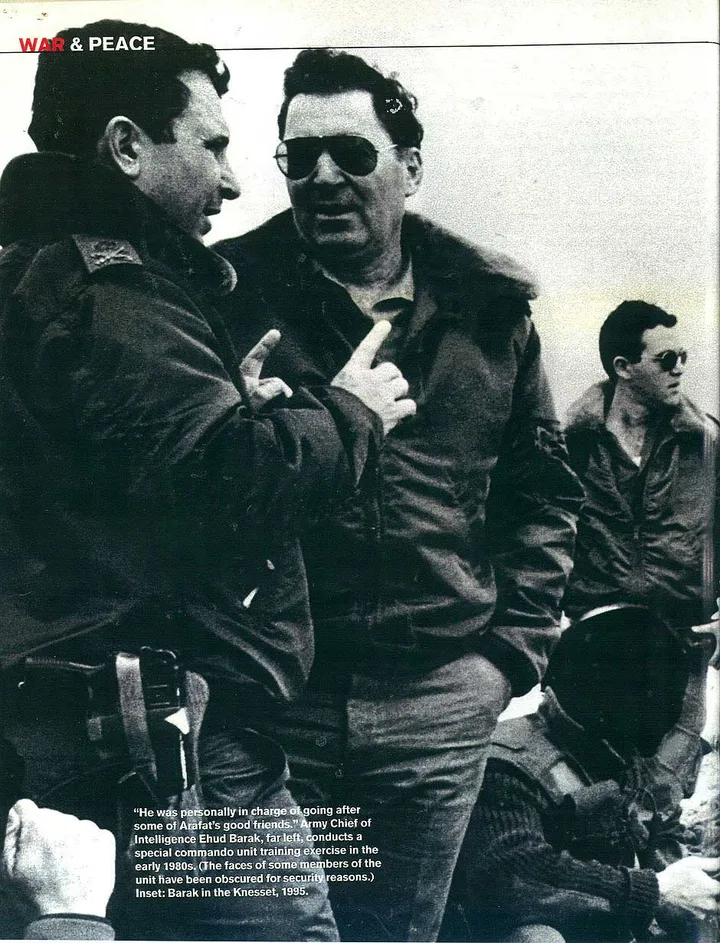
SHIBLEY TELHAMI holds the Anwar Sadat chair for peace and development at the University of Maryland: The very military record that makes him a hero in Israel is the record that makes Palestinians dislike him very much at a personal level. Arafat, in particular, remembers him from the days when he hunted PLO guerrillas in Lebanon, and for being behind the operation that killed Arafat’s key lieutenant in Tunis. He was personally in charge of going after some of Arafat’s good friends.
ROBERT ROSENBERG cowrote Secret Soldier: The True Life Story of Israel’s Greatest Commando with Muki Betser, the book’s subject: Barak got himself noticed by the head of the unit at the time, Avraham Arnan. He had unusual skill at anything mechanical. He also has this extraordinary demeanor of self-confidence and he is incredibly inventive. Part of his effort to prove to the unit that they should accept him, that he could handle secret missions, was that he dismantled what was at the time one of the biggest billboards in the country. Over a period of a week, night after night he’d go out loosening all the bolts, loosening, loosening, loosening. Nobody noticed him. Then on the last day, bam! The whole thing disappeared.
Ehud was in charge of the operation for Black September, the Palestinian group that killed 11 Israeli athletes during the 1972 Olympics in Munich. It was the first time in the Israeli Army’s history that they were going to go in mufti, wearing civilian clothes. Barak dressed up as a woman, wearing hand grenades in his brassiere, and he strolled into the neighborhood where the attack was to take place on Muki Betser’s arm, like they were a couple. It was a dead end with a T-intersection, and there were two separate buildings they were going to hit. While the soldiers were still in one of the buildings, Ehud’s job was to stay down below and maintain radio contact with a land base they set up for the operation. While an assassination is going on upstairs, out of nowhere comes a jeep with Lebanese police. For reasons that aren’t too clear, some shooting begins.
Ehud Barak is standing in the middle of the street on his own as these guys are up there, and his main concern is their safety. So on his own he stands off first one jeep and then another with a little machine gun and manages to send one jeep turning over and one catches on fire. The guys are able to come down and jump into the car. They still have to shoot a little to get out of there, but Ehud is cool; he maintains his cool through the whole thing. The man is able to maintain the same temperature all the time.
YASSER AL-NAJAR is the son of a Palestinian leader who was killed in retaliation for his participation in the Black September group by commandos led by Barak: It was one o’clock, after midnight. All of us were in bed… They came in and shot at my father. There were three of them, one a man dressed like a woman. After my father fell on the ground, this one, the leader, said in broken Arabic, “Keep shooting him until he stops moving.”
Just before the elections in Israel this year, Barak himself admitted that this was him. He was on Israeli television talking about killing my father and the others. He said, “I am proud that I had their blood on my hands and my shirt and their brains on my beret.” No good soldier describes with pleasure brains and flesh flying all over the place, especially not when running for prime minister.
PINCHAS LEVIATAN is a childhood friend of Barak’s: We went to officer’s school together. I ended my army career as a tank battalion commander; he ended his as army chief of staff, because he was the best. We went to many, many wars. We’re sick of wars and bloodshed and funerals. We took part in four wars—the Six Day War, the Yom Kippur War, the invasion of Lebanon, and a few others that are not so public. In this kibbutz the idea of living without war was how we were raised. We absorbed it from a very early age. If you take Judaism, Jews pray for peace daily. Even as secular people we have our own prayers: No more war. No more bloodshed.
A New Battlefield
RICHARD FAIRBANKS, a former U.S. negotiator for the Middle East peace process, is counselor at the Center for Strategic and International Studies: He was known as the Colin Powell of Israel. As he was finishing his tour as the chief of staff for the Israeli Defense Forces, he called me from Tel Aviv and he said, “I know that they’re going to suck me back into the morass of politics. I’ve been in the army for 30-plus years; I need a break. Can I come over to your think tank?”
So I go to see the fellow who was then the president of CSIS, David Abshire. And I said, “David, we have this extraordinary opportunity to get General Ehud Barak, known as the Colin Powell of Israel, to come over here.” He looked at me and said, “Fairbanks, we can’t take every washed-up general you know from around the world and give them an office.” And I said, “This is not your average washed-up old general. This is a future prime minister of Israel.” And Abshire said, “Right. What do you know about Israeli politics?” I’ve been dining out on that ever since.
JAMES CARVILLE was a media consultant for Barak’s campaign for prime minister: We did a lot of strategy at his house, which is just north of Tel Aviv. At night we’d open up a bottle of Scotch, and you’d kind of loosen up a bit. I mean, who wouldn’t want to sip a glass of whiskey and sit at the feet of somebody like that? He was a witness to so much in Israel—he’d seen so much history. It was fascinating how in the Yom Kippur War in ‘73 he was at Stanford and Bibi Netanyahu was at MIT, and they flew back to Israel together—interrupted their studies to go fight a war.
He was once telling me a story about being a commander in the Yom Kippur War. There was some mechanical flaw in a tank that he kind of fixed in the middle of a battle. He saw it and jury-rigged the thing. In the middle of war. I mean, he would be a good guy to have around the house.
ROBERT SHRUM also worked as a consultant to the Barak campaign: He had won by the largest margin in the history of the country. I mean, it was, like, 56-44, which in Israeli terms is a tremendous landslide. The night after he was elected—he’s sort of a late-night person—pollster Stan Greenberg and I had a drink with him about 1:30. And we sat and talked with him till 2:30 or 3 in the morning. We talked about the campaign and us and him. And then we talked about peace a little bit. And he said, “Look, I really want to do this. And I’m going to try and do it.” He said, “Now we’re going to find out whether or not the Palestinians really want to do it too.”
Playing Hardball
RABBI DOV BEGUN has been a friend of Barak’s since childhood: Before he became prime minister, he called me and told me: “Dov, I want you to know that when I become prime minister, I will make peace, then I will bring economic strength, and after that I will bring national unity in the country.” I told him: “Ehud, your aims are positive and I know that you want to strengthen the people of Israel, but you are going about it backward. If you want to make peace, first unify the people. If you begin with peace, you will tear the nation apart.” But Ehud remained the same from the time he was a child. He has this stubbornness that gives you the sense that he is banging his head against the wall. When he is out to get something, nothing in the world will stop him.
URI SAVIR is a former Israeli negotiator and an architect of the Oslo accords: Ehud Barak is more unscrupulous than anyone I know. But he is also more completely fearless. That means his array of what is possible is much larger than for people who are fearful. He can envision a military confrontation here, but at the same time he can also see himself making concessions for peace that nobody else would. It is a lack of fear.
NISSIM ZVILI was general secretary of the Labor Party under Prime Minister Yitzhak Rabin: After Rabin was killed I discovered the real Barak. He was Shimon Peres’s campaign adviser when Peres ran for prime minister. The day after our party lost the elections to Netanyahu, Barak started a brutal campaign to get rid of Peres in order to become the party leader. If, God forbid, you were not on his side you were an enemy, a traitor.
I will never forget sitting in Peres’s home and discussing Peres’s retirement. Peres suggested a date. Barak insisted Peres leave his post 12 hours earlier. Suddenly, Peres’s wife Sonia, who is the most polite woman I know, burst with anger and yelled at Barak: “Shame on you. Who the hell are you to humiliate my husband like this? Without him you wouldn’t be here today.” But Barak showed no emotion.
This is the education he received in the special units—how to kill, how to survive. I told him, “Ehud, why do you behave like this?” He said: “A political leader has to be like this, with no emotions, no compassion.”
JAMES P. RUBIN is former spokesman for the U.S. State Department: Look, Barak is a guy who had a very clear idea of what he wanted to do and went forward. Some of the things he did were quite brave and he did them despite a lot of opposition. And he seemed fairly cool amid the storm to me.
You know, some people enjoy the give-and-take of negotiation. They consider that the finest art form of being diplomats or leaders. I don’t think he was in that school. He didn’t enjoy negotiating for negotiating’s sake. He was more focused on “what I need to get and how I can get it quickly without going through a long process to prove how tough I am.”
UZI BARAM is a Labor Party member of the Knesset: One day he came to me and said, “Uzi, you are an expert on the media, and I would like you to be in charge of my public relations.” A few days later, he was smeared by a right-wing parliament member who accused him of reckless behavior when he was army chief of staff. We met for a long time and we decided what should be his reaction in public and in the press. He was pleased and said, “Uzi, you’re great.”
The day after, I watch TV news and I see him react totally differently from the original idea we’d had the day before. I met him in the parliament and asked him about his reaction. He said that he went to sleep on it and woke up with a different idea.
I told the story to my colleagues and they laughed at how naive I had been about Barak. I tell you, this guy never consulted anybody seriously. He does not rely on any advice, but his own mind only. You can convince him that he’s wrong, but he will never give a chance to something different from his own view. His suspicion is dangerous, so dangerous that it even killed the peace process with the Palestinians.
SAEB EREKAT is a senior Palestinian negotiator: We were meeting in Egypt, in September 1999, at Sharm el-Sheikh, over interim agreements. Before Barak and Arafat were to arrive, I was with one of his negotiators and we had agreed to everything we were going to do. The only thing we disagreed on was the release of Palestinian prisoners in Israeli jails.
I took out my computer and typed up everything we’d agreed to, and wrote that the Palestinians want this many prisoners released while the Israelis want to release this number. That was the only disagreement. I initialed it, I gave a copy to my Israeli counterpart, he read his copy, he initialed it. Arafat flies into Alexandria airport to come sign the formal agreement. Barak sends somebody to meet Arafat’s plane, to tell Arafat, “Saeb Erekat’s version is wrong. We still have big differences.” Barak had changed his mind on several of the points, so Barak told everyone he was right, I was wrong, and that was it. Madeleine Albright called me later to thank me. She said someone had shown her those papers showing that we had come to an agreement. She was very angry at Barak, but of course she couldn’t say so publicly. (Barak and Arafat did reach agreement by session’s end.)
MADELEINE ALBRIGHT is U.S. secretary of state: Barak has an ability to obviously be very serious about the negotiations and very personal and friendly and very practical. We had been having intense negotiations at Shepherdstown, West Virginia, site of the January 2000 peace talks between the Israelis and the Syrians. I invited the prime minister and his wife and a couple of other members of the delegation to my farm, which is nearby, for lunch, and we were able to continue discussions but also have more personal talks. After lunch, we went outside. I have an old tower clock on my barn that I have never been able to make work. The prime minister immediately took note of it and he said, “Your clock doesn’t work. The next time I come back, I will fix it.”
AHMAD “ABU ALA” QUREI is a senior Palestinian negotiator: The most important meeting we had with Barak was in Oslo in November of 1999, when we were there with Arafat and Clinton in memory of Rabin’s death. And there we made an agreement to have two tracks of negotiations—formal negotiations and secret negotiations. And that agreement led to secret negotiations in Stockholm between me and Arafat adviser Abu Mazen and Israeli foreign minister Shlomo Ben-Ami.
I felt that the Stockholm negotiations started in a very serious way. Then they wanted to stop the negotiations—and this was Barak. Ben-Ami told me, “Let’s stop and concentrate on the meeting that will happen at Camp David.” I asked him, “Why? The gaps are still big; let’s continue to work.” He said, “No, Barak will go to Camp David, Arafat will be there, Clinton, and there we will conclude the final agreement.” I said, “I don’t think it’s a good idea.” He said, “No, I am insisting. The prime minister is insisting.” Maybe this is Barak’s way—to negotiate by himself. You have to prepare for these meetings, to give the two leaders time to look at what is possible—give them a chance to disagree with things or agree before the big meeting. Camp David failed because there was no time spent preparing.
Camp David
ELI YISHAI is head of Israel’s ultra-Orthodox party, Shas: The truth is that he is a very nice individual and quite pleasant to chat with. But the moment we start talking politics, the man changes right before your very eyes and his wisdom evaporates. He has such a sharp mind but such a hard heart that you can’t understand how they live together in the same body.
I can’t forget the day in July that Barak was about to leave for Camp David for the talks with Clinton and Arafat. I came to see him in his office. I asked him to share with me the positions he was planning to present to Arafat. He said that he could not. I told him, “Mr. Prime Minister, I am the head of the third-largest party in this coalition government. I owe my voters answers.” He said that his negotiating positions had to remain secret. I told him that if he stuck to his refusal, we would quit.
JOE LOCKHART is former press secretary to President Clinton: Obviously, keeping the discussion private was a high priority for Barak and the Israeli delegation. And that’s why he liked Camp David so much: because it really was so cut off. You couldn’t use your cell phones. The bottom line is that, except for standing on one foot in a far corner of camp, there was no cell coverage. So you had to go through the operator to get out.
We all felt strongly about not telling the press anything, because it’s impossible to get an agreement when you have to spend most of the day fighting over who leaked what the day before. We sort of had a mid-morning ritual, where Barak would walk down to see the president and on the way in he would stop in. Barak would look at me and say, “Telling the press anything today?” and I’d say, “No, Mr. Prime Minister. I’m not going to tell them anything today.” And he’d look at me and smile and say, “That’s good.”
EREKAT: At Camp David we saw him only once, other than the evening dinners arranged by Clinton. The one time we saw him, he was walking, and we were sitting on the terrace of Arafat’s cottage, and so I stood up and waved and said “Come! Come!” I made tea for them with my own hands and they sat and talked for about 15 minutes. They talked about the weather—how it rains in the morning and then gets sunny, how the weather here is so strange. And that was the only time they sat together. He never sat and met with Arafat alone other than that. Rabin and Arafat, Peres and Arafat, even Netanyahu and Arafat would spend hours alone.
At Camp David, Barak was depressed. He hardly left his room for four days, because he really thought Arafat would just accept the offer that he had made.
SHLOMO BEN-AMI is Israel’s foreign minister: I followed closely his state of mind and was shocked to see how flexible he was in regard to the most crucial issues of the conflict between us and the Palestinians. There was no fixed idea for him. He was ready to change his mind when he thought it necessary. He really believed we could reach an agreement with the Palestinians in order to put an end to the conflict, but Arafat was not ripe for it during the Camp David summit. He failed to match Barak’s boldness. No Israeli prime minister has offered the Palestinians more than he has.
BRUCE RIEDEL is special assistant to President Clinton and senior director for Near East and South Asian affairs: Barak, for a break from the intensity of the negotiations, asked to go and see two Civil War battlefields. He was extremely interested in the American Civil War, why the war had happened, the weapons that were used, the divisions that it caused, the casualties. He looked at it through the eyes of a professional soldier. This was not Shimon Peres talking about building a future of love and peace. This was a hard-edged soldier looking at a famous battlefield and trying to understand what had happened there, and yet at the same time seeing the parallels for his own country today.
MURPHY: At Camp David, Barak went beyond where the Americans had expected him to go. Barak pushed for the Camp David summit. I think he pushed the American side hard to hold the summit. Clinton may well have been hoping it would work for the sake of his own legacy, but no one would have criticized him for that had the talks succeeded. In any event Barak, by again breaking the mold on a number of Israeli positions—this time on Jerusalem, borders, and settlements—further raised the respect that Clinton and U.S. envoy Dennis Ross had for him. He gave the White House and our experts the hope that a comprehensive deal just might be within reach. Unfortunately, Barak didn’t need an agreement with Washington but one with Damascus and Arafat.
SAVIR: He saw us optimists about Oslo as dreamers. I think he saw Oslo as giving away too much, too many cards. For us the freedom of the Palestinians really meant something.
Barak had a more courageous approach to the Palestinians’ interests than many of us. He had a courageous view of their interest in Jerusalem. So he puts more on the table. But he does it in a take-it-or-leave-it way.
I think Barak was ready to come out of Camp David with Arafat saying yes to the whole package. But with Arafat, there are no shortcuts. Arafat is prepared to go to the brink and a little bit beyond. Barak is a man of the pressure cooker. Arafat is much more a person of struggle and patience.
The Days of Rage
EDGAR BRONFMAN is president of the World Jewish Congress: I was over there just after violence erupted in late September. And that’s when we talked. That was probably two weeks into it. You know, he was sitting at the table—it was a full table. But you would not have thought that there was anything wrong. I mean, he is Mr. Cool. He does not display his emotions. He didn’t look frustrated, he didn’t look angry. He had a job to do. He was doing it. But I mean, the question is, What does he show? He’s a great poker player—reveals very little of his hand.
BARAM: I must confess one thing: Being a Laborite and one of the leaders of the peace camp in Israel, I hate to think that a prime minister from my party would lose in the elections. But this time I feel that I wouldn’t grieve much if Barak were replaced by somebody else, even from the right-wing party. Anybody would be better than Barak.
I say if you have an electrical problem at home you call for an electrician. If you have a medical problem, you call for a doctor. Why, for God’s sake, when we have a political problem, do we call for an army general? Why don’t we call for a real politician?
EREKAT: If I could take a tape recorder and record any one of the meetings between Barak and Arafat I could just play it back at all the rest, because it’s always the same: “Peace of the brave; we have to make courageous decisions…” In Barak’s time—and nobody really knows this—he has not ever agreed to transfer one inch of land to us. He transferred the land that Netanyahu committed to transfer. But he has not himself committed to the transfer of one inch of land. I think he is the only Israeli prime minister since the time of the agreements with Egypt in the 1970s who has not conceded to transfer one inch of land under Israeli military occupation.
Barak believes he is the savior. He got 56 percent of the popular vote, so he owed nobody anything. He can look Israelis in the eye and say, “What the hell are these people talking about? I was in the military; I know what is needed.” And he can say, as he did publicly the other day, “If it takes 2,000 Palestinians to die to get what we want, we’ll do it.”
RABBI MICHAEL MELCHIOR is minister for Israeli Society and the World Jewish Community: He has difficulty in personal relationships, creating a warmth around him—including in relationships with Arafat. But he has gone so far in order to find a real, decent compromise—a win-win compromise, which would give the Palestinians their self-determination and their own state—this they could have got. This is what Barak gave them. They didn’t need to have all this bloodshed for that. And he just can’t accept… that just because you haven’t kissed Arafat the right way, or you haven’t created that kind of relationship, that that’s a justification for starting off a whole intifada with hundreds of people killed and endangering really the whole future of the Middle East.
It’s a tragedy. And I think he feels also this is a tragedy. And he is now caught between the necessity to defend our country and our citizens and the imperative not to give up the hope of peace so that everything falls apart. Israel will pay a very dear price.
Additional reporting by Nancy Beiles