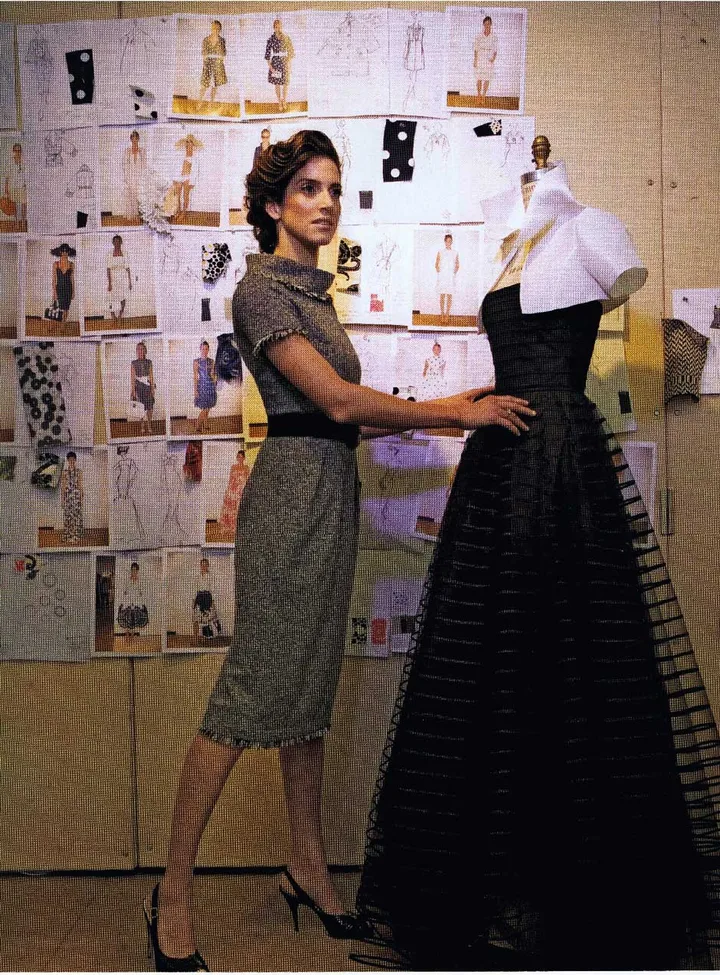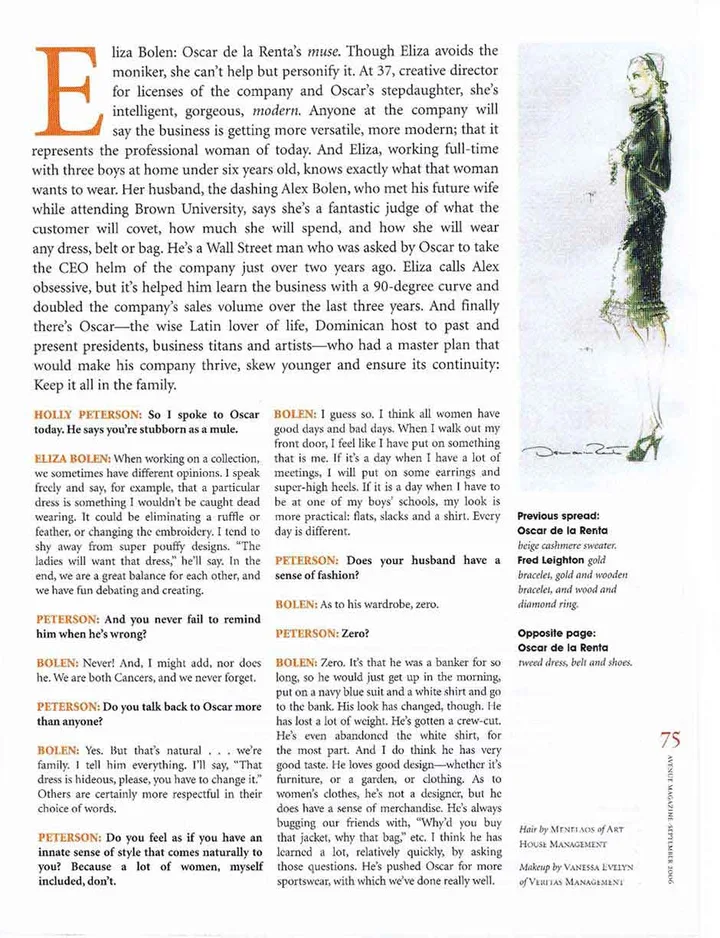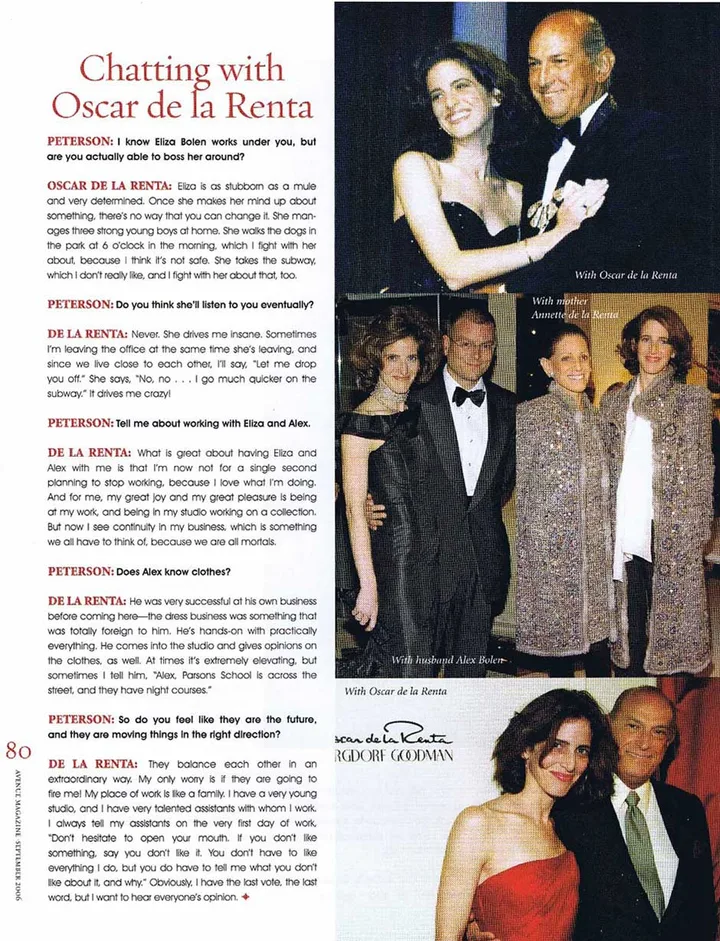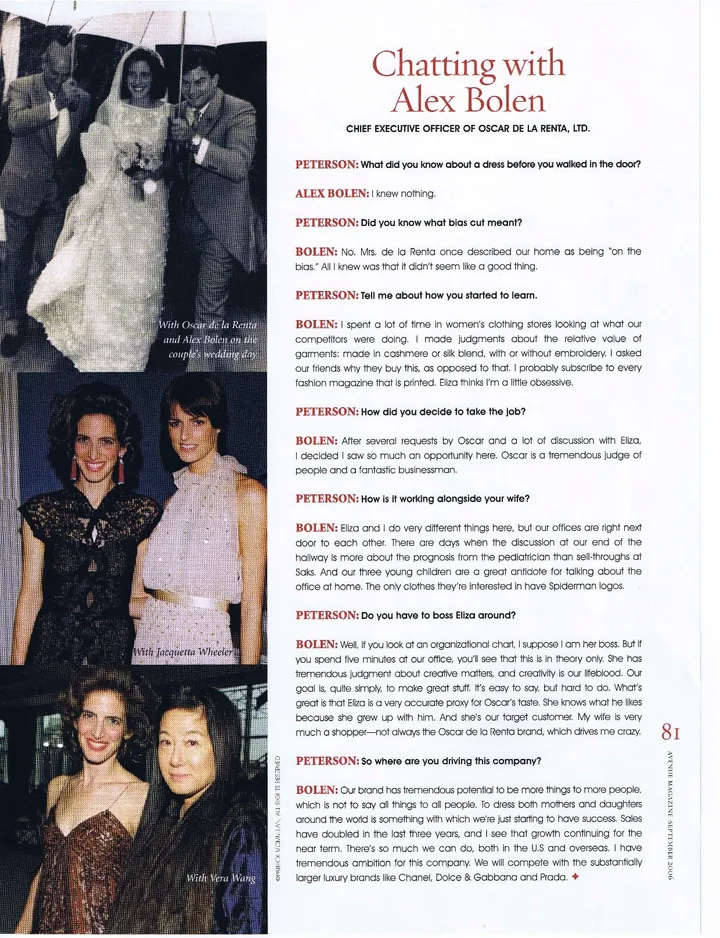
Eliza Bolen: Oscar de la Renta’s muse. Though Eliza avoids the moniker, she can’t help but personify it. At 37, creative director for licenses of the company and Oscar’s stepdaughter, she’s intelligent, gorgeous, modern. Anyone at the company will say the business is getting more versatile, more modern; that it represents the professional woman of today. And Eliza, working full-time with three boys at home under six years old, knows exactly what that woman wants to wear. Her husband, the dashing Alex Bolen, who met his future wife while attending Brown University, says she’s a fantastic judge of what the customer will covet, how much she will spend, and how she will wear any dress, belt or bag. He’s a Wall Street man who was asked by Oscar to take the CEO helm of the company just over two years ago. Eliza calls Alex obsessive, but it’s helped him learn the business with a 90-degree curve and doubled the company’s sales volume over the last three years. And finally there’s Oscar—the wise Latin lover of life, Dominican host to past and present presidents, business titans and artists—who had a master plan that would make his company thrive, skew younger and ensure its continuity: Keep it all in the family.
PETERSON: So I spoke to Oscar today. He says you’re stubborn as a mule.
BOLEN: When working on a collection, we sometimes have different opinions. I speak and say, for example, that a particular dress is something I wouldn’t be caught dead wearing. It could be eliminating a ruffle or feather, or changing the embroidery. I tend to shy away from super poufy designs. “The ladies will want that dress!” he’ll say. In the end, we are a great balance for each other, and we have fun debating and creating.
PETERSON: And you never fail to remind him when he’s wrong?
BOLEN: Never! And, I might add, nor does he. We are both Cancers, and we never forget.
PETERSON: Do you talk back to Oscar more than anyone?
BOLEN: Yes. But that’s natural… family. I tell him everything. I’ll say, “That dress is hideous, please, you have to change it.” Others are certainly more respectful in their choice of words.
PETERSON: Do you feel as if you have an innate sense of style that comes naturally to you? Because a lot of women, myself included, don’t.
BOLEN: I guess so. I think all women have good days and bad days. When I walk out my front door, I feel like I have put on something that is me. If it’s a day when I have a lot of meetings, I will put on some earrings and super-high heels. If it is a day when I have to be at one of my boys’ schools, my look is more practical: flats, slacks and a shirt. Every day is different.
PETERSON: Does your husband have a sense of fashion?
BOLEN: As to his wardrobe, zero.
PETERSON: Zero?
BOLEN: Zero. It’s that he was a banker for so long, so he would just get up in the morning, put on a navy blue suit and a white shirt and go to the bank. His look has changed, though. He has lost a lot of weight. He’s gotten a crew-cut. He’s even abandoned the white shirt, for the most part. And I do think he has very good taste. He loves good design—whether it’s furniture, or a garden, or clothing. As to women’s clothes, he’s not a designer, but he does have a sense of merchandise. He’s always bugging our friends with, “Why’d you buy that jacket, why that bag,” etc. I think he has learned a lot, relatively quickly, by asking those questions. He’s pushed Oscar for more sportswear, with which we’ve done really well.
PETERSON: Ten years ago when you started working here, did you have to be obsequious and conciliatory towards your stepfather as your boss? How did you handle the employee/employer relationship at the beginning?
BOLEN: At the beginning, I went to work in the back room, and I sort of kept my head low, and I learned each department. I was never reporting directly to Oscar.
PETERSON: Wasn’t it an “older” company when you started?
BOLEN: When I first came to the company there were some “old timers” here. By my third year, I stepped up to the role of bringing in younger people. Oscar trusted me, and it just changed the attitude of the place, the energy. We were stuck in our ways. We had a wonderful clientele, but we weren’t evolving with the times. The times were separates and sportswear. If you’re young, you don’t wear suits.
PETERSON: Was that one of your major contributions?
BOLEN: I think and hope so. By then Oscar noticed how the young people in our office were putting themselves together, and I think that had a big impact on him. The company has made an enormous change in the past six years—it’s an evolution, and not all of it is in the public eye. We’ve had to update all the behind-the-scenes operations—shipping, customer service, production, etc.—and opened all the stores. This is where Alex has made a big difference. I think the changes and the energy are exciting for Oscar… really, for us all. So far, we have been successful and, even with the changes, stayed true to Oscar’s vision.
PETERSON: Tell me about the first night your husband came home after he was offered the job.
BOLEN: Well, it took a while for him to really decide to do it. First of all, I wanted to make sure Alex was happy. I was nervous about working together and living together, but we really don’t see each other that often during the day. He’s brought tremendous energy to this company. And, to be truthful, sometimes it allows us to talk together without boys and dogs jumping all over us—talking at home is hopeless!
PETERSON: Do you report to him?
BOLEN: As if…
PETERSON: You report to Oscar? Your husband says on an organizational chart you technically report to him.
BOLEN: Please tell my husband I don’t know what an organizational chart is, and I’m not really interested in learning!
PETERSON: What does the company stand for?
BOLEN: Walk into any Oscar de la Renta store, or store within a store, and you’ll be able to find something that is feminine, that’s got some detail on it, and that is pretty. There’s going to be a beautiful print or embroidery on it, and color that goes with our accessories, as well. We try and make everything feminine and pretty.
PETERSON: How is it balancing work with your kids?
BOLEN: It’s difficult. I never have a second for myself. You’ve got the 17-month-old baby serving as a punching bag. And then, there are the dogs…
PETERSON: Do you see going part-time as an option?
BOLEN: No, I love working. I love that I can talk to you about the thread count of a towel, how sunglasses are made, how you make a dress, and how you make an alligator/crocodile bag. I love what I do.
PETERSON: I don’t, frankly, see how someone of your intellect can get so excited about making a bag. You seem more…
BOLEN: Of course it doesn’t sound intellectually stimulating to make a bag, but there is so much more behind that; intelligent strategy to run a huge business and an artistic aesthetic to make a beautiful piece that on the one hand is totally original and, on the other, creates intense desire. I love sitting down with our Italian manufacturers and looking at the flats, and the details of how to improve our bag, or improve our shoe to make it look better, make it look sexier, make it look younger, make it a better color, or make it a different fabric. A handbag is an expression of a woman and her taste. This accessory is a natural extension of clothing.
PETERSON: Are you the muse?
BOLEN: I don’t think so. Oscar says that, though. The way I run into the office and whatever I’m wearing speaks aesthetically to some of our customers.
PETERSON: To the more modern woman?
BOLEN: Yes.
PETERSON: Is the more modern woman harried?
BOLEN: She is harried. I can’t think of a better word. She’s running around doing a million things—trying to get it all done, and succeeding. In terms of fashion, I think there’s a lot more freedom in how women present themselves. We can mix and match. I think the woman today can do whatever she wants. Oscar always says: “No rules.” He’s right.
PETERSON: The modern woman is making up her own rules?
BOLEN: Yes. She has her job, but she also has her family. She is choosing what she wants to do, what she wants to wear. She’s independent… not unlike myself.
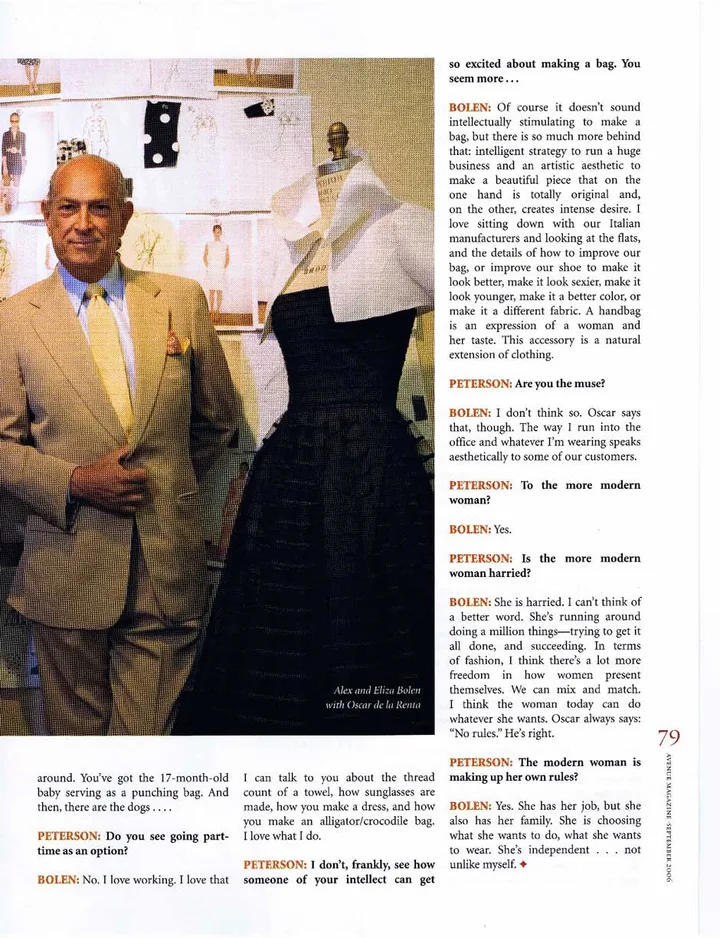
Oscar de la Renta
PETERSON: I know Eliza Bolen works under you, but are you actually able to boss her around?
OSCAR DE LA RENTA: Eliza is as stubborn as a mule and very determined. Once she makes her mind up about something, there’s no way that you can change it. She manages three strong young boys at home. She walks the dogs in the park at 6 o’clock in the morning, which I fight with her about, because I think it’s not safe. She takes the subway, which I don’t really like, and I fight with her about that, too.
PETERSON: Do you think she’ll listen to you eventually?
DE LA RENTA: Never. She drives me insane. Sometimes I’m leaving the office at the same time she’s leaving, and since we live close to each other, I’ll say, “Let me drop you off.” She says, “No, no… I go much quicker on the subway.” It drives me crazy!
PETERSON: Tell me about working with Eliza and Alex.
DE LA RENTA: What is great about having Eliza and Alex with me is that I’m now not for a single second planning to stop working, because I love what I’m doing. And for me, my great joy and my great pleasure is being at my work, and being in my studio working on a collection. But now I see continuity in my business, which is something we all have to think of, because we are all mortals.
PETERSON: Does Alex know clothes?
DE LA RENTA: He was very successful at his own business before coming here—the dress business was something that was totally foreign to him. He’s hands-on with practically everything. He comes into the studio and gives opinions on the clothes, as well. At times it’s extremely elevating, but sometimes I tell him, “Alex, Parsons School is across the street, and they have night courses.”
PETERSON: So do you feel like they are the future, and they are moving things in the right direction?
DE LA RENTA: They balance each other in an extraordinary way. My only worry is if they are going to fire me! My place of work is like a family. I have a very young studio, and I have very talented assistants with whom I work. I always tell my assistants on the very first day of work, “Don’t hesitate to open your mouth. If you don’t like something, say you don’t like it. You don’t have to like everything I do, but you do have to tell me what you don’t like about it and why.” Obviously, I have the last vote, the last word, but I want to hear everyone’s opinion.
Alex Bolen, Chief Executive Officer of Oscar de la Renta, Ltd.
PETERSON: What did you know about a dress before you walked in the door?
ALEX BOLEN: I knew nothing.
PETERSON: Did you know what bias cut meant?
ALEX BOLEN: No. Mrs. de la Renta once described our home as being “on the bias.” All I knew was that it didn’t seem like a good thing.
PETERSON: Tell me about how you started to learn.
ALEX BOLEN: I spent a lot of time in women’s clothing stores looking at what our competitors were doing. I made judgments about the relative value of garments: made in cashmere or silk blend, with or without embroidery. I asked our friends why they buy this, as opposed to that. I probably subscribe to every fashion magazine that is printed. Eliza thinks I’m a little obsessive.
PETERSON: How did you decide to take the job?
ALEX BOLEN: After several requests by Oscar and a lot of discussion with Eliza, I decided I saw so much opportunity here. Oscar is a tremendous judge of people and a fantastic businessman.
PETERSON: How is it working alongside your wife?
ALEX BOLEN: Eliza and I do very different things here, but our offices are right next door to each other. There are days when the discussion at our end of the hallway is more about the prognosis from the pediatrician than sell-throughs at Saks. And our three young children are a great antidote for talking about the office at home. The only clothes they’re interested in have Spiderman logos.
PETERSON: Do you have to boss Eliza around?
ALEX BOLEN: Well, if you look at an organizational chart, I suppose I am her boss. But if you spend five minutes at our office, you’ll see that this is in theory only. She has tremendous judgment about creative matters, and creativity is our lifeblood. Our goal is, quite simply, to make great stuff. It’s easy to say, but hard to do. What’s great is that Eliza is a very accurate proxy for Oscar’s taste. She knows what he likes because she grew up with him. And she’s our target customer. My wife is very much a shopper—not always the Oscar de la Renta brand, which drives me crazy.
PETERSON: So where are you driving this company?
ALEX BOLEN: Our brand has tremendous potential to be more things to more people, which is not to say all things to all people. To dress both mothers and daughters around the world is something with which we’re just starting to have success. Sales have doubled in the last three years, and I see that growth continuing for the near term. There’s so much we can do, both in the U.S. and overseas. I have tremendous ambition for this company. We will compete with the substantially larger luxury brands like Chanel, Dolce & Gabbana and Prada.