Portraits by John Huba
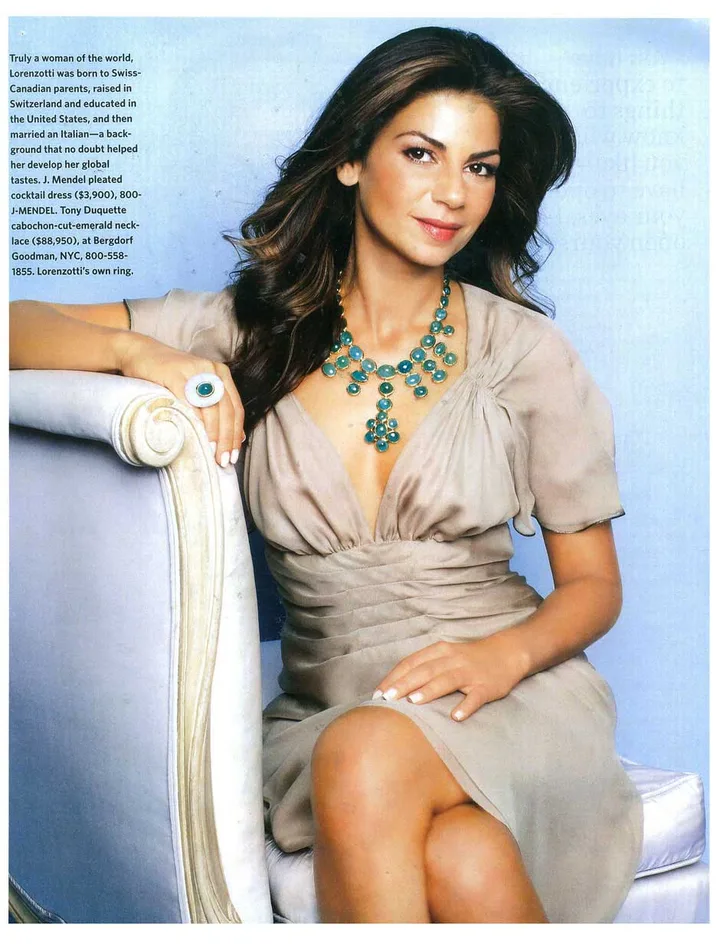
Eva Jeanbart-Lorenzotti doesn’t shop. She collects. You’ll find her more often in the back of a store, rather than in the front, getting to know the owners and asking if they can open up all the drawers. From experience, she’s learned that that’s where all the pieces de resistance lie. She’s been known to hunt down a storekeeper in a back alley, as she once did in Greece when she saw an outrageously beautiful piece of pottery in the window of a closed-up shop.
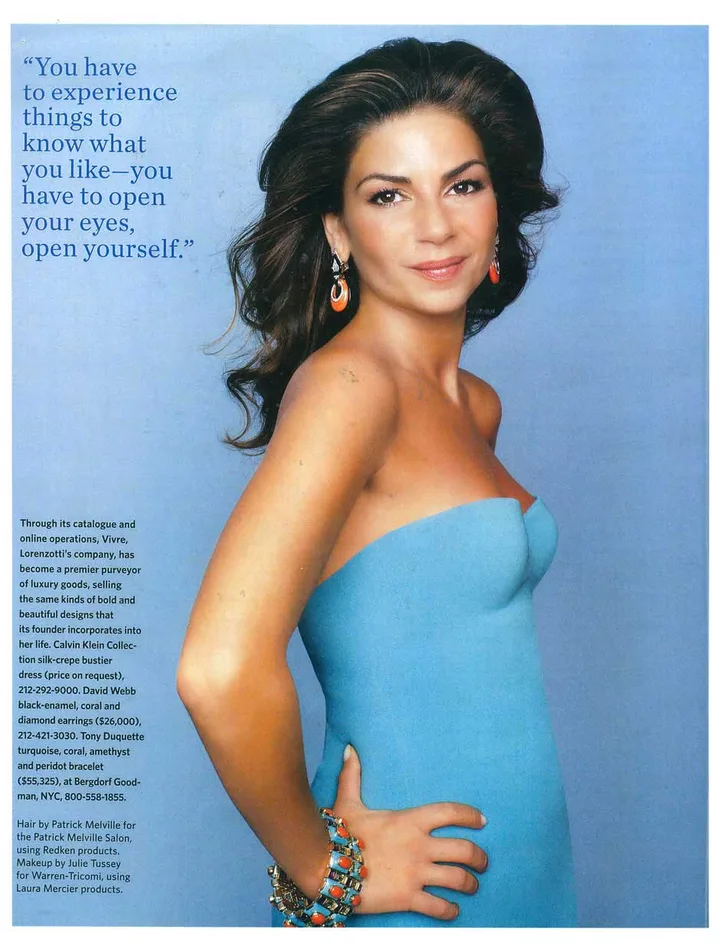
Out of this constant search for the uncommon and the extraordinary, Lorenzotti has built a business, Vivre, which caters to people who mistakenly believe that they have access to everything already. Those people open up her thick, glossy catalogue and get an education in serious luxury. They enter a world of exceptional objets — bracelets, earrings, water goblets, lamps — many collected from little ateliers all over the world, each dripping with individuality and significance. Like a curator, Lorenzotti has pulled in shoes, sweaters and bags from her favorite designers and presents them in outfits together, like little poems on the page.
In a commercialized world where collections whiz by us at warp speed, it’s hard to understand what style means anymore. It’s doubly hard for the modern consumer to figure out what she wants or even what she likes. In their rush to appeal to a larger, globalized market, brands have become so big and, somewhere in the process, downright amorphous. As a result, many of us are experiencing product sensory overload. Vivre, both in print and online, brings us back to where we once were: a calmer place where luxury was rare, coveted and easy to recognize. I recently met with Lorenzotti at her Manhattan home to discuss the state of luxury today.
T&C: Your outfits aren’t always expensive, but they are so well considered. Where did your intensity about your clothes and accessories come from? Is it about breaking up the monotony of your day, or making yourself feel happy and beautiful? You have so many rare pieces that are utterly exuberant.
EJL: I’m a big believer in a life of collecting. When you go into an amazing house or see a woman with amazing style, it’s never something that was done overnight. If you and I went shopping together, we could be on a mission. And we could totally fail in that mission, though not because we didn’t have the intention. But if we’re building a collection, that means a constant search for your table, your home and your clothes — and that buildup should be part of your life. It shouldn’t be simply that this jacket was a big jacket this year. If you feel you just plain love it, that’s what makes it special, and it becomes you. And, yes, that can make you feel happy.
T&C: Are your own clothes linked to your psyche and to your personality?
EJL: Yes. What you wear, where you live, everything has something to do with what you look for in life. I get very excited about the necklaces in my collection. When I wear one, I enjoy wearing it, and I understand the handiwork that went into it and made it me. And that’s the big definition of luxury. It reflects my love of the art of creating something special. It’s not the brand but the point of view. The craftsmanship, the authenticity, the passion — all of that, which I think has been lost in translation somewhere.
T&C: Do you believe that luxury goods have become too mass marketed in our culture?
EJL: Yes, yes.
T&C: Is that because of the Internet? What happened and where? Can you pinpoint it?
EJL: You can go back ten to fifteen years, when luxury was a smaller industry, largely mom-and-pop. The more exclusive brands were born from the original founders, the original craftsmen. And all of a sudden, the economy changed. People started earning more. And the brands consolidated. And that consolidation and that big business meant that they were beginning to distribute luxury at a mass level. They had to appeal to many more price points.
T&C: How do you explain the pressure the brands are under, now that their reach is so much greater?
EJL: What’s happened is that fashion has spread so much and so far, and it’s become so big, that it’s changed. The quality’s changed; the point of view has changed. And, perhaps most important, the speed at which we, the customers, are expecting change has changed. The span of time between one collection and the next has gotten shorter. There is so much pressure on the designers and artists to produce something new all the time, and it’s getting harder and harder. It’s a much more commercial engine. You walk into a department store today and there’s a sea of new fall bags. I can tell you, every brand has an incredible bag, but it’s hard to see it because there is so much.
T&C: What’s your favorite bag?
EJL: I do have a Saint Laurent bag from five years ago. Blue velvet with a silver handle. I don’t care that it’s from five years ago. It’s still a damn great bag.
T&C: What makes something survive through time?
EJL: If you own a Valentino dress, it will always be beautiful. Every time you put it on, it will be just as good as the first day. If you have an incredible Saint Laurent suit, it’s the same thing. Whether those things sold well that season or not doesn’t matter — what matters is that the vision came from a real point of view. And that creates great design. It can be seen in any art form. When people talk about New York apartment buildings today, they might say, “It’s a Candela building.” And they are saying that because he had such a point of view. And that point of view in design has been able to last through the ages. That to me is what luxury is all about. But I think it has changed because people want fast consumption. And their attention spans are very short.
T&C: So if they have short attention spans, what are they seeking?
EJL: Most people talk about exclusivity, but exclusivity doesn’t mean anything. It’s so pretentious, in my mind. All people are saying is that they want something that’s theirs. It could be an old Saint Laurent bag; it could be a painting they just bought. Whatever it is, it’s something that they care about. I think that’s what people are looking for today. And that’s why the art market is going through the roof, because art is very personal. Luxury is that: the storytelling behind a piece and the craftsmanship.
T&C: But what gives a luxurious product zing?
EJL: It has to be relevant. And if there’s something I love on eBay, what’s wrong with that? The problem is that people don’t know what they want anymore, because there’s just too much. It’s an overabundance. There isn’t one great bag; there are thirty-five great bags. And in some sense, they’re all the same.
T&C: If you’re saying that luxury means that something resonates for us personally, how do we recognize that?
EJL: Do you like it? Do you want to invest in it? Are you going to like it next year, or is it a one-season item?
T&C: And then you have to burn it next year. You know, there are women who can’t figure all this out so well. They don’t have the confidence to figure out the thirty-five-bag moment, to decide which one they actually like. A lot of women feel they don’t understand style.
EJL: I don’t think anybody’s born with style. You’re born with affinities. You may be more creative; you may be more artistic. The biggest thing in life is, you have to experience things to know what you like — you have to open your eyes, open yourself. When I go to a dinner party I look at the way the table is set, and then maybe I will take an idea from it or reinterpret it. There’s nothing wrong with looking. Look at people on the street. If you see somebody who’s dressed incredibly, look at her. Go with what you like. Buy what you like. I am absolutely sure that it’s not that people don’t know what they like but that they are too concerned about buying something that is the “right” thing.
T&C: How is your business helping women to find what they love in themselves and, in turn, in products and accessories?
EJL: What I’m trying to do is give credit to products’ places of origin and to their inherent interest — to the “why.” Why certain things are important. Why an artist is inspired. Why a piece is interesting. I want my customers to take the time to focus on that — take the time to focus on the backstory, on the context, instead of just looking at product versus product. People feel so much pressure to dress a certain way, and we’re hoping to alleviate this pressure by having them try different things and feel a certain type of confidence. There is a lot of thought to how our stuff is being presented so that people can trust themselves again. It’s about appreciation, enjoyment, collecting and finding your passions.
T&C: What happens when people buy things they don’t actually like?
EJL: Very simple: they can’t pull it off. And that’s when it starts to look bad. You know, those little round-toe shoes were in, but they just plain don’t suit me. I looked like Minnie Mouse in them. I think people need to know themselves. They need to understand it’s okay to make mistakes, but they also need to forget what the fashion says and realize what looks good on them. And I think that’s the beginning.
T&C: What is over-the-top in fashion? When do you see a person and say to yourself, “She went way too far — this is just craziness”?
EJL: When there’s no sense to it, when you walk into a house and you don’t understand what you’re walking into. It’s like anything in life; you can have a great meal, but if it’s too many courses after the Champagne and aperitif, then it’s just too much.
T&C: Well, what about taste? Do you think good taste is innate, and how does one’s taste get corrupted?
EJL: People’s taste gets corrupted when they forget that their taste matters, when they forget that their opinions matter. They believe that things need to be a certain way, and they don’t at all try to develop what they have and what they like. Instead, they say, “I’m going to buy this or that furniture or photography because everybody is doing it,” and they get sucked in. Maybe there’s a new, huge shiny silver bag right now. Well, I’m five foot four. Of course I’m going to look ridiculous with it. Maybe it looks great when Kate Moss walks down the catwalk with it, because she’s got a whole thing going. Some people can pull it off; some people can’t. But the only way you’re going to be able to pull any bag off is if you love that bag. And if you walk into a store and you say, “I love that bag, and I don’t care what I look like,” when you walk down the street, that’s how it’s going to read. It’s going to look great on you.
T&C: What helps us appreciate a great find?
EJL: I think the object is good only when the experience is good. There’s a sense of excitement when you experience something wonderful, when you go into a gallery and you meet a great art expert or a great artist or you are blown away by a painting. Or you’ve been to the flea market, and you’ve had so much fun — then the object you bought has so much more importance. In that way, I think that the experience and the object are always tied together.