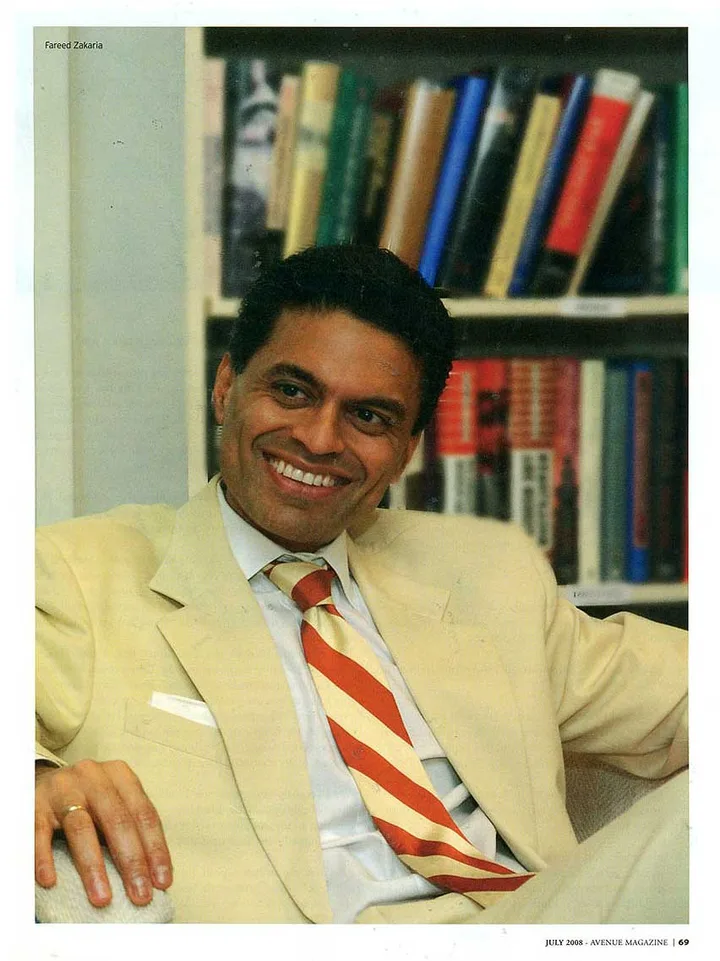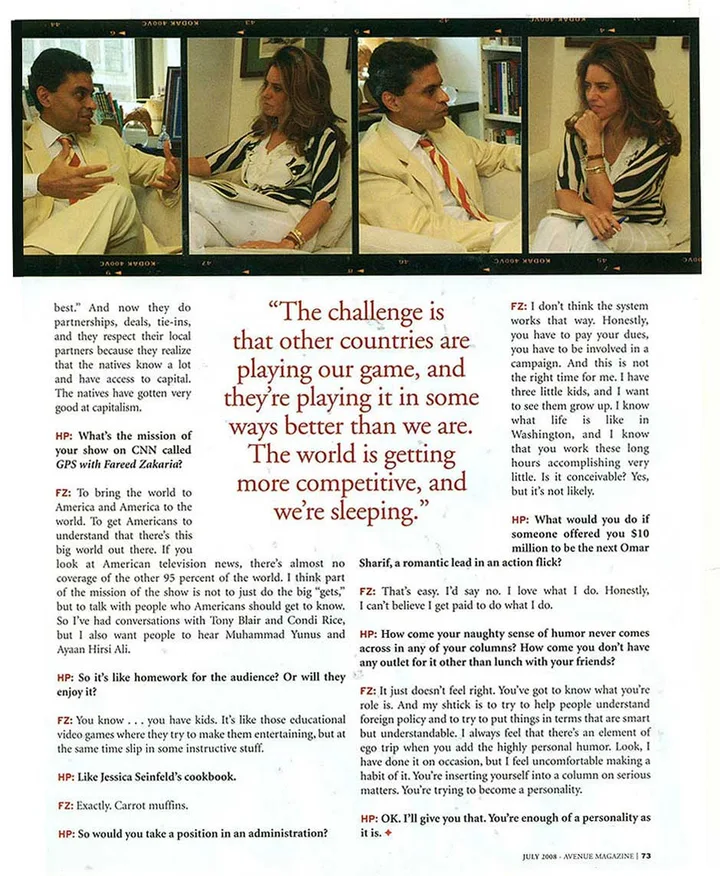
It’s often said that the smartest people explain things in the simplest manner. They have such confident grasp of their material that they can chop and dice and dissect the facts any way they like for any given audience. Fareed Zakaria’s following relies on his straightforward, eloquent analysis of this increasingly complicated world in which we live. Whether we are reading his weekly, must-read column in Newsweek—where he has been editor of the international edition since October 2000—or devouring his new best seller, The Post-American World, we are always given a fresh, reasoned understanding of the events that both frighten and confound us.
As of this past June, CNN has Zakaria anchoring a new show, GPS with Fareed Zakaria, airing on Sundays at 1 pm. The program aims to educate Americans about international affairs, with each edition including an interview with a special guest. On air, Zakaria comes off as a mixture of Henry Kissinger and Omar Sharif. But as his close friends know, his serious overachiever facade—built up with degrees from Harvard and Yale—can crumble in private as he lets loose his naughty sense of humor. To put it simply, he’s just plain beguiling.
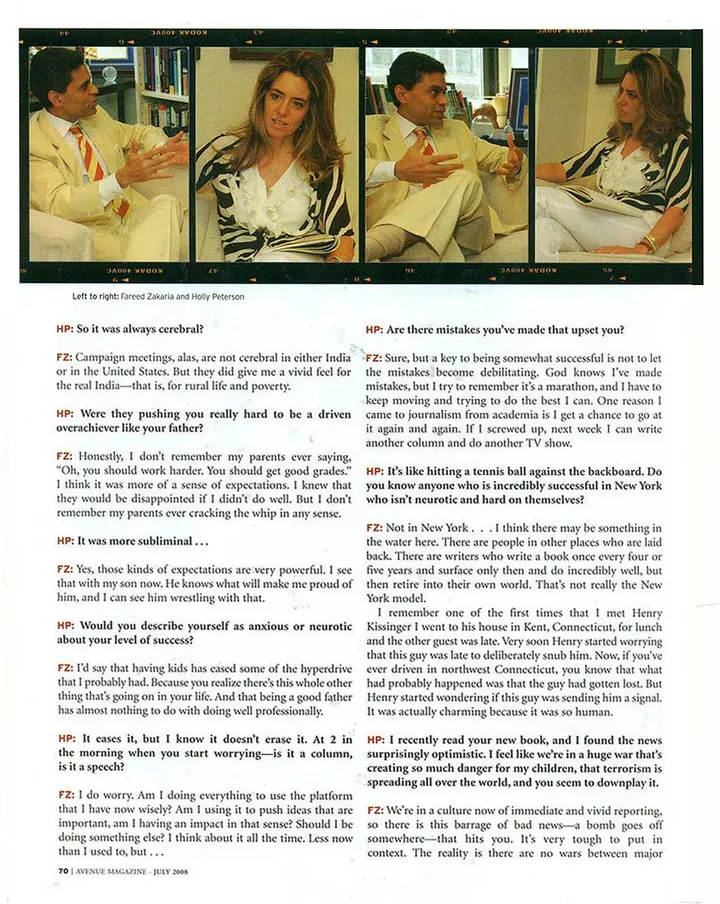
HOLLY PETERSON: Tell me about your childhood. And how did it form the writer you are today?
FAREED ZAKARIA: I grew up in Mumbai in a house where my father was a politician, my mother a journalist and both very engaged in the world. They had friends who were poets, architects, politicians, all mixing and churning together. Nowadays in the U.S., the poets go to poetry readings and politicians go to fundraisers, and never the twain meet. I grew up perhaps having a little less of a real childhood than other people. I remember going to campaign meetings when I was 5 years old.
HP: So it was always cerebral?
FZ: Campaign meetings, alas, are not cerebral in either India or in the United States. But they did give me a vivid feel for the real India—that is, for rural life and poverty.
HP: Were they pushing you really hard to be a driven overachiever like your father?
FZ: Honestly, I don’t remember my parents ever saying, “Oh, you should work harder. You should get good grades.” I think it was more of a sense of expectations. I knew that they would be disappointed if I didn’t do well. But I don’t remember my parents ever cracking the whip.
HP: It was more subliminal…
FZ: Yes, those kinds of expectations are very powerful. I see that with my son now. He knows what will make me proud of him, and I can see him wrestling with that.
HP: Would you describe yourself as anxious or neurotic about your level of success?
FZ: I’d say that having kids has eased some of the hyperdrive that I probably had. Because you realize there’s this whole other thing that’s going on in your life. And that being a good father has almost nothing to do with doing well professionally.
HP: It eases it, but I know it doesn’t erase it. At 2 in the morning when you start worrying—is it a column, is it a speech?
FZ: I do worry. Am I doing everything to use the platform that I have now wisely? Am I using it to push ideas that are important, am I having an impact in that sense? Should I be doing something else? I think about it all the time. Less now than I used to, but…
HP: Are there mistakes you’ve made that upset you?
FZ: Sure, but a key to being somewhat successful is not to let the mistakes become debilitating. God knows I’ve made mistakes, but I try to remember it’s a marathon, and I have to keep moving and trying to do the best I can. One reason I came to journalism from academia is I get a chance to go at it again and again. If I screwed up, next week I can write another column and do another TV show.
HP: It’s like hitting a tennis ball against the backboard. Do you know anyone who is incredibly successful in New York who isn’t neurotic and hard on themselves?
FZ: Not in New York… I think there may be something in the water here. There are people in other places who are laid back. There are writers who write a book once every four or five years and surface only then and do incredibly well, but then retire into their own world. That’s not really the New York model.
I remember one of the first times that I met Henry Kissinger. I went to his house in Kent, Connecticut, for lunch and the other guest was late. Very soon Henry started worrying that this guy was late to deliberately snub him. Now, if you’ve ever driven in northwest Connecticut, you know that what had probably happened was that the guy had gotten lost. But Henry started wondering if this guy was sending him a signal. It was actually charming because it was so human.
HP: I recently read your new book, and I found the news surprisingly optimistic. I feel like we’re in a huge war that’s creating so much danger for my children, that terrorism is spreading all over the world, and you seem to downplay it.
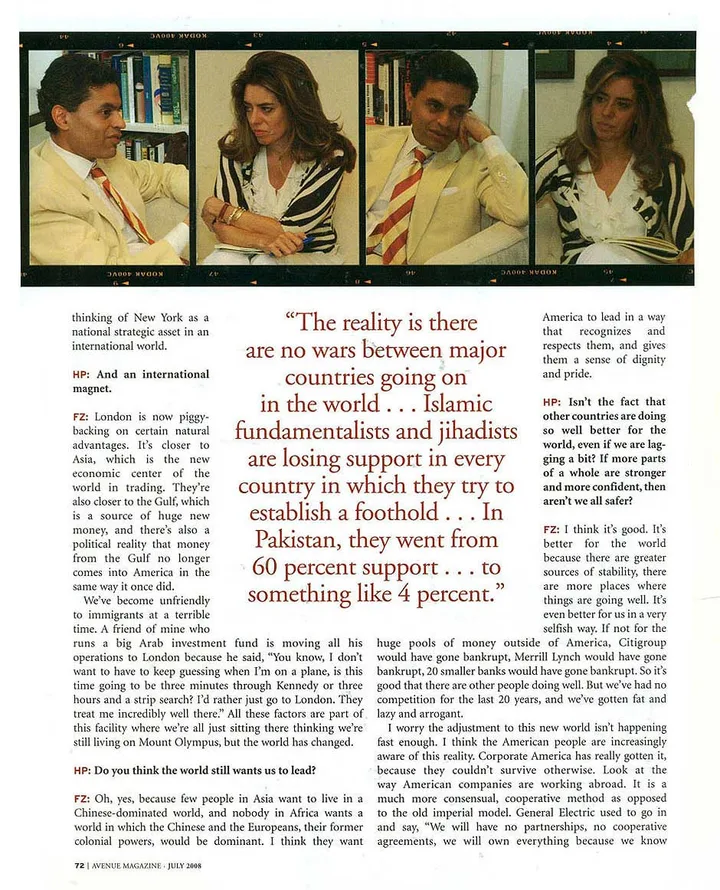
FZ: We’re in a culture now of immediate and vivid reporting, so there is this barrage of bad news—a bomb goes off somewhere—that hits you. It’s very tough to put in context. The reality is there are no wars between major countries going on in the world; the reality is Islamic fundamentalists and jihadists are losing support in every country in which they try to establish a foothold.
HP: Give me examples.
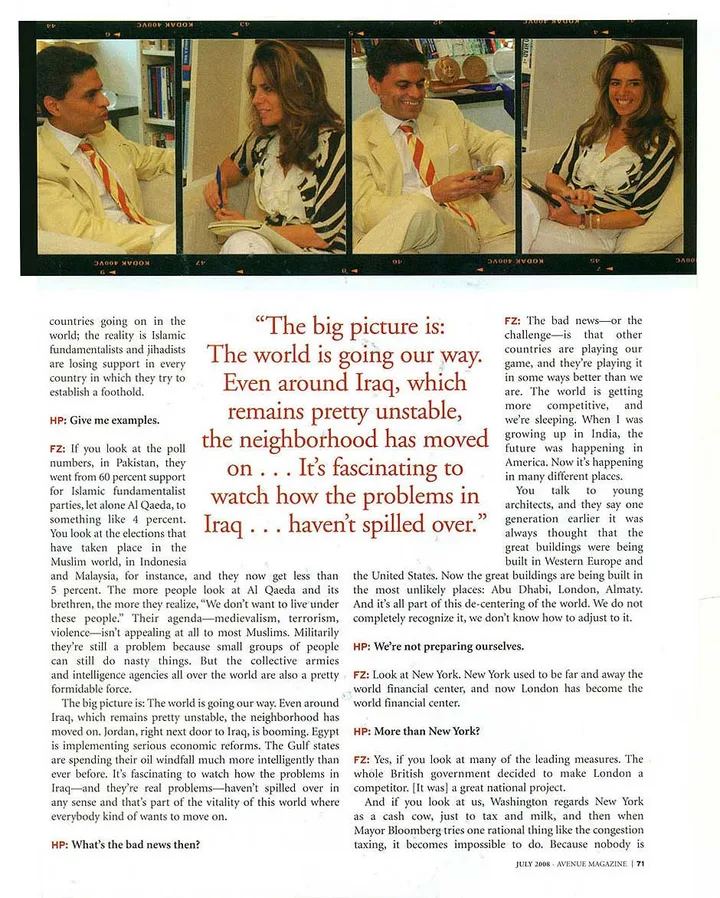
FZ: If you look at the poll numbers, in Pakistan, they went from 60 percent support for Islamic fundamentalist parties, let alone Al Qaeda, to something like 4 percent. You look at the elections that have taken place in the Muslim world, in Indonesia and Malaysia, for instance, and they now get less than 5 percent. The more people look at Al Qaeda and its brethren, the more they realize, “We don’t want to live under these people.” Their agenda—medievalism, terrorism, violence—isn’t appealing at all to most Muslims. Militarily they’re still a problem because small groups of people can still do nasty things. But the collective armies and intelligence agencies all over the world are also a pretty formidable force.
The big picture is: The world is going our way. Even around Iraq, which remains pretty unstable, the neighborhood has moved on. Jordan, right next door to Iraq, is booming. Egypt is implementing serious economic reforms. The Gulf states are spending their oil windfall much more intelligently than ever before. It’s fascinating to watch how the problems in Iraq—and they’re real problems—haven’t spilled over in any sense and that’s part of the vitality of this world where everybody kind of wants to move on.
HP: What’s the bad news then?
FZ: The bad news—or the challenge—is that other countries are playing our game, and they’re playing it in some ways better than we are. The world is getting more competitive, and we’re sleeping. When I was growing up in India, the future was happening in America. Now it’s happening in many different places. You talk to young architects, and they say one generation earlier it was always thought that the great buildings were being built in Western Europe and the United States. Now the great buildings are being built in the most unlikely places: Abu Dhabi, London, Almaty. And it’s all part of this de-centering of the world. We do not completely recognize it, we don’t know how to adjust to it.
HP: We’re not preparing ourselves.
FZ: Look at New York. New York used to be far and away the world financial center, and now London has become the world financial center.
HP: More than New York?
FZ: Yes, if you look at many of the leading measures. The whole British government decided to make London a competitor. It was a great national project.
And if you look at us, Washington regards New York as a cash cow, just to tax and milk, and then when Mayor Bloomberg tries one rational thing like the congestion taxing, it becomes impossible to do. Because nobody is thinking of New York as a national strategic asset in an international world.
HP: And an international magnet.
FZ: London is now piggybacking on certain natural advantages. It’s closer to Asia, which is the new economic center of the world in trading. They’re also closer to the Gulf, which is a source of huge new money, and there’s also a political reality that money from the Gulf no longer comes into America in the same way it once did. We’ve become unfriendly to immigrants at a terrible time. A friend of mine who runs a big Arab investment fund is moving all his operations to London because he said, “You know, I don’t want to have to keep guessing when I’m on a plane, is this time going to be three minutes through Kennedy or three hours and a strip search? I’d rather just go to London. They treat me incredibly well there.” All these factors are part of this reality where we’re all just sitting there thinking we’re still living on Mount Olympus, but the world has changed.
HP: Do you think the world still wants us to lead?
FZ: Oh, yes, because few people in Asia want to live in a Chinese-dominated world, and nobody in Africa wants a world in which the Chinese and the Europeans, their former colonial powers, would be dominant. I think they want America to lead in a way that recognizes and respects them, and gives them a sense of dignity and pride.
HP: Isn’t the fact that other countries are doing so well better for the world, even if we are lagging a bit? If more parts of a whole are stronger and more confident, then aren’t we all safer?
FZ: I think it’s good. It’s better for the world because there are greater sources of stability, there are more places where things are going well. It’s even better for us in a very selfish way. If not for the huge pools of money outside of America, Citigroup would have gone bankrupt, Merrill Lynch would have gone bankrupt, 20 smaller banks would have gone bankrupt. So it’s good that there are other people doing well. But we’ve had no competition for the last 20 years, and we’ve gotten fat and lazy and arrogant.
I worry the adjustment to this new world isn’t happening fast enough. I think the American people are increasingly aware of this reality. Corporate America has really gotten it, because they couldn’t survive otherwise. Look at the way American companies are working abroad. It is a much more consensual, cooperative method as opposed to the old imperial model. General Electric used to go in and say, “We will have no partnerships, no cooperative agreements, we will own everything because we know best.” And now they do partnerships, deals, tie-ups, and they respect their local partners because they realize that the natives know a lot and have access to capital. The natives have gotten very good at capitalism.
HP: What’s the mission of your show on CNN called GPS with Fareed Zakaria?
FZ: To bring the world to America and America to the world. To get Americans to understand that there’s this world out there. If you look at American television news, there’s almost no coverage of the other 95 percent of the world. I think part of the mission of the show is not to just do the big “gets,” but to talk with people who Americans should get to know. So I’ve had conversations with Tony Blair and Condi Rice, but I also want people to hear Muhammad Yunus and Ayaan Hirsi Ali.
HP: So it’s like homework for the audience? Or will they enjoy it?
FZ: You know, I have kids. It’s like those educational video games where you try to make them entertaining, but at the same time slip in some instructive stuff.
HP: Like Jessica Seinfeld’s cookbook.
FZ: Carrot muffins.
HP: So would you take a position in an administration?
FZ: This is not the right campaign, and this is not the right time for me. I have three little kids, and I want to see them grow up. I know what life is like in Washington, that you work these long hours accomplishing very little. Is it conceivable? Yes, but it’s not likely.
HP: What would you do if someone offered you $10 million to be the next Omar Sharif, a romantic lead in an action flick?
FZ: That’s easy. I’d say no. I love what I do. Honestly, I can’t believe I get paid to do what I do.
HP: How come your naughty sense of humor never comes across in any of your columns? How come you don’t have any outlet for it other than lunch with your friends?
FZ: It just doesn’t feel right. You’ve got to know what your role is. And my shtick is to try to help people understand foreign policy and to try to put things in terms that are smart but understandable. I always feel that there’s a danger the moment you add the highly personal humor. Look, I do it sometimes, but I feel uncomfortable making a habit of it. You’re inserting yourself into a column on serious matters. You’re trying to become a personality.
HP: OK. I’ll give you that. You’re enough of a personality as it is.