“Somehow Marc Rich is orchestrating all of this.” —former U.S. prosecutor Sandy Weinberg
The Fugitive
It was a beautiful Sunday afternoon this February in St. Moritz, the height of the season. A horse race was being held on the frozen lake in the village, and hundreds had gathered to drink champagne and watch what is one of the year’s biggest events in this exclusive resort.
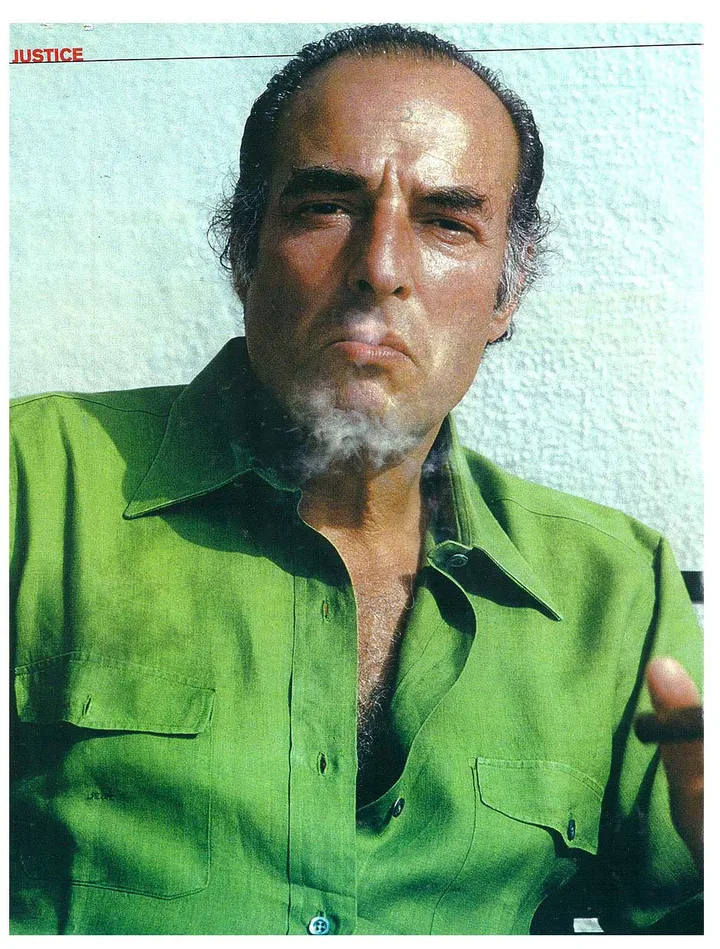
But not Marc Rich. He was out for an afternoon of skiing, accompanied by two bodyguards. Always eager to avoid crowds, he wore dark ski goggles. “I haven’t seen you in a couple of years,” he said in his accented English as I planted myself in his path.
It was indeed Marc Rich, the 66-year-old billionaire whose pardon in the final hours of the Clinton presidency may well go down as the gravest of Clinton’s missteps as president. No one in law enforcement could recall a top fugitive whose name had been removed from the U.S. government’s Most Wanted lists as the result of a presidential pardon.
“I’m not answering anyone’s questions,” Rich said as he snapped on his skis and slid toward the lift line, just a few hundred yards from his chalet.
“But Mr. Rich, the whole country wants to know what happened,” I shouted as he and one of his bodyguards were swept away by the chairlift. “Did you give any money to President Clinton?”
There was no answer, and if Rich has his way there isn’t likely to be one for a long time, if ever. He has made his way through life, and made his considerable fortune, as a quiet, shy, tough guy. The young refugee from war-torn Belgium, growing up in Kansas City. The determined commodities trader in New York City, with scant regard for burdensome regulations and tax laws. The fugitive who renounced his American citizenship and tried again and again to use his wealth and connections to buy his way out of what prosecutors considered a certain trip to federal prison. This time he had pulled off the deal of a lifetime, expertly manipulating his ex-wife Denise Rich, famous politicians who were indebted to his philanthropic largesse, and even a harried, susceptible president scurrying to settle as many accounts as he could in his final hours in office.
Rich and I had first met at the exact same ski lift in St. Moritz nine years earlier, when he was still on the Most Wanted lists, sought by the FBI and U.S. Marshals every time he left Switzerland. My colleague Rhonda Schwartz and I had persuaded our former bosses at NBC News that we could do what American law enforcement had not been able to do: track down Marc Rich and bring him back, at least on videotape.
The concierge at the fashionable Badrutt’s Palace Hotel in St. Moritz was coaxed into giving us the private line at the Rich chalet. A butler told us when Mr. Rich would be skiing. A ski instructor informed us he always used the same lift near his home. We waited three hours that morning nine years ago, and Rich showed up, saw the cameras, and said, “Congratulations, you’re the first.” Two days later he called and invited us to his office for a full-scale interview in front of the cameras.
He professed to be content with his life as a fugitive, which he had been since 1983, and said he had few regrets about his activities, which he saw as mere civil matters to be settled with some kind of fine, not prison. And as to going back to the United States, he said, “I’m comfortable here.” Though hunted by the U.S. Marshals, he lived in great style and luxury. His business, now headquartered in Switzerland, brought in billions in profits. As one of the biggest taxpayers in the canton of Zug, he enjoyed the protection of Switzerland’s lack of an extradition treaty with the U.S. Rich had never even considered asking for a pardon during the Reagan and Bush years, according to his lawyers. U.S. prosecutors had insisted that Rich serve some time in prison. That was a deal breaker for the billionaire. His path to a pardon began when he hired former Clinton White House counsel Jack Quinn two years ago. The appeal to Clinton was brilliant: Rich was another victim of an overzealous prosecutor. They cast former U.S. Attorney Rudy Giuliani as Ken Starr, a description that wasn’t true, as Rich’s original lawyers, and Rich himself, certainly had to know, since the Rich case was well underway before Giuliani took office.
In addition, Rich was able to get dozens of prominent world figures and even his ex-wife to help him. After the broadcast of my first interview with Rich in 1992, Denise’s divorce lawyer called me to say she would do anything she could to help the FBI catch him. That was before the divorce settlement, which may have been worth as much as $500 million.
As Rich skied away from me that morning last February, word was that he and his stunning, blond second wife, Gisela, had just canceled what was to be a highlight of the week: a Las Vegas-themed party at a private club in St. Moritz. No explanation was offered, but everyone knew Marc Rich had to lie low. His pardon from Clinton had wiped out all American criminal charges against him. He was a free man. But he had bought himself a notoriety that he never had as a tax fugitive. Here, Rich’s friends and enemies tell the tale of the secretive billionaire’s 17-year-long gambit to rid himself of U.S. efforts to put him in prison. It was the most ingenious deal of the brilliant commodities trader’s life. —Brian Ross
MORRIS “SANDY” WEINBERG JR. was the chief prosecutor of the Rich case in the early 1980s: I was an assistant U.S. Attorney in the Southern District in New York, doing white-collar Wall Street prosecutions; I was 31 years old. I got a call asking if I was interested in looking into a case about some guy named Marc Rich, that there was some scheme to move funds out of the United States. I’d never heard of Marc Rich. That’s how the investigation started.
I flew down with an FBI agent to Abilene, Texas, checked these two guys from West Texas Marketing out of prison, got them a furlough for the weekend. (West Texas Marketing was one of the oil companies involved in the Rich scheme.) We went to their offices in Abilene, and they pulled out their files. There was $70 million that was domestic profits of Marc Rich’s American subsidiary. They explained how they had agreed to do trading for Marc Rich, hold Marc Rich’s profits on their books, and then funnel these profits out of the country through a series of totally made-up transactions. These phony transactions would result in losses that would eliminate the money from their books. And this money, this extra profit, was hidden from the Department of Energy and the IRS. That money was called the pot. And Marc Rich’s people, including the CFO and their traders, would keep off-the-record ledgers tracking the pot and what was in the pot at any given time.
They explained all this in a day to me and an FBI agent, and at that point, before we had done one thing in the investigation, we knew that we had one of the largest tax frauds in the history of the United States.
Building His Business Empire
A. CRAIG COPETAS, staff writer for The Wall Street Journal in Paris, wrote an unauthorized 1985 biography of Rich, Metal Men: Marc Rich and the 10-Billion-Dollar Scam, which was reissued in March: The metal trade grew out of rag and bone men at the turn of the 20th century. Rich came from a rag and bone family in Antwerp. This was all that the Jews could do during those years: collect the flotsam and jetsam of industry and then sell it. This trade turned into a major industry.
That was Rich’s background. He’s on what the traders call “the jazz.” He loves to trade. He knows how to structure deals that extend far beyond what you see on Wall Street. Metal men are vibrantly important to the global economy. His deals involve the physical movement and warehousing of huge stores of commodities. Pinky [Rich’s partner Pincus Green, a fugitive also pardoned by President Clinton] was the traffic man. Marc did the deals; Pinky moved the material. Marc Rich did high calculus, whereas Ivan Boesky and Michael Milken did kindergarten arithmetic. The amounts of money were much grander for Rich and his companies, and the risk was much heavier than anything a Milken could ever dream of. What Milken did wasn’t really essential to the well-being of the universe. But what Marc Rich traded was. There are 80 naturally occurring minerals [with commercial value] in the earth. About 40 are necessary for life as we know it. These 40 metals are in everything in your office right now. There’s a damn good chance that 80 to 90 percent of those were provided through a Marc Rich deal.
“Marc Rich feels sad, the way he’s being treated. The bright side is that he feels an injustice has been undone.” —Avner Azulay
DAN BURTON is a Republican congressman from Indiana who has been chairing congressional hearings on the Rich pardon: He was dealing with the Ayatollah when we had hostages over there, in violation of our embargo; he was dealing with Russia during the grain embargo; he was dealing with Qaddafi; he was dealing with every enemy the United States had. So I don’t think you could say Marc Rich was a patriotic American. Marc Rich was out for Marc Rich.
WEINBERG: This is a pretty calculating, callous guy. U.S. trade embargoes didn’t make any difference to Marc Rich; it was just a matter of money. It just annoyed him that the United States government would interfere with him making a profit, and so he said, “The hell with that: I’m keeping my profit.”
MARC RICH (from a 1992 interview with Brian Ross, at the time an NBC News correspondent): I did trade, not with Mr. Ayatollah personally, but with Iran, yes—but as a Swiss company, which we are. We’re not political. In our business we’re not political. We never have been. That’s the philosophy of our company.
MARY THOMAJAN socialized with Marc and Denise Rich in Switzerland from 1980 through 1991, when she was married to Rich’s then-lawyer and business associate: Marc made all of his own money. Nobody made it for him. Marc had offices in 59 countries. It was a global empire. He started as a young trader at Philipp Brothers in New York, on the floor. He’s doing something that nobody really understands: the commodities market. Marc takes risks. Not reckless ones, but calculated ones. He usually wins.
AVNER AZULAY is a former Mossad agent who is now the Israel-based managing director of the Rich Foundation for education, culture, and social welfare: He works for fun. He gets up very early and he’s on the phone until midnight. He works every day. Even when skiing he is also working. He works from his home, he works from his car, he works from wherever he is.
THOMAJAN: I remember a story the traders told. One day they realized that several different traders at once were dealing with silver, and at one point, for a few minutes, they cornered the world market on silver without realizing it. Marc said, “Push the button. Sell. We can’t do this!” And his traders said, “But Marc, it’s a billion dollars.” And he said, “Well, a billion dollars isn’t what it used to be.” That became kind of a little trading floor ditty that they put on the wall there to remind them. They always had to be conscious of what they were doing because of the scale of things.
Denise and Marc at Play
THOMAJAN: Marc always had a room full of interesting people. That was one of the things that he did really well. I remember sitting one night next to Julian Schnabel and Annenberg. They were all in and out, like a revolving door.
RABBI SHLOMO RISKIN has been a personal friend of Rich’s for more than 20 years: If I spend a day or two with him, we’ll sit in the steam room at night in his house, in Zurich, and talk about religious philosophical issues: why good people suffer, what does it mean to be the chosen people, how seriously do you take that. Israeli politics also—we don’t always agree. He’s more to the left than I am.
He’s a very emotional person. You see it in his eyes. He cares very deeply. He’s very much involved in Birthright, a program that brings young Jewish people from all over the world to visit Israel. He was crying when he talked to me about it on the phone, because he went to see the kids. He was very moved. Jews discovering who they were. Marc is not necessarily religiously observant, but has a very profound sense of Jewish identity.
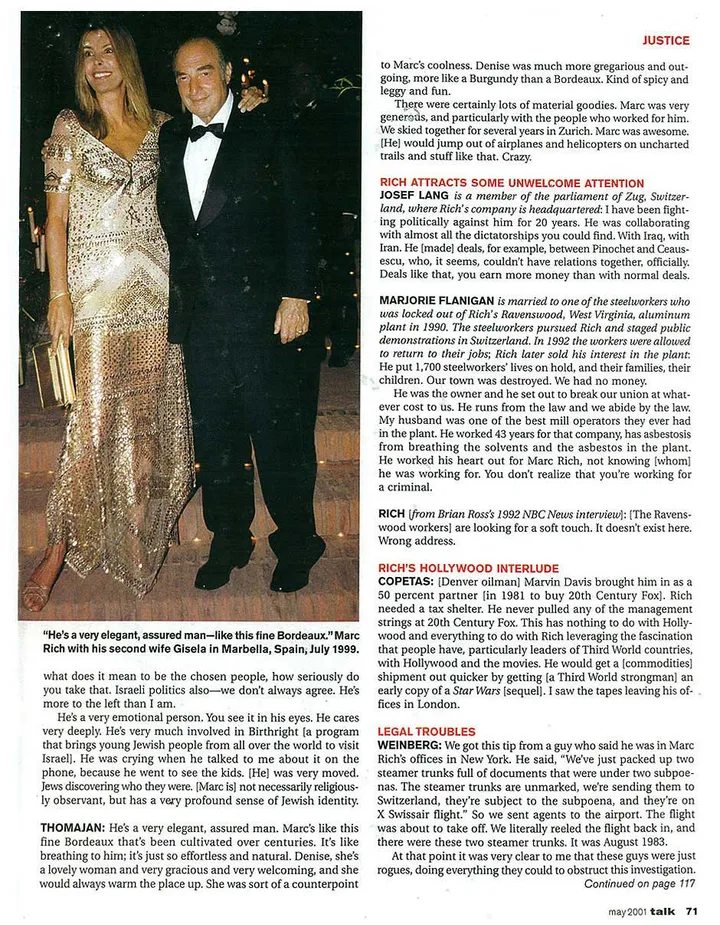
THOMAJAN: He’s a very elegant, assured man. Marc’s like this fine Bordeaux that’s been cultivated over centuries. It’s like breathing to him; it’s just so effortless and natural. Denise, she’s a lovely woman and very gracious and very welcoming, and she would always warm the place up. She was sort of a counterpoint to Marc’s coolness. Denise was much more gregarious and outgoing, more like a Burgundy than a Bordeaux. Kind of spicy and leggy and fun.
There were certainly lots of material goodies. Marc was very generous, and particularly with the people who worked for him. We skied together for several years in Zurich. Marc was awesome. He would jump out of airplanes and helicopters on uncharted trails and stuff like that. Crazy.
Rich Attracts Some Unwelcome Attention
JOSEF LANG is a member of the parliament of Zug, Switzerland, where Rich’s company is headquartered: I have been fighting politically against him for 20 years. He was collaborating with almost all the dictatorships you could find. With Iraq, with Iran. He made deals, for example, between Pinochet and Ceausescu, who, it seems, couldn’t have relations together, officially. Deals like that, you earn more money than with normal deals.
MARJORIE FLANIGAN is married to one of the steelworkers who was locked out of Rich’s Ravenswood, West Virginia, aluminum plant in 1990. The steelworkers pursued Rich and staged public demonstrations in Switzerland. In 1992 the workers were allowed to return to their jobs; Rich later sold his interest in the plant: He put 1,700 steelworkers’ lives on hold, and their families, their children. Our town was destroyed. We had no money.
He was the owner and he set out to break our union at whatever cost to us. He runs from the law and we abide by the law. My husband was one of the best mill operators they ever had in the plant. He worked 43 years for that company, has asbestosis from breathing the solvents and the asbestos in the plant. He worked his heart out for Marc Rich, not knowing whom he was working for. You don’t realize that you’re working for a criminal.
RICH (from Brian Ross’s 1992 NBC News interview): [The Ravenswood workers] are looking for a soft touch. It doesn’t exist here. Wrong address.
COPETAS: Denver oilman Marvin Davis brought him in as a 50 percent partner in 1981 to buy 20th Century Fox. Rich needed a tax shelter. He never pulled any of the management strings at 20th Century Fox. This has nothing to do with Hollywood and everything to do with Rich leveraging the fascination that people have, particularly leaders of Third World countries, with Hollywood and the movies. He would get a commodities shipment out quicker by getting a Third World strongman an early copy of a Star Wars sequel. I saw the tapes leaving his offices in London.
WEINBERG: We got this tip from a guy who said he was in Marc Rich’s offices in New York. He said, “We’ve just packed up two steamer trunks full of documents that were under two subpoenas. The steamer trunks are unmarked, we’re sending them to Switzerland, they’re subject to the subpoena, and they’re on a Swissair flight.” So we sent agents to the airport. The flight was about to take off. We literally reeled the flight back in, and there were these two steamer trunks. It was August 1983. At that point it was very clear to me that these guys were just rogues, doing everything they could to obstruct this investigation.
[Rich and Green were indicted that September.]
AZULAY: He’s sore about the way he’s being treated. Very sore. Deep in his heart he likes America. He immigrated from Europe and America was good for him, for his family. His daughters are there, his grandchildren are there. U.S. authorities and the media are making him look like a monster. If you met him personally you would see a completely different person…a human being.
WEINBERG: Edward Bennett Williams, Rich’s attorney, was the preeminent lawyer in the country. He came into my office, put his feet up on the desk, and said that the Rich situation had been going on for a long time, and we really needed to get it over with, and that they would pay us $100 million if the U.S. dropped the criminal charges against Rich and Green.
I said no. We can’t walk away from what was then the biggest tax fraud in the history of the United States. These guys have got to answer the charges; they’ve got to face jail time. How could we ever prosecute another tax case if we allowed the biggest tax cheats in the history of the United States to buy their way out of being prosecuted?
The Fugitive Kind
HOWARD SAFIR headed the U.S. Marshals in the hunt for Rich: We missed him by a matter of hours in Jamaica. I went to Zurich. We had a couple of sting operations ready to go. The Swiss found out about it and made it very clear that if I took any action against Marc Rich in Switzerland, where they did not recognize the crimes that he was charged with, that I would be subject to arrest.
Rich was one of the highest-profile fugitives that existed. He was sitting in Zurich, thumbing his nose at us. He didn’t particularly care about being here. The only thing he cared about was the fact that he couldn’t travel freely. When you let somebody who flees the jurisdiction of the U.S. continue to operate, it’s incumbent upon law enforcement, especially the U.S. Marshals, to find them and bring ‘em back to justice. Bottom line is, we didn’t get him. And now we don’t have the opportunity to get him.
THOMAJAN: Marc had extreme karma. He affected many lives. When you’ve got that kind of negativity pouring at you, day after day for 17 years, and you’re chased and badgered, and he could never go out anywhere for fear of being nabbed—he had to live a very isolated life.
COPETAS: I followed the instructions of a source, and I was waiting for Rich in the lobby of his headquarters in Zug. It was March 12, 1984. Rich slid out of one of the elevators and walked to this Swiss pizza joint, which was dolled up to resemble a classy Italian restaurant. He was having lunch with his business partner, Pinky Green.
I remember Rich’s eyes scanning the dining area, almost like Jesse James making sure the Pinkerton boys weren’t there. He sat down with his back against the wall so he had a clear view of the comings and goings of the lunch crowd.
I sat down at a nearby table and watched him. After a few bites of his cappelli d’angeli, he stood up and started toward the bathroom. He had not responded to any of my interview requests, and that seemed like the only time I had a shot at meeting him mano-a-mano.
So when he walked by me I stood up and said calmly, “Mr. Rich.” He looked at me, and he was frightened. Really frightened. He may have thought that I was one of the federal marshals who were at the time trying to find him. I suspect that’s what it was because the marshals played all kinds of marvelous little mind games on him during their hunt. He bounded quickly through the kitchen and then backtracked slightly to reach the bathroom.
Now it gets really silly. I went into the bathroom, and there was an open window and there was a waiter at the urinal and I asked him, “Where’s the guy who came in here?” and he kind of motioned toward the open window. I left. I didn’t look to see if he was behind one of the stalls. I thought that would be a bit much.
The Pardon Campaign: Rich’s 17-Year Attempt to Make a Deal with the Feds
SAFIR: In 1986, during the Berlin spy exchange for Soviet dissident Natan Sharansky, an East German attorney named Wolfgang Vogel made a proffer of $250 million for Marc and Pinky if the U.S. government would wash the criminal charges. This offer came out of nowhere. When I heard that, I thought that this guy would go anywhere and spend anything to get these charges dropped. The response at that time was, Justice is not for sale. But it was amazing that Marc Rich’s name came out of nowhere in the middle of a very unlikely setting. Clearly Marc Rich has his tentacles on both sides.
MARTIN AUERBACH is a former Assistant U.S. Attorney who worked with Weinberg on the 1983 Rich indictment: Rich’s representatives offered us his services as an intelligence asset. Garment [Leonard Garment, Rich’s attorney from the mid-’80s through the mid-’90s] said, “This guy has a remarkable network of people and contacts that could be very helpful to our government because of his access.” The problem was that, once again, the price tag was immunity from the potential of incarceration. He was never interested in his day in court.
LEONARD GARMENT was Nixon White House counsel and is now an attorney in Washington, D.C.: There was an offer to assist the government in its intelligence activities, but the prosecutor’s statement of the conditions on the offer is incorrect.
WEINBERG: Over the last 20 years, what’s he done? He’s hired the best lawyers, and once he became a fugitive, if there was a Republican administration, he’d go hire the most influential Republican guy. And if there was a Democratic administration he’d go hire the most influential Democratic guy.
LLOYD CUTLER, senior counsel, Wilmer, Cutler & Pickering, served as White House counsel in the Carter and Clinton administrations: Leonard Garment asked me to go with him to Zug in 1984 or 1985 to see Rich on whether I could be of any help in trying to negotiate a plea. Rich had left the U.S. because he was about to be indicted. I met for half a day with Leonard and Rich and Pinky Green.
Zug is a quaint little town, maybe 45 minutes from Zurich. Marc Rich’s offices are full of security guards and buttons—you have to hit the right combinations to move from one room to another. In the course of the day I very quickly came to the conclusion that he was really unrepentant and unwilling to do what would have to be done in order to try to negotiate any kind of settlement of the case. His personality was rather withdrawn, with a certain amount of self-pity, quite suspicious of everyone, and a feeling of being persecuted. Rich felt victimized by the U.S. prosecutors.
We never did form a lawyer-client relationship. I didn’t think any kind of plea bargain could be worked out, because he wouldn’t come back to the United States. And the Justice Department policy for fugitives from justice was that the government would not deal with you if you stayed abroad. You’d have to come back and take your chances. I came to the conclusion that I should not get involved.
BOAZ GAON is an Israeli reporter who has had a rare face-to-face interview with Rich: I remember asking, “Why, if it’s so painful? Why don’t you go back and face the trial and get it over with?” I remember him saying that he feels that if he goes back he’ll get an unfair trial. That’s why he’s not willing to go back.
Dissolving a Partnership
DENISE RICH (from her 1986 song, “Sweet Pain of Love”):
This is a story ‘bout a boy and girl / They lived together in a fantasy world… Time can change two loving hearts / Turn passion into hate, tear us apart.
PETER WIDMER was Marc Rich’s divorce attorney: Even in a divorce case, there was nothing emotional and nothing irrational about him. A lot of money was at stake. But he was always calm, even when it took a lot of time and things dragged out. He never let anybody else put him under pressure.
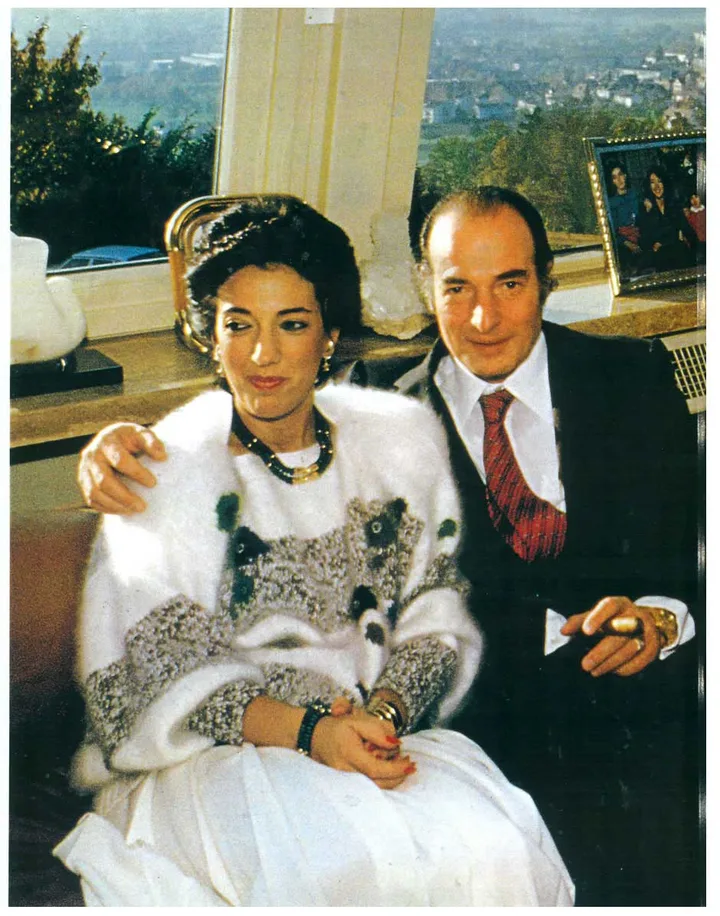
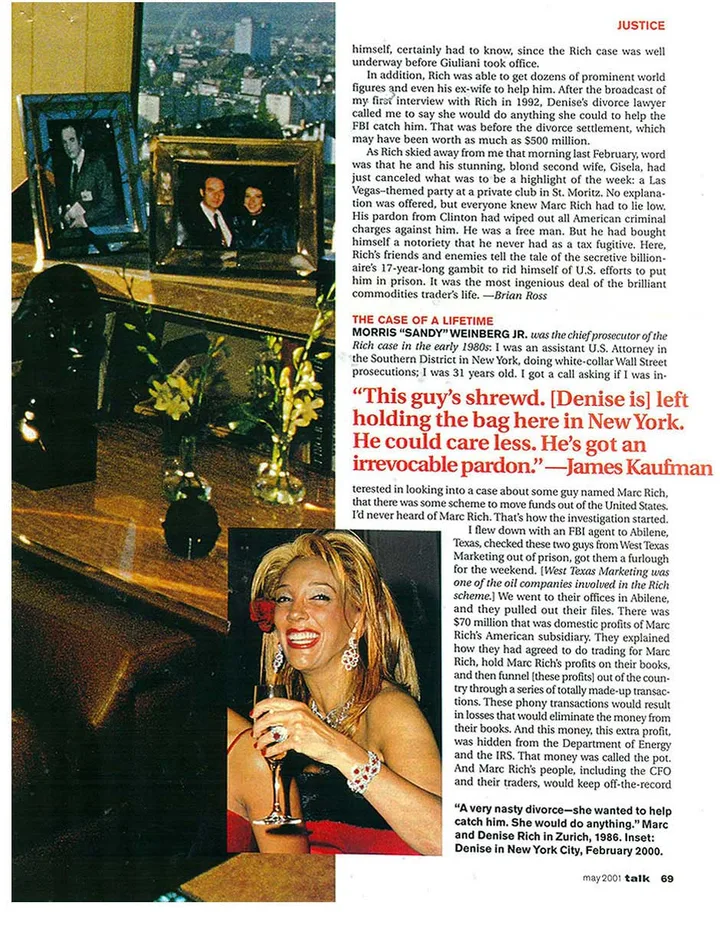
WEINBERG: Her divorce lawyer called me and wanted my help. I think it was in the early ’90s. He just went on and on about how outrageously awful Marc Rich was. He was just an awful human being, and this was a very nasty divorce, and he wasn’t being fair to Denise. He was saying that she wanted to help catch him. She would do anything.
Denise’s Game
JAMES KAUFMAN is a friend of Denise’s and a Republican fund-raiser and president of James M. Kaufman Capital Associates, a New York investment banking firm: She wanted to get started in the business. Show biz and music. He laughed at it. He being Marc. He said, “You know that’s stupid; do something serious with your life.” The divorce was acrimonious. He was playing around, apparently, in Switzerland. He persistently made unflattering comments to her. He was not exactly one of nature’s noblemen.
NATALIE COLE is a longtime friend of Denise Rich’s. The pair cowrote “Livin’ for Love,” which topped the Billboard dance chart this December: I met Denise as she was divorcing from Marc. It must have been ‘92. She was a totally different person. Very insecure, sweet as she could be. All she wanted to do was write music.
I met her at a very big dinner party in Beverly Hills. She just seemed out of place. She was kind of shlubbing around trying to meet people. Her hair was very long, dark, kind of wild, and definitely not coiffed. She had on an outfit that I can’t even describe to you. It just didn’t fit. Lots of makeup—too much. I remember more her movements than her dress. And the movement was the feeling of, I’ve got to meet people.
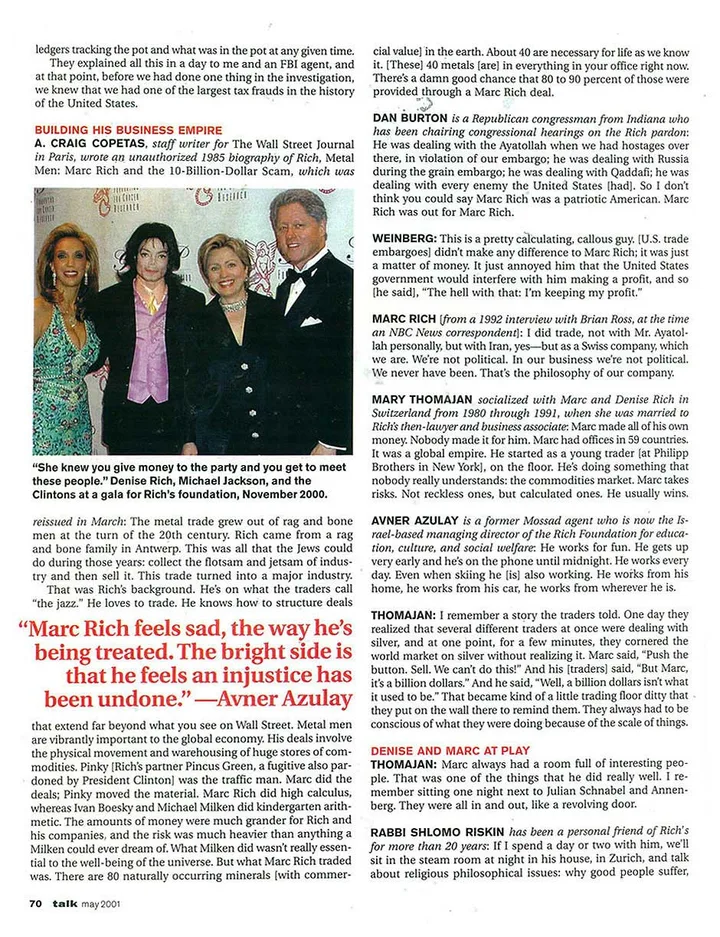
CINDY ADAMS is a New York Post columnist: What she did is she starts to get PR people. This one knew show people. This one knew political people, and little by little you start adding and widening. Look, it’s easy to get a celebrity to come to a party when there will be another celebrity, when there will be free food, free drinks, and you will have photographers putting out your pictures for the papers next day. As you start giving the party for a better class of people, you get a better class of guests. She gave parties at the beginning for Milton Berle. Then the parties became for Bill Clinton. It was just a question of going up higher. I just think she knew you give money to the party and you get to meet these people. She did exactly what New Yorkers do.
GERALDO RIVERA is an anchor at CNBC who has been friends with Denise Rich for nine years: If anything, she wants to be Gertrude Stein. She doesn’t want to be Machiavelli. She wants to be someone whose salon is the venue for the popular culture to parade through.
Denise and Clinton
KATHY SLOANE, a New York real estate broker, helped the Clintons in their recent purchases of homes in Chappaqua, New York, and Washington, D.C.: I introduced her to Clinton. It was at a party in the summer of 1993. When we were all together at the Middle East peace signing at the White House in September 1993, Denise said to me, “Clinton is going to do everything he can to bring about peace in the Middle East, and I’m going to do everything I can to support him.” Remember, her father was a survivor of the Holocaust who came here.
The Pardon Campaign: First Steps
AZULAY: A decision was made to go for a pardon, a spontaneous decision in September or October.
BURTON: I don’t think that’s accurate. If you look at memos exchanged in the past year between Azulay and other Rich advisers, it’s pretty clear that they were discussing a pardon and Denise Rich’s involvement in it as early as March of the year 2000… There’s no question that additional contributions were then made to Clinton’s presidential library by Denise Rich.
AZULAY: The legal side was taken care of by Rich’s attorneys in the U.S., Jack Quinn and Bob Fink, and I was to collect all the support that could be collected. I went to Denise. She was reluctant. She said, “This could be a lot of trouble for me.” You know her social position. But her daughters wanted this. There is no contact between Marc and Denise. I did not go on his behalf. I thought it was the right thing to do because she is friendly with the Clintons. I said, “Look, it will be embarrassing to see everybody, every VIP in Israel supporting it, and the mother of his two daughters and the grandmother of his grandchildren will not say a good word about him?”
She consulted with her friends and lawyers and decided finally to write the letter. She did not lead this. She did not push it. She was asked, and reluctantly she wrote a beautiful letter.
DENISE RICH (in her December 6, 2000, letter to President Clinton): I am writing as a friend and an admirer of yours to add my voice to the chorus of those who urge you to grant my former husband, Marc Rich, a pardon for the offenses unjustly alleged and so aggressively pursued in the 1983 indictment by U.S. Attorney for the Southern District of New York Rudolph Giuliani. I support his application with all my heart. The pain and suffering caused by that unjust indictment battered more than my husband—it struck his daughters and me.
Let no one think exile for life is a light burden. The world we cared about was cut off from us. When our daughter was dying from leukemia, Marc was cruelly denied the opportunity to see her by the prosecutors.
I can tell you, he did not get the benefit of the doubt. His innocence was never presumed.
The pardon application is the last resort. You have the power in this matter not just to show mercy, but to do justice.
RISKIN: Gabrielle, his daughter, was the most beautiful and intelligent woman. When she was ill, it was terrible for him that he couldn’t be there.
No, I don’t know if that was an option, to visit her on her deathbed in the U.S. himself. I think he sent her videos—you know, messages of strength, love, etcetera. It was a horrible, horrible death, and his suffering was intense. That was the tenor of my letter supporting his pardon: that he had suffered so much.
Whenever I thought about it, it would break my heart. Look, your daughter is dying and you can’t see her. I can’t imagine a greater punishment.
JACK QUINN was White House counsel from 1995 to 1996 and has served as Marc Rich’s chief pardon attorney since 1999: At the heart of this case is a tax charge that I do believe is meritless. That tax charge formed the basis for attendant fraud charges, and that in turn formed the basis for one of the very first uses in a case of this kind of the federal racketeering statute. It was this misuse, I believe, of RICO, on top of…a tax and energy case that I think did not have merit… The case was fundamentally flawed. [from Quinn’s Feb. 8, 2001 testimony before the House Committee on Government Reform]
AUERBACH: The companies engaged in all sorts of genuinely outrageous, contemptuous conduct. They preferred spending $50,000 a day in court-ordered fines rather than turning over documents that Jack Quinn would have us all believe would have proved that they were innocent. I think Rich made a calculated decision to try to figure out who could get next to people in the Justice Department, and when that didn’t work he figured out how to get close to somebody who could get close to the president. The money buys access. Money builds relationships.
The Pardon Campaign: The Philanthropy Dividend
EHUD OLMERT, the mayor of Jerusalem, wrote a letter on Rich’s behalf: I can certainly say that he gave $200 million over the years to Israel. I know that he gave at least $20 million to Jerusalem. He must feel something very strong to this country.
I’m a mayor of Jerusalem. I’m in a certain position here, which bears some weight. I was asked to send a letter. So I send a letter. If I’m a friend, I’m ready to send a letter.
ELIE WIESEL is a Holocaust survivor, author, and 1986 winner of the Nobel Peace Prize: A man named Mr. Azulay came. He spoke about his Mossad past. I’m a romantic. I hear stories about the Mossad and listen. Then he gave me the folder—a huge folder—with letters of those who had written to the president. I said, “Look, the man is a fugitive. Why doesn’t he go to court?” There is something wrong with a man who was a fugitive for 17 years.
KAUFMAN: Nothing matters to him. If this guy was such a good Jew, why is he doing business with Saddam Hussein and Qaddafi? You know it’s all about dollars. The common denominator in everything he does: What’s the price?
BURTON: I don’t think that this is something that Denise Rich could’ve done on her own or would’ve done on her own. Those e-mails between Rich’s pardon strategists, some about Denise’s efforts with Clinton on Marc Rich’s behalf, raise a lot of questions. How can you not investigate it if Denise Rich is taking the Fifth Amendment?
The Pardon Campaign: Blame the Prosecutor
WEINBERG: Jack Quinn’s not a criminal defense lawyer, he’s a politician. In my opinion, he’s a lobbyist. And he was trying to use the Giuliani card. Rudy Giuliani had nothing to do with this investigation—absolutely zero. The investigation was signed, sealed, and delivered before Rudy ever got into the office.
DENISE RICH (from her December 6, 2000, letter to President Clinton): Because of the indictment, I have seen what happens when charges are falsely—even if just incorrectly—made against those closest to you, and what it feels like to see the press try and convict the accused without any regard for the truth. I know the immense frustration that comes when the prosecutors will not discuss their charges, and when no one will look at the facts in a fair way. My husband and I could not return to the United States because, while the charges were untrue, no one would listen—all the prosecutors appeared to think about was the prospect of imprisoning Marc for the rest of his life.
GEORGE STEPHANOPOULOS is an ABC News political analyst and was senior adviser to President Clinton: Pushing the overzealous-prosecutor button—the reason that strategy is so smart is because it’s not simply an intellectual argument. It picks at every one of Clinton’s scabs. It’s something he’s lived. Look at what was happening with Clinton in those final days. Not only is he giving all these pardons, but also he is trying to implement a lot of other executive orders and he is negotiating his plea deal with independent counsel Robert Ray for Arkansas’s charge that Clinton lied under oath in the Ken Starr investigation.
So he was exhausted, overwrought, probably emotional about leaving, and at that time I think he was particularly susceptible. He’s got Beth Dozoretz calling him, Ehud Barak calling him, Denise Rich calling him, Israeli Foreign Minister designate Shimon Peres calling him. I think he was faced with a proliferation of people he felt that he couldn’t say no to. He is vulnerable.
DICK MORRIS is a New York Post columnist and was formerly an adviser to Clinton: I think a very important consideration was probably the funding to the Clinton presidential library. Whether there was any quid pro quo involved or not is a question for juries and prosecutors and judges to determine.
A change took place in Bill Clinton between the mid-’90s and the end of his term. The Clinton that I used to work for really didn’t care much about luxury—did not care much about the perks of office, the staff, and the sort of royal trappings of being president. I think that he’s become increasingly dependent on them, increasingly almost addicted to them. The library is really a sort of a holding company for the rest of his life—a funding mechanism for all of the extras that he used to have as president that he wouldn’t have now.
I think that one cannot ignore the contributions that people made to the library as motivations for these pardons.
Materialism has really corrupted him in a way that he was not corrupted before. I do not believe that Bill Clinton in 1995 and ‘96 was a corrupt person. I think he was somebody who lied a lot because he had a lot of sexual scandals to cover up, but he had been doing that since he was a teenager. I think in a fundamental financial way he was not corrupt. I think the Bill Clinton we’re looking at today is corrupt. I think, whether it is legally true or just in effect true, that he sold pardons. I think he in fact sold pardons.
He stayed up all night before his presidency ended on January 20 because he had to use every one of those hours. I think that he developed a belief that he could get away with anything in those last few hours because nobody would be focusing on it. Everybody would be thinking about the Bush inauguration. The spotlight would shift away from him and he could do all the things that he felt obliged to do for people who had done things for him—in particular, library contributions.
The Political Fallout
WEINBERG: I was at home. It was a Saturday: Inauguration Day. I got a call from a Newsweek reporter, and he said, “What do you think about the pardon?” And I said, “What, you mean Milken got pardoned?” And he said, “No, Marc Rich.” I uttered some very unprintable words.
RAHM EMANUEL was a senior adviser to President Clinton and is now managing director of the investment banking firm Dresner, Kleinwort, Wasserstein: As far as I can tell, Jack Quinn circumvented the process and used his relationship with the president—not exactly aboveboard. I think he did that knowingly and consciously because of all the uproar it would have caused.
QUINN (from the House Committee on Government Reform hearing on February 8, 2001): I’m an advocate. Should I have called Mr. Weinberg up and said, “Guess what? I’m seeking a pardon. I hope you’ll get up here and argue against it”? Of course not. But I do not believe that I did anything less than what was professionally responsible and ethically required.
HENRY SIEGMAN is a senior fellow on the Middle East for the Council on Foreign Relations: I’ve heard this theory over and over again. That there was pressure from Israeli leaders on Jonathan Pollard, an American accused of spying for Israel, and Clinton couldn’t deliver on Pollard so he delivered on a man who was totally unworthy and undeserving. Does that mean just “Give ‘em a Jew?” If not this Jew then we’ll give ‘em another Jew. And I find that offensive. Deeply offensive.
What in the world do Israelis have to do with this? This is a man who violated American law. This is an internal American matter.
FLANIGAN: I felt betrayed, because for someone to owe that amount of taxes and to have been that involved in racketeering and fraud, that is an injustice to all American families, from the rich, the middle class, to the poor. It’s just not fair for people that supported Clinton through his two presidential elections. When Clinton was running in 1992, he was in Charleston, West Virginia. And when he was leaving that evening, I was able to get close enough to him to get his autograph and shake hands with him, and I told him—I said, “If you’re ever fortunate enough to become president of the United States, would you investigate Marc Rich?” And he said, “I’ve never heard of him.”
The Personal Fallout
ADAMS: It’s anti-Clinton fever. Everybody’s against him—he took too many spoons and knives and forks. You can’t get him for the pardon because that’s the Constitution. So you get the other side of the equation. You can’t get Marc. You have to get the one in the middle. Denise is caught in the middle.
KAUFMAN: I received a phone call from her the Tuesday after the inaugural. She professed to have been as shocked as anyone else by Clinton’s pardon of her ex-husband. But a direct quote from Bob Fink in The New York Times that morning alleged that clearly she had been in the loop and had called the president on Marc’s behalf.
Marc and Denise: Their Lives Intertwine Again
RIVERA: I have no doubt what her motivation was. She wanted the father of her children to be someplace where he could see them. She never in my presence ever said a nice word about Marc Rich, except that he loved his children and his grandchildren. That is bizarre and absurd if anyone thinks she has some kind of surreptitious love affair with her ex-husband. He was out with every broad in Europe, for God’s sake.
COLE: I wouldn’t dare repeat the things that she said about her marriage. I could say with some accuracy, you know, without her being upset, that our picture of Mr. Rich is not the most nice one. I do know that he just wasn’t terribly nice. To his family, and particularly to her. And that’s pretty much all I can say.
Denise and I both are suckers for love. Her last couple relationships, she met some real idiots. She’s very fragile and vulnerable, like so many women I know.
KAUFMAN: Did Marc Rich push Denise into politics? My opinion is that he knew her Achilles heel. She was sort of the white female version of Rodney Dangerfield. You know: I’ve got $600 million. What the hell do I do now? I’ve got no respect. What he wanted, before this even came up, was to get this pardon. But it wasn’t going to be an overnight thing. What he had to do was to get her to subtly ingratiate herself with the president and into the White House: I will let you avail yourself of my ability to get you into the mainstream.
By mixing with the Clintons and other political types, in his mind, she could get what she didn’t have, which is respectability and credibility. You see, now she perceived that she was being taken seriously by somebody important. And I don’t know, quite candidly, whether she ever took the time to realize that the only people who were around her were the lowest common denominator: the people that she could provide a party atmosphere for, people that could use her, and people that had their hands in her pockets.
This guy’s shrewd. Rich could get what he wanted and still hang her out to dry. She’s left holding the bag here in New York. He doesn’t have to show up at any Congressional hearing. He could care less. He’s got an irrevocable pardon.
COLE: There always is that stigma of having a lot of money and wondering why people hang around. My wish for Denise has always been that she would have more friends like me who really love her.
WEINBERG: I would guess that somehow Marc Rich is orchestrating all of this, and that she didn’t have much choice, and that this was all planned and it was part of a very orchestrated effort, and that he’s at the center of it.