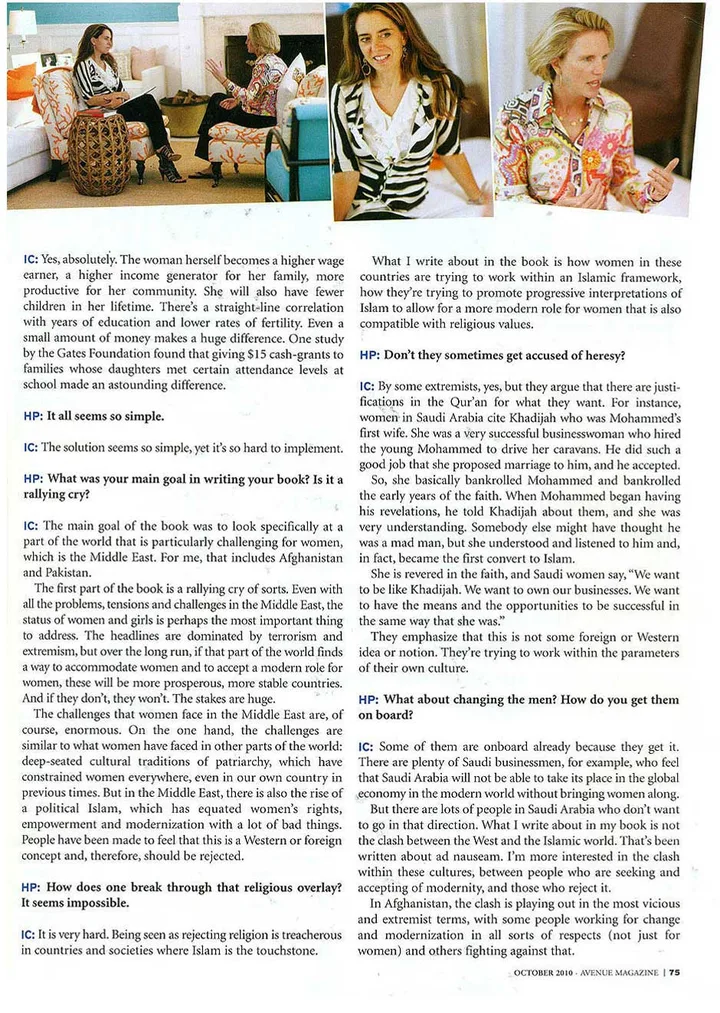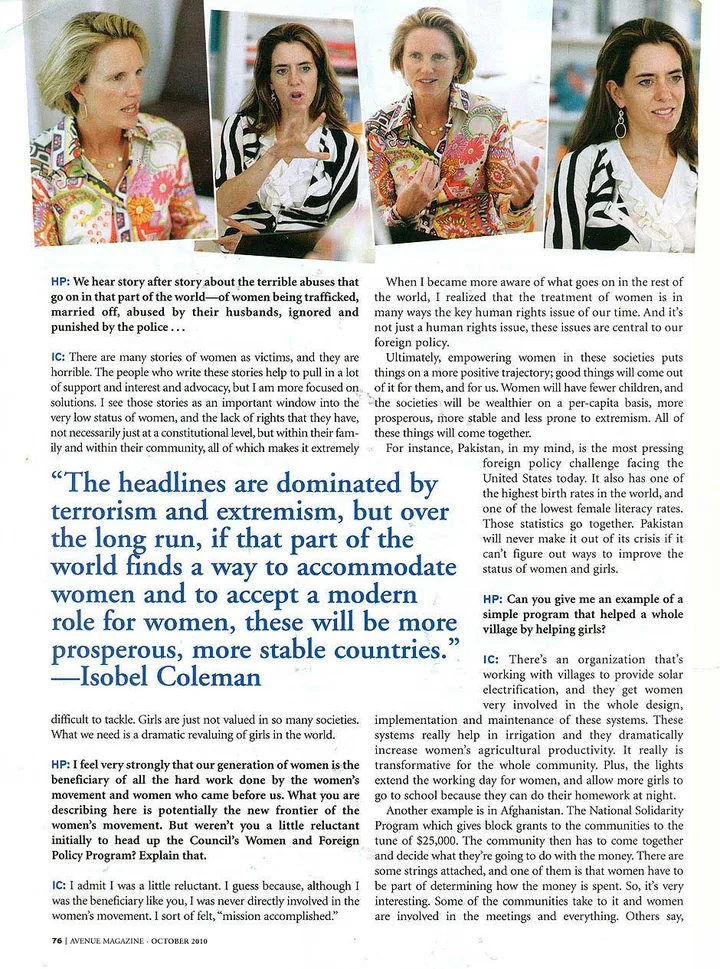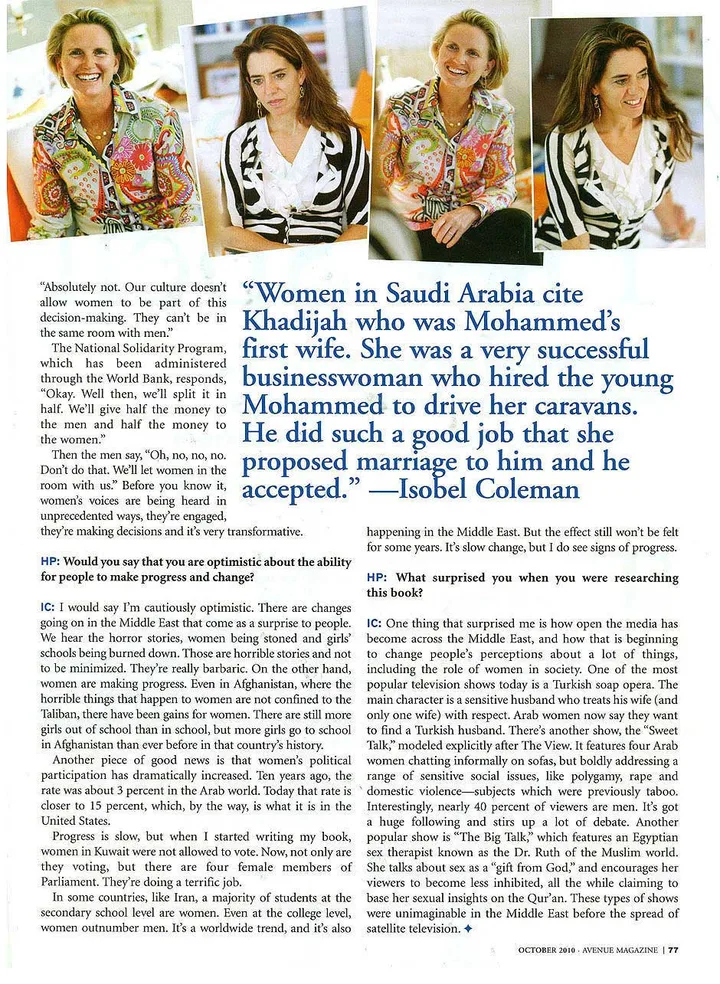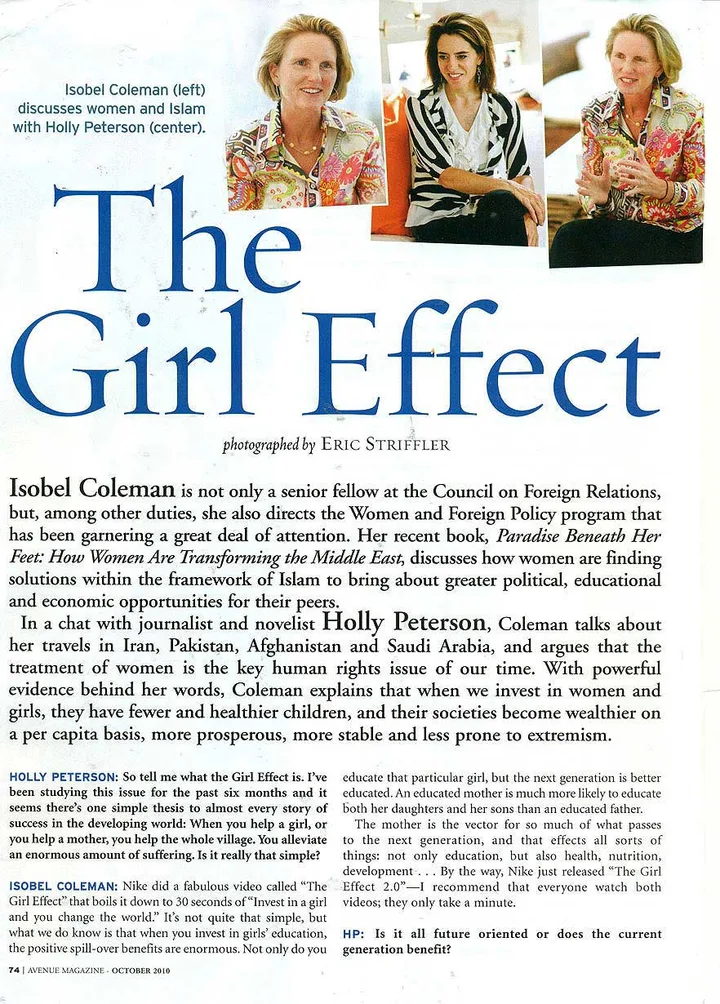
Isobel Coleman is not only a senior fellow at the Council on Foreign Relations, but, among other duties, she also directs the Women and Foreign Policy program that has been garnering a great deal of attention. Her recent book, Paradise Beneath Her Feet: How Women Are Transforming the Middle East, discusses how women are finding solutions within the framework of Islam to bring about greater political, educational and economic opportunities for their peers.
In a chat with journalist and novelist Holly Peterson, Coleman talks about her travels in Iran, Pakistan, Afghanistan and Saudi Arabia, and argues that the treatment of women is the key human rights issue of our time. With powerful evidence behind her words, Coleman explains that when we invest in women and girls, they have fewer and healthier children, and their societies become wealthier on a per capita basis, more prosperous, more stable and less prone to extremism.
HOLLY PETERSON: So tell me what the Girl Effect is. I’ve been studying this issue for the past six months and it seems there’s one simple thesis to almost every story of success in the developing world: When you help a girl, or you help a mother, you help the whole village. You alleviate an enormous amount of suffering. Is it really that simple?
ISOBEL COLEMAN: Nike did a fabulous video called “The Girl Effect” that boils it down to 30 seconds of “Invest in a girl and you change the world.” It’s not quite that simple, but what we do know is that when you invest in girls’ education, the positive spill-over benefits are enormous. Not only do you educate that particular girl, but the next generation is better educated. An educated mother is much more likely to educate both her daughters and her sons than an educated father.
The mother is the vector for so much of what passes to the next generation, and that affects all sorts of things: not only education, but also health, nutrition, development. By the way, Nike just released “The Girl Effect 2.0”—I recommend that everyone watch both videos; they only take a minute.
HP: Is it all future oriented or does the current generation benefit?
IC: Yes, absolutely. The woman herself becomes a higher wage earner, a higher income generator for her family, more productive for her community. She will also have fewer children in her lifetime. There’s a straight-line correlation with years of education and lower rates of fertility. Even a small amount of money makes a huge difference. One study by the Gates Foundation found that giving $15 cash-grants to families whose daughters met certain attendance levels at school made an astounding difference.
HP: It all seems so simple.
IC: The solution seems so simple, yet it’s so hard to implement.
HP: What was your main goal in writing your book? Is it a rallying cry?
IC: The main goal of the book was to look specifically at a part of the world that is particularly challenging for women, which is the Middle East. For me, that includes Afghanistan and Pakistan.
The first part of the book is a rallying cry of sorts. Even with all the problems, tensions and challenges in the Middle East, the status of women and girls is perhaps the most important thing to address. The headlines are dominated by terrorism and extremism, but over the long run, if that part of the world finds a way to accommodate women and to accept a modern role for women, these will be more prosperous, more stable countries. And if they don’t, they won’t. The stakes are huge.
The challenges that women face in the Middle East are, of course, enormous. On the one hand, the challenges are similar to what women have faced in other parts of the world: deep-seated cultural traditions of patriarchy, which have constrained women everywhere, even in our own country in previous times. But in the Middle East, there is also the rise of a political Islam, which has equated women’s rights, empowerment and modernization with a lot of bad things. People have been made to feel that this is a Western or foreign concept and, therefore, should be rejected.
HP: How does one break through that religious overlay? It seems impossible.
IC: It is very hard. Being seen as rejecting religion is treacherous in countries and societies where Islam is the touchstone.
What I write about in the book is how women in these countries are trying to work within an Islamic framework, how they’re trying to promote progressive interpretations of Islam to allow for a more modern role for women that is also compatible with religious values.
HP: Don’t they sometimes get accused of heresy?
IC: By some extremists, yes, but they argue that there are justifications in the Qur’an for what they want. For instance, women in Saudi Arabia cite Khadijah who was Mohammed’s first wife. She was a very successful businesswoman who hired the young Mohammed to drive her caravans. He did such a good job that she proposed marriage to him, and he accepted.
So, she basically bankrolled Mohammed and bankrolled the early years of the faith. When Mohammed began having his revelations, he told Khadijah about them, and she was very understanding. Somebody else might have thought he was a mad man, but she understood and listened to him and, in fact, became the first convert to Islam.
She is revered in the faith, and Saudi women say, “We want to be like Khadijah. We want to own our businesses. We want to have the means and the opportunities to be successful in the same way that she was.”
They emphasize that this is not some foreign or Western idea or notion. They’re trying to work within the parameters of their own culture.
HP: What about changing the men? How do you get them on board?
IC: Some of them are onboard already because they get it. There are plenty of Saudi businessmen, for example, who feel that Saudi Arabia will not be able to take its place in the global economy in the modern world without bringing women along.
But there are lots of people in Saudi Arabia who don’t want to go in that direction. What I write about in my book is not the clash between the West and the Islamic world. That’s been written about ad nauseam. I’m more interested in the clash within these cultures, between people who are seeking and accepting of modernity, and those who reject it.
In Afghanistan, the clash is playing out in the most vicious and extremist terms, with some people working for change and modernization in all sorts of respects (not just for women) and others fighting against that.
HP: We hear story after story about the terrible abuses that go on in that part of the world—of women being trafficked, married off, abused by their husbands, ignored and punished by the police…
IC: There are many stories of women as victims, and they are horrible. The people who write these stories help to pull in a lot of support and interest and advocacy, but I am more focused on solutions. I see those stories as an important window into the very low status of women, and the lack of rights that they have, not necessarily just at a constitutional level, but within their family and within their community, all of which makes it extremely difficult to tackle. Girls are just not valued in so many societies. What we need is a dramatic revaluing of girls in the world.
HP: I feel very strongly that our generation of women is the beneficiary of all the hard work done by the women’s movement and women who came before us. What you are describing here is potentially the new frontier of the women’s movement. But weren’t you a little reluctant initially to head up the Council’s Women and Foreign Policy Program? Explain that.
IC: I admit I was a little reluctant, I guess because, although I was the beneficiary like you, I was never directly involved in the women’s movement. I sort of felt, “mission accomplished.”
When I became more aware of what goes on in the rest of the world, I realized that the treatment of women is in many ways the key human rights issue of our time. And it’s not just a human rights issue, these issues are central to our foreign policy.
Ultimately, empowering women in these societies puts things on a more positive trajectory; good things will come out of it for them, and for us. Women will have fewer children, and the societies will be wealthier on a per-capita basis, more prosperous, more stable and less prone to extremism. All of these things will come together.
For instance, Pakistan, in my mind, is the most pressing foreign policy challenge facing the United States today. It also has one of the highest birth rates in the world, and one of the lowest female literacy rates. Those statistics go together. Pakistan will never make it out of its crisis if it can’t figure out ways to improve the status of women and girls.
HP: Can you give me an example of a simple program that helped a whole village by helping girls?
IC: There’s an organization that’s working with villages to provide solar electrification, and they get women very involved in the whole design, implementation and maintenance of these systems. These systems really help in irrigation and they dramatically increase women’s agricultural productivity. It really is transformative for the whole community. Plus, the lights extend the working day for women, and allow more girls to go to school because they can do their homework at night.
Another example is in Afghanistan. The National Solidarity Program gives block grants to the communities to the tune of $25,000. The community then has to come together and decide what they’re going to do with the money. There are some strings attached, and one of them is that women have to be part of determining how the money is spent. So, it’s very interesting. Some of the communities take to it and women are involved in the meetings and everything. Others say, “Absolutely not. Our culture doesn’t allow women to be part of this decision-making. They can’t be in the same room with men.”
The National Solidarity Program, which has been administered through the World Bank, responds, “Okay. Well then, we’ll split it in half. We’ll give half the money to the men and half the money to the women.”
Then the men say, “Oh, no, no, no. Don’t do that. We’ll let women in the room with us.” Before you know it, women’s voices are being heard in unprecedented ways, they’re engaged, they’re making decisions and it’s very transformative.
HP: Would you say that you are optimistic about the ability for people to make progress and change?
IC: I would say I’m cautiously optimistic. There are changes going on in the Middle East that come as a surprise to people. We hear the horror stories, women being stoned and girls’ schools being burned down. Those are horrible stories and not to be minimized. They’re really barbaric. On the other hand, women are making progress. Even in Afghanistan, where the horrible things that happen to women are not confined to the Taliban, there have been gains for women. There are still more girls out of school than in school, but more girls go to school in Afghanistan than ever before in that country’s history.
Another piece of good news is that women’s political participation has dramatically increased. Ten years ago, the rate was about 3 percent in the Arab world. Today that rate is closer to 15 percent, which, by the way, is what it is in the United States.
Progress is slow, but when I started writing my book, women in Kuwait were not allowed to vote. Now, not only are they voting, but there are four female members of Parliament. They’re doing a terrific job.
In some countries, like Iran, a majority of students at the secondary school level are women. Even at the college level, women outnumber men. It’s a worldwide trend, and it’s also happening in the Middle East. But the effect still won’t be felt for some years. It’s slow change, but I do see signs of progress.
HP: What surprised you when you were researching this book?
IC: One thing that surprised me is how open the media has become across the Middle East, and how that is beginning to change people’s perceptions about a lot of things, including the role of women in society. One of the most popular television shows today is a Turkish soap opera. The main character is a sensitive husband who treats his wife (and only one wife) with respect. Arab women now say they want to find a Turkish husband. There’s another show, the “Sweet Talk,” modeled explicitly after The View. It features four Arab women chatting informally on sofas, but boldly addressing a range of sensitive social issues, like polygamy, rape and domestic violence—subjects which were previously taboo. Interestingly, nearly 40 percent of viewers are men. It’s got a huge following and stirs up a lot of debate. Another popular show is “The Big Talk,” which features an Egyptian sex therapist known as the Dr. Ruth of the Muslim world. She talks about sex as a “gift from God,” and encourages her viewers to become less inhibited, all the while claiming to base her sexual insights on the Qur’an. These types of shows were unimaginable in the Middle East before the spread of satellite television.