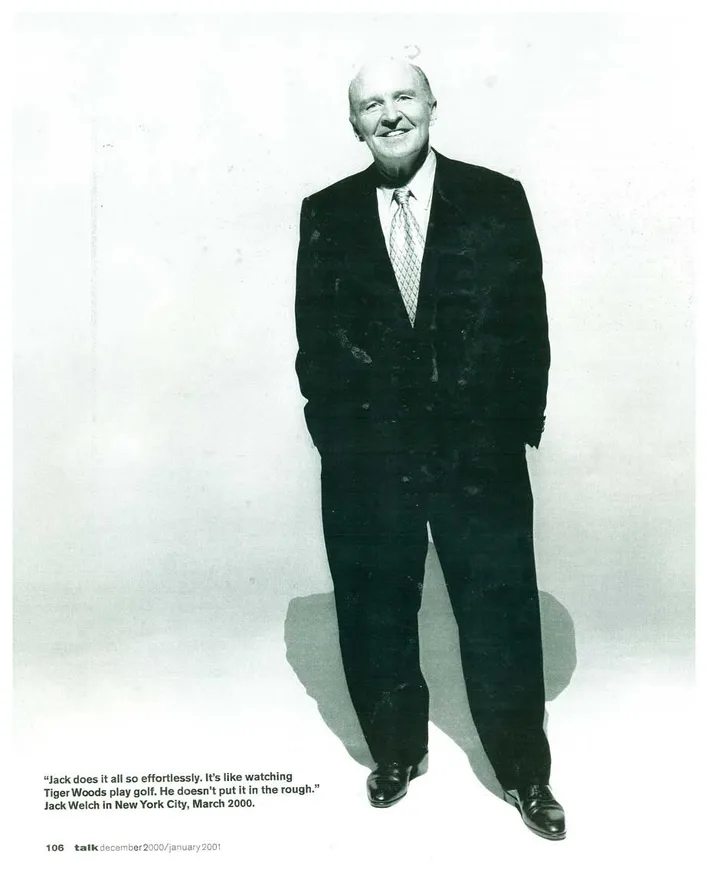
JACK WELCH
How did Jack Welch, General Electric’s chairman of 20 years, turn a sluggish behemoth into America’s most valuable company, and himself into a corporate legend? As he prepares to cap off his career, insiders and competitors portray a titan in motion. By Holly Peterson
Consider this: In the year 2000, as the high-tech revolution continues to transform the economy, America’s most valuable company is not Microsoft, Cisco, or Intel. It’s the blue-chip behemoth the General Electric Company, which traces its roots all the way back to Thomas Edison.
But it is scarcely Edison’s association with the company, formed in 1892, that has brought it to its current standing. No, that distinction belongs to a legend of our own time: GE’s chairman of 20 years, Jack Welch.
Last summer, as Welch approached retirement, Warner Books agreed to pay the 64-year-old $7.1 million for his memoirs, more than twice what Robert Rubin, former Treasury secretary, fetched. More than Colin Powell, Norman Schwarzkopf, or Margaret Thatcher…
That Welch should merit such a fee seems extraordinary. But his achievements at GE have earned him almost mythic status. Those who have come into contact with him are dazzled by the scope of his abilities. They cite a photographic memory for detail, an intuitive agility with numbers, and a gift for loyalty that softens a ruthless streak. It is not an exaggeration to say that CEOs across America consider his annual report a must-read. And no matter which of the three talented executives now in the running assumes his mantle in the spring, analysts fear for GE’s share price when the current chairman goes.
Fortune named Welch the greatest manager of the 20th century, but to call him a manager is to sell him short. Welch is also a field general—a man who seems as comfortable addressing his troops on a factory floor as he is making deals. In many ways, presiding over GE is more like running a country than managing a company.
Until Welch was named CEO, in 1981, GE’s goal had always been modest: to grow at the same rate as the American economy. Welch raised that bar. Over the course of his two decades at the helm, he has raised the company’s market value from $13 billion to more than $550 billion. This figure will likely go north pending approval of his $45 billion October takeover of Honeywell International. Under his leadership GE has gotten rid of its venerable small appliance business and expanded into global, service-oriented businesses. In 1985 it also acquired media communications giant RCA—which included NBC.
Welch grew up in the middle-class town of Salem, Massachusetts. His father was a conductor for the Boston & Maine Railroad, and a local union leader. “Jackie,” as the son was known, had a stutter as a child and was very close to his mother, who encouraged him to be candid and realistic. Unlike the new generation of CEOs, Welch is not an Ivy Leaguer; he attended the University of Massachusetts. From there he went on to another state school, the University of Illinois, where he received a Ph.D. in chemical engineering.
Welch started out as a junior engineer for GE’s chemical (now known as plastics) division in Pittsfield, Massachusetts. He was 26 and his salary was $10,500. After a year, he was given only the standard $1,000 raise. He quit, angry that he wasn’t being adequately rewarded for his work and disgusted with the endless layers of GE bureaucracy that he believed stifled innovation. But his mentor in the company, Reuben Gutoff, managed to coax him back, promising him a bright future. That was definitely what Welch had in mind for himself; never humble about his professional ambitions, Welch wrote one year in his own annual performance review that his long-term goal was to run the company.
In 1981 Welch achieved that goal. He was an unusual choice for GE. Not only was he, at 45, the youngest CEO in the history of the company, he had also cut his teeth on what was considered at GE an unglamorous fringe business: chemicals. As CEO, Welch immediately set about surgically dismantling the bureaucracy that had been chafing him since his earliest days in Pittsfield. During this period, he fired more than 100,000 people, earning the nickname “Neutron Jack”; like the bomb, he eliminated people but left buildings intact. “Fix, close, or sell” was his mantra. Any division that wasn’t number one or number two in its business was vulnerable. Early castoffs included such former GE flagships as small appliances, air-conditioning, and semiconductors.
Welch also instituted “Work-Outs”: town meetings on factory floors in which even the company’s lowest-ranking employees were encouraged to discuss production problems without fear of reprisal from their bosses. And he instituted an internal quality-review system called Six Sigma, to monitor defects in all of the company’s operations, from manufacturing to delivery to loan processing.
He took GE in new directions, expanding into Europe and launching an initiative to offer not just products but product services; the latter now account for more than 70 percent of the company’s annual revenue. And at the beginning of 1999, after seeing his wife buy Christmas presents for their grandchildren online, Welch decided it was time to get into e-commerce—earning him a new moniker, “Electron Jack.”
On the eve of Welch’s closing on Honeywell, the biggest deal of his life, Talk spoke with dozens of people who have fought alongside him—as well as against him—during his 40 years at GE.
DAYS IN THE LIFE OF JACK WELCH
ROSANNE BADOWSKI is Welch’s executive assistant: A normal day starts somewhere between 7:30 and 8 a.m. Jack comes in and often gets nailed in the hallway. He has a very large capacity to do many things at one time. He’ll call out about a news story or something he saw in the papers that morning. He starts with e-mails and then regular mail, and then he’ll yell, “Do you have a copy of that report?” and “Can you get me so-and-so on the phone?” Then, “What’s this e-mail coming in?” and a whole bunch of other requests. He’ll say, “Is he here yet?” meaning that he expected me to dial that person on the phone while I’ve been doing these seven other things.
I’ve never met anybody like that, who could simultaneously focus on so many different things. For lunch it’s always a turkey sandwich, lettuce and tomato on whole wheat, with mustard. He has a diet Slice. He eats at his desk, while he’s on the phone and still working. And he’s a fast eater.
MATT LAUER is coanchor of NBC’s Today show: The only time I saw him pissed off on the golf course, it had nothing to do with golf. We’re on the driving range on the second day of a tournament, and Jack and I are standing next to each other, and this CEO comes up to us and says, “Jack, do you mind if I have a minute with you?” And Jack says, “Sure.”
And the guy is saying, “My wife is having some problems with our dishwasher. There’s a problem. I don’t know whether it’s the dry cycle or the rinse cycle, but it’s making a noise and it’s really upsetting her and she’s gonna buy some other product. Can you see if you can take care of that for us?”
I was flabbergasted. I kinda stopped hitting balls to think, Is this a joke? I heard Jack talk to him for a little bit, then he turns around and he walks back to me.
I look over at him and I say, “Jack, did that guy really just ask you to fix his dishwasher?” And he goes, “I am speechless. I don’t believe what just happened.” I said, “What are you gonna do?” He goes, “I’m gonna get his dishwasher fixed.”
SUE HERERA coanchors CNBC’s Market Wrap and Business Center: When I was anchoring The Edge, Joe Kernen and I were bantering back and forth. We were just having a little fun on the air. We said, “You know, wouldn’t it be nice if Jack just upped the dividend and split the stock? But who knows when he’s going to do that? But it would really be a nice thing to do.” Joe said, “He’s probably not watching. You know, it’s late; he’s probably having a nice dinner, doing one of those corporate events.”
Before I got off the air, there was a fax on the machine that said, “Good try—I’m always watching; love, Jack.”
ROOTS, RESEARCH, AND THE RACE FOR THE CHAIRMANSHIP
BILL CULLEN, a retired teacher, has been a friend of Welch’s since grammar school: Jack was just like everybody else, just a normal everyday American kid who didn’t have a heck of a lot. His father was a conductor on the railroad. We didn’t have our own cars in high school.
He liked to win just like everybody else. He was extremely competitive, but so was the whole gang.
As kids we all caddied at Kernwood Country Club in North Salem. It was a big part of our life, caddying on Saturdays and Sundays. For 18 holes, if you carried one bag you made a dollar and a quarter, and if you carried two bags you made three dollars.
At high school reunions his personality is no different. He doesn’t flaunt his position or money. I think coming back here is good for him. It just shows that he hasn’t forgotten his roots.
LARRY BOSSIDY is former vice chairman of GE and retired chairman of Honeywell International Inc.: He had a wonderful relationship with his mother, who died at a relatively young age. I think he was doted upon. He had a stuttering problem. His mother used to tell him, “It’s only because your mind works faster than everybody else’s.”
REUBEN GUTOFF was an executive with GE’s components and materials group: Early on we were both fighting a system we felt we could beat. The chemical business was always in support of the electrical thing. It was never a legitimate business in its own right.
Our balancing act required keeping the bureaucracy away, harnessing the good parts. The GE research laboratory in Schenectady had Nobel Prize winners. They had world-class scientists; they had geniuses there. But it gets kind of lonely shaking test tubes. So Jack and I figured out that these scientists could be seduced to pay more attention to us on the chemical side.
We got disproportionately more support, more effort, more patent applications, more intellectual energy out of that research laboratory because we would take the 60-mile trip over the mountain from Pittsfield to Schenectady. That was a brilliant, low-key way to get that business the help it needed.
Jack was always outside the box in terms of looking at issues and trying to figure out better ways—not in the book, not in the Harvard curriculum. I mean, it’s sort of the Michael Jordan kind of thing, or the Dr. J thing. When they do moves around the basket that are unscripted, they just sort of come out of their genius.
DENNIS DAMMERMAN is chairman and CEO of GE Capital Services and vice chairman of GE: You’ve got to remember it was very much a race [for GE chairman]. I mean, everybody was running for office. They narrowed it to five or six guys on the long list. Then they narrowed it down to three. And then to one.
There’s never been any doubt in my mind that, from the first day I met him, he believed that he could—should—run the place. Did we talk about it? Yes. We talked a lot about it. He was dying to run it.
NEUTRON JACK
BOSSIDY: In 1981, as [Welch] took over the GE job, we went to Florida and put together a book of things that ought to be changed in GE. I knew it was going to be difficult, because it wasn’t changing a company in duress, it was changing a company that was successful.
So he came up with a couple of things that have made a huge difference. He came up with the notion that if you weren’t number one or two in your marketplace you ought to fix, close, or sell the business. And then he started restructuring. He had a notion that you ought to have global business leaders who had responsibilities that encompassed more than one continent.
He also understood service businesses. The theory was simple: If you could follow up a product with a service capability and differentiate yourself from the competition, then your ability to sustain that product advantage would be increased and last longer.
Instead of being smug or even cocky about GE, he always had a concern that something negative was going to hit. His job was to try to ameliorate it before it happened.
In 1984 he sold the small appliances business to Black & Decker. That shook GE’s foundations, because it was part of the company no one ever thought would disappear. And then we swapped the television [manufacturing] business for the Thompson medical equipment business. Then he began to try to fix the businesses that remained.
There were layoffs and there were plant movements, and things that were essential to put the businesses in better competitive condition. And with that came a lot of press. And then this Neutron Jack thing, which certainly annoyed him. But he kept going and never stopped.
DAMMERMAN: I don’t think I would use depressed as the word to describe Jack during the Neutron Jack period. Jack is a very sensitive and a very compassionate man. And Neutron Jack bothered him. He thought he had a job to do and he was trying to position a company for the future.
Back in those days it was not perceived as anything wrong if you were number five in the business. But Jack’s view was that if you weren’t number one or number two, if number one got a head cold, you were going to get pneumonia.
When I started with the company, it was an incredibly hierarchical and formal place. The chance that you would ever see your boss’s boss’s boss was just beyond imagination. And not only that, we found that in some of GE’s businesses, from the top of the business to the person on the factory floor was, like, nine layers. First of all, you had to get rid of some of that.
LARRY JOHNSTON is president and CEO of GE Appliances: You know, if he sees on a document that some poor guy needed 20 signatures to get something done, Jack will go into orbit. Next week there’ll be one signature. Of course, that doesn’t happen much in our company anymore.
BILL CONATY is a GE senior vice president for corporate human resources: Jack can be as tough as nails—on business results, on people assessments. We remove 10 to 15 percent of our executives on an annual basis for nonperformance. Most corporations don’t do that.
Jack’s the kind of guy who has no middle road. And whether it’s on people or ideas, it’s either the best idea he’s ever heard or the worst idea he’s ever heard.
How does he feel about letting people go? He feels it’s the most compassionate thing that we as a company can do. He’ll say to people, “Hey, we’ve given this thing a good run, and it’s time we wrap it up. I’m going to make a change.” It happens in his office; it happens in my office.
TOM BROKAW is anchor of NBC Nightly News: He is a man who lives and dies by the numbers, and I think it has to do with his discipline as a scientist. He knows that numbers don’t lie, so he is absolutely an authoritarian when it comes to numbers.
MARC ONETTO is vice president and general manager for the global supply chain, GE Medical Systems: When he was praising us he would say, “Good job. Customers are going to like it. Tell the guys in the plant I like it.” So the good notes I would post on the public board. The bad notes I would keep in my drawer. The bad notes would kick my ass. “You’re a bloody Frenchman. You’re too theoretical. I want action. I don’t want words.” You never know if he’s joking or serious. If you succeed, it was joking. If you don’t succeed, it could become serious.
THE MAN THAT MAKES THE MANAGER
SCOTT McNEALY is chairman and CEO of Sun Microsystems and a member of GE’s board of directors: Jack does it all so effortlessly. It’s like watching Tiger Woods play golf. He doesn’t put it in the rough. He doesn’t have to hack a tree down to get the ball on the green. He’s easily the most effective leader I’ve ever seen. Asking me if Jack Welch ever blew up is like asking have I ever seen Tiger Woods throw his club?
ANDY LACK is president of NBC News: What makes me feel so connected to him is not the Jack who is well-known for his business acumen.
I had a bad patch. I couldn’t solve a problem with one of the programs. During the same period, a gossipy piece was written about me in one of the tabloids. It hurt my feelings. I couldn’t shake it.
I was having a business review with Jack about three months afterward. He was cheerful, chatty. Great. Got back to my office, closed the door, phone rings. Pick it up; it’s Jack: “What’s wrong with you?” “What do you mean? Nothing’s wrong.” “Why—are you still bothered by last year’s stuff? Just stop it. When are you taking a vacation?” “In a couple of weeks, actually.” “Why don’t you go away on Friday?”
Sure enough, on Friday I was on his plane. And it worked. That’s the most important part. I just settled down.
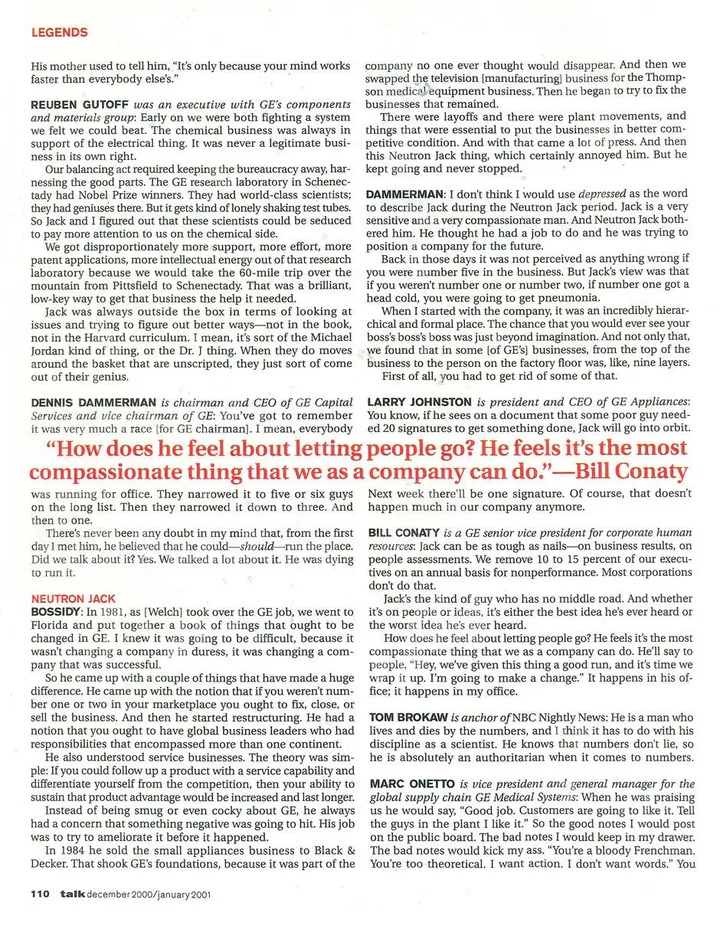
CLAUDI SANTIAGO is president and CEO of GE Nuovo Pignone Power Systems: When you have three hours with him, he will give you one idea about your business that you never thought about. That happened a few months ago. We were having this discussion about growing in the service business. We were selling gas turbines and compressors to oil and gas companies.
But he said, “Why are we only servicing our gas turbines and the compressors that are transporting the gas or the oil? Why can’t we go to a customer that has our equipment and say, ‘Not only will we commit to servicing our gas turbines and compressors, but we can help you, Mr. Customer, by servicing the whole pipeline’?”
He has a three-hour meeting with every GE CEO every year, probably from about 40 different businesses. We will all come out with one or two or three new ideas that we are convinced are worth exploring. Not all the ideas, obviously, will be home runs. So he doesn’t get upset if you send a note to him and say, “Jack, I thought that this was a brilliant idea, but now I am changing my opinion.” What he will not be happy with is if you accept the status quo.
LET’S MAKE A DEAL: THE GREAT NEGOTIATOR
MICHAEL EISNER is chairman and CEO of the Walt Disney Company: In 1994, after I had my heart bypass, I went up and had dinner with him. I was discussing a deal in which Disney would buy half of NBC. We would manage it. This was his deal. He’s a pretty good salesman. I used to think I was a pretty good buyer.
Jack had me wrapped around his little finger. I was all excited about this. In the negotiations, the one thing that he was insistent on was that, though we were going to manage it, [NBC president] Bob Wright be part of the deal. NBC was having a rough time. Bob Wright was really being criticized in the press. I thought this was very impressive, because here was a guy who could have easily thrown an executive to the wolves.
That said, he completely convinced me that it was a great deal. He’s such a good salesman. I was ready to go. But then I got in the elevator and realized that the economics of it made absolutely no sense for us. It was a totally one-sided deal. The next day I called him and said, “You know, I can’t believe that I’m thinking about doing this.” He laughed and said, “Oh, okay.” He was not surprised that he got the phone call. But at that moment I thought he had completely mesmerized me into oblivion.
DAMMERMAN: We were in the GE dining room: Mike [Eisner], his CFO, and one other guy. We wanted to sell half of NBC. We wanted to keep 51 percent and have control. And Eisner was going to merge his television operations into that. Now, Disney didn’t have ABC at that time.
And Jack sat there and convinced Michael Eisner that, in effect, we knew more about the entertainment business than Disney did, so we should have controlling interest. We had a few glasses of wine; Jack did a hell of a selling job. When Michael left the room, Jack said to us, “Do you fuckin’ believe it? That he’s going to buy into this deal? That he agreed?”
We said, “You know, tomorrow morning he’s going to think about this one again.”
Michael called him back the next day and said, “I got on the plane last night and my guys jumped all over me. They wouldn’t let me sleep. I couldn’t do anything. For the five hours it took us to get back to the West Coast, all they were doing was beating me up. They said, ‘How could you be so stupid?’”
DONALD B. MARRON is chairman and CEO of PaineWebber: First, you’re dealing with somebody very smart who’s in charge, who can make the decision. The second thing is, he understands the issue on the table. And the third thing, when you get into it, is that there’s a give-and-take to all this. There’ll be a couple of jokes and asides and a sense of, “Hey, you know, let’s get this thing done and be friends.”
People think that businesses—big businesses—are huge, monolithic, powerful enterprises. In fact, it’s people. And a lot of people with a lot of emotions and a lot of separate issues. He is a master at understanding all those issues and getting the best out of that combination.
THE MASTER SALESMAN OVERSEAS
PAOLO FRESCO is chairman of Fiat and former vice chairman of GE: We were operating on a couple of acquisitions overseas. Jack needed to be very secret. The company we were working with was very famous. The people involved were very famous. The person that we were in touch with was probably the most famous businessman in that country.
Jack said to him, “When you call me, don’t use your name. Say that you are Mr. Hood from GE.” And so then we were discussing how to handle this deal, and Jack had completely forgotten that he had asked the man to use a different name. The secretaries kept saying, “Ed Hood is on the phone.” Jack would say, “Tell him I’ll call him back when I’m finished with this deal.” So finally, after a couple of hours, the secretary came in and said, “There’s a guy that says he’s Hood but he’s not Hood. He has a very strong British accent.”
So Jack stopped a moment and realized what had happened.
JOHNSTON: We put together a dinner in Paris for 25 to 30 customers. It was at a very elegant club, and Jack spoke. Afterward he touched every customer. He called them by name, got into specific issues, thanked them for specific things.
The minister of defense from Romania showed up. He didn’t speak English; he spoke French. Jack had us translate the order we wanted. And then he dropped on his knees and said, “Please, Mr. Minister, give us the business.” Of course, the minister of defense went, “Oh, Mr. Welch, please get up!”
Jack is a customer zealot. Before he gets back to the United States, on the plane he’s written a personal note to all these people: “Dear Mr. Minister, I enjoyed being with you, thanks so much; we really want that medical order.”
JUMPING THE FLAGSHIP
PETE PETERSON is chairman of the Blackstone Group investment bank: One of the best examples of Jack’s ability to think strategically is how he handled the sale of the small appliance business. In 1984 I was chairman of the finance committee of Black & Decker. Black & Decker had decided that they wanted to broaden their product line beyond power tools to include small appliances. It was clear that General Electric’s business was the one they wanted most.
So I called him and said, “Jack, I’d like to ask you a question about the terms on which you might sell a business you’re in. I’ll give you numbers on a scale from one to five. One being it’s like your daughter—you wouldn’t sell her at any price—and five being you want to get out of the business as soon as you can.”
He said, “Now why should I tell you that?” I said, “I hope you trust me. I know I trust you. Whatever you tell me will be kept totally confidential.” He said, “Okay, let’s go ahead. What are you interested in?” I said, “Small appliances.” He said, “Hmmmm, small appliances. That’d be a category three: I would sell it, but only if I got a fair market value for it.” I told him about Black & Decker. Jack said, “Look, Black & Decker is a fine company. Do they have a substantial amount of cash? Because I would want cash.” And I said, “I’m chairman of the finance committee. I can assure you that they have plenty of cash.” He said, “Okay.”
So Larry Farley, the CEO of Black & Decker, and I went up to Lexington Avenue, to the old GE headquarters building. Larry was stunned to find that only Jack was in the meeting. Jack said, “Pete’s explained to you the confidentiality aspect of this. There is only one condition. If you buy this business, it must not only be cash. I must have your word that Bob Wright [who was at the time supervising this business] cannot go with this deal. I have other plans for him.”
Larry had a whole bunch of highly detailed questions. Larry asked, “Where are you making your irons? How many irons are you making? What proportion of your production is there? What are your costs there relative to other areas?” Jack knew the answer to every question. Larry asked a highly sophisticated question about the tax situation with a Brazilian factory: “What payments were due?” Jack knew the answer.
You could tell that Larry was just stunned that a CEO running a company as large and diversified as GE could handle all the questions.
I said, “All right, Jack, let’s talk about the price.” Jack replied, “I won’t accept anything less than $300 million. It’s got to be in cash. And that’s the deal. It’s got to be kept totally confidential. And I would expect this to be consummated immediately, because I’m not going to upset the organization.”
Larry and I stepped outside. “Larry, what do you think?” He said, “Well, the price happens to be at the midpoint of what we think it’s worth, and I can understand why he’d want cash.”
So we walked back in again and said, “Well, okay, Jack. Subject to a very quick due diligence, we have a deal.” Jack had thought through virtually everything. He laid out the conditions. He lived up to his word in every respect, and the deal was done in about 10 days or so. That’s very unusual. Extremely unusual.
THE GREAT SALESMAN GOES SHOPPING
SANDY WEILL is chairman and CEO of Citigroup [In 1986 Welch bought Kidder Peabody, the investment brokerage company, and then sold it to PaineWebber in 1994]: The [initial] Kidder Peabody transaction turned out to be a big disappointment for Jack. But it was just a speck. Well, it was really so small, the problem of Kidder—relative to what was happening in all the other parts of GE that were doing so well. Still, he took it very personally, and it overshadowed all or a lot of the good things in his own mind.
PETERSON: Kidder Peabody was one of the rare businesses that Jack had been involved in that clearly did not make the grade. It had no dominance as a number one or two company. He therefore decided that he’d sell it. PaineWebber was the perfect buyer.
PaineWebber CEO Don Marron asked me to get involved in the deal. The negotiations at that point between GE and PaineWebber had failed. There were a lot of conditions that the GE executives had put on the merger that were not acceptable to PaineWebber. So once again I had a one-on-one conversation with Jack.
Jack was smart enough to appreciate that this was his chance to surgically get out of a business he should not have been in in the first place. So he agreed to sell Kidder to PaineWebber for about a 20 percent ownership in PaineWebber stock.
Six years later, in July 2000, when UBS [an international investment bank] wanted to buy PaineWebber, we had finally agreed on the price that UBS would pay. But it was essential that we have a quick decision from someone we trusted to vote their PaineWebber shares for the deal. I must have called Jack at about 6:30 or 7 that evening. He was already headed to the airport. I said, “I wouldn’t be bothering you on a weekend unless I thought it was important. I’ve known since you got into this deal that at some point you wanted to sell your shares in PaineWebber. You’ve been wonderfully patient. I want to talk to you about selling PaineWebber to UBS for $73.50 a share, which I think comes to something like $2 billion for you. And I’d like to help make your weekend.” And he laughed and then said to me, “You’ve made my whole damn year.” Actually, his language was more, shall I say, colorful.
By Monday afternoon we had everything signed that we needed signed—again without staff, without all the bureaucracy that you normally see in a situation like this.
FELIX ROHATYN is the current U.S. ambassador to France and former managing director of Lazard Freres: I had known Welch personally for some time when Thornton Bradshaw decided that he wanted to merge RCA before he retired. It was clear to us that GE was undoubtedly the best possible company, and that we should talk to Welch about it.
So I went to see him. Our offices are three floors separate from each other. It took all of about 12 seconds for Welch to say, “Yes, I want to do it.” You don’t see the chairmen of some of the very big old-line companies making decisions that way. His grasp of numbers is superb. It is superb.
He knew a great deal about RCA. I told him that clearly we couldn’t have 80 people studying numbers, because it would get out into the newspapers, and if it did we would need to call any discussions off. Leaking just upsets a lot of people. It upsets the markets. It upsets the employees. And if you announce that you’re in a merger discussion and then it fails, then you’ve gotten two things wrong. So he said he would have only one person, his chief planning guy, work on this with him. And first we decided, obviously, that he and Bradshaw should have a discussion, which took place at my apartment a few days later. And we came to an agreement and put the deal through.
DAMMERMAN: In the mid-’80s, when we did the RCA deal, it was the largest non-oil company deal ever. NBC was hardly a star at the time. Jack says, “Now, just think. Ten years from now, as we’re sitting there out in the middle of the 1990s, do you think you’d rather be in the network business, or the lightbulb business or the circuit breaker business or something like that? Where do you think you’ll be more in touch with where the world’s going to be?” And so we did it.
LET ME ENTERTAIN YOU: WELCH AND NBC
WARREN LITTLEFIELD is principal of the Littlefield Co. and former president of NBC Entertainment: When I took over the entertainment division in ‘90 we were in a downturn. We were number three in household viewing. And when you get down to it, it’s your ass in the hot seat. Critical? Absolutely. Jack was critical. But what he managed to do, amazingly, was motivate you. He makes you believe in yourself. And his questions help—if you don’t find the answer, at least you’ve begun a process to find the answer. And that’s his genius.
BROKAW: I wrote him a very strong memo about the stewardship of NBC News and NBC, following that Dateline fiasco in which they were blowing up the GM pickup trucks and not revealing to the audience how they were doing it. I wrote about stewardship and the importance of the public trusts that networks represent.
I wanted to go on the record with him saying that there’s a very fragile relationship between network news divisions and their audiences, and it is all based on credibility and integrity. If we lose that, we’ve lost the franchise. I said, “If you and I come to the end of our lives, and we denigrate the network or the value of it in the minds of the public, that’s what people will write about.”
And he could not have been more responsive. He called me early the next morning and said, “You have a better way with words than I do, but you reflect my thinking exactly, and we’re gonna solve this problem.”
CHARACTER REFERENCES
LITTLEFIELD: In the great late-night debate of Jay Leno versus David Letterman—who will inherit Johnny Carson’s throne?—Jack had a really interesting role. He did have an opinion, but it was very clear that this was not gonna be his call. And in many ways the debate tore the company apart. Jack said to the small group of decision-makers as we sat around the table, “This is your decision. It’s clear that they’re both very talented. I think there’s something to be said for loyalty and who you’re in business with.” That was Jack’s way of saying, “In a close call, if someone were asking me, I think I’d probably lean toward Jay Leno.”
JAY LENO is host of The Tonight Show: He reminds me of my old man a little bit, because he’s a hard worker.
One day I call him and they say, “Oh, Jack’s not here, he’s in Florida.” So I call there, and they put me through. I say, “Hello Jack, you on the golf course? This is Jay Leno in California. Look, Jack, I’m here working. I’m just keeping the store open. So listen, I know you’re semiretired and you’re taking it easy.” He says, “Goddamn it, I’m working out here. I’ve got clients here.”
He gets all pissed. God forbid you should accuse him of taking a day off or being lazy. And that’s what I used to do to my old man all the time. You know, it’d drive my father nuts. I just play him the way I played my dad.
LITTLEFIELD: I remember the first pitch he ever gave us. Michael Douglas’s Wall Street had just come out, and Jack said, “That’s a great movie. Why don’t you guys do that as a series?” “Wall Street?” We pissed all over his idea, and he goes, “I’m going back to businesses where people listen to me.” And it was a perfect response. I mean, we shut him down.
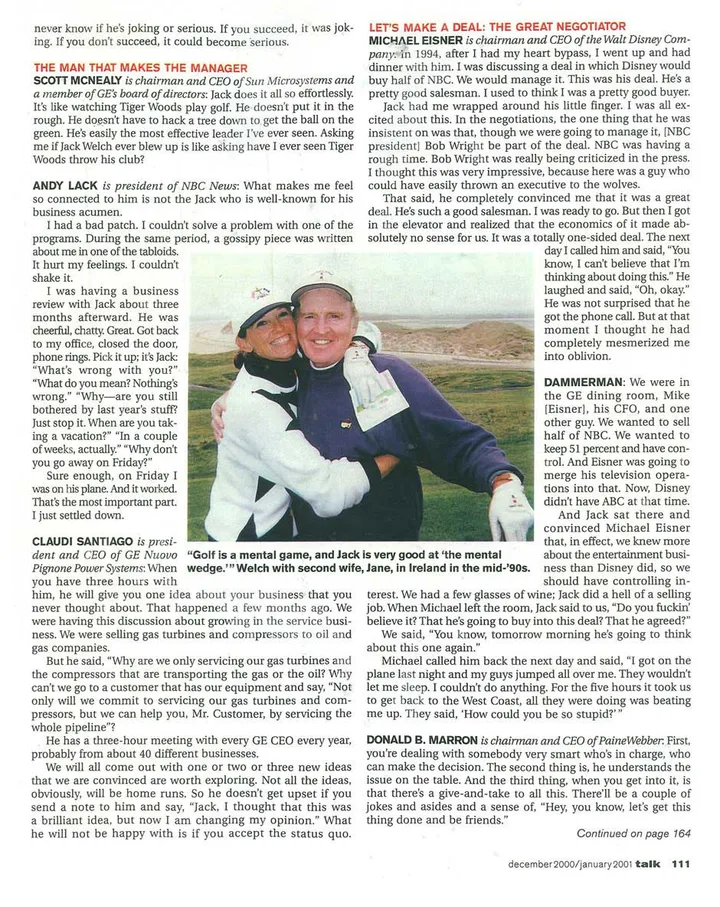
LAUER: He has a wicked sense of humor, razor sharp. He loves to get into your head. Golf is a mental game, and Jack’s very good at what we call “the mental wedge.” He’ll get right into your head if you’re his opponent. I remember one time I’m playing against him, and I step up on a tee and I’m about to hit my shot, and it was getting to a point in the match where it was important, and he looks at me and he says, “You know, you’re really losing your hair.”
And I was like, “You son of a bitch.” And he goes, “You better make the most of your career, ‘cause it’s going.”
BOB WRIGHT is a vice chairman of GE and president and CEO of NBC: His weight would fluctuate dramatically. I can remember many years ago when he was determined he was going to lose a lot. He weighed probably about 190-some-odd pounds.
He had gotten to the point where he was down to about 175 pounds, so we had a contest. He signed up to lose 10 more pounds. Two or three weeks later everybody had to go in for official weighing. He came in and he proudly got on the scale and he had lost 15 more pounds. Then he informed us that he had purchased a whole new wardrobe. He’d won the largest amount of it, because he had lost the most weight from the beginning.
THE FINAL FRONTIER: GE GOES INTO CYBERSPACE
ANTHONY LOFRISCO, a New York lawyer, is a friend of Welch’s: For five years I had been telling him that the company should really get into e-commerce. He knew nothing about computers. He didn’t have one—didn’t know how to turn one on. His wife Jane was very attuned to computers. She was telling him the same thing. Well, they were away on vacation, and one night I got an e-mail from him. The message was very short, because he didn’t know how to type. So I sent one back. When he came back from vacation, he was so excited about the Internet and the possibilities for business. He then got the entire company rallying behind the e-commerce business, and that only happened less than two years ago. And since then, just to give you an insight into the kind of person he is, he’s been teaching himself how to type. He’s been using a CD-ROM program and he’s learning how to type.
PAM WICKHAM is GE’s manager of e-business PR and of ge.com, and is Welch’s Internet mentor: It was 5:30 p.m., and Jack was ready for his lesson. He had pulled up a chair right next to his, in front of his computer, and asked me to sit down. He had questions about everything: security, personalization—even things like packaging. “Why do browsers come with preselected favorites? Who put those in there?” In his office the phones are ringing, and his secretary Rosanne needs him, and he’s shouting to Rosanne and he’s got heads of businesses calling in. He’s multitasking: there’s, like, 50 things going at once. He was just watching the screen the whole time. And he would be saying, “Why is this site taking so long to come up?” At the same time he’s saying, “Rosanne, get me so-and-so on the phone.” He’s just not going to sit there and do nothing while he’s waiting. In the background you’d hear the helicopter arrive, and he’d be like, “Oh, my ride’s here, I’m going to have to go.”
JOHN CHAMBERS is president and CEO of Cisco Systems: Eighteen months ago Welch didn’t have the Internet on his top 10 agenda. The company was headed one way, and he said, “Let’s turn.” And they turned on a dime. GE went from the edge of the pool to breakneck speed, faster than any other major company out of the Industrial Revolution has ever done it. I mean, we’re good, but they’re better.
PETER FOSS is president of GE Polymerland: In ‘98 Polymerland was the first business in GE to get going in e-commerce. Now we’re doing probably $28 million a week, but we started at $10,000 a week, so it’s been a pretty rapid rise. He said, “Guys, this is important. You get on this train or, you know, you’re gonna—you ain’t gonna be on a train.”
When Jack got on e-mail, I’d start to get a Sunday night e-mail from him every week: “How are you doing? How were the numbers last week?” I got an e-mail from him one Sunday night that said, “Hey, you guys have plateaued, what’s going on?” Those are the kind of things that put the fear through your stomach as you’re reading them. I mean, it’s very simple, direct—there’s no paragraphs.
KEEPING PERSPECTIVE
LAUER: He took me down to Augusta National to play golf. Bryant Gumbel and Bob Wright were with us. We were coming from different directions, so we flew down in a couple of the jets, and it was a perk because we’d had a particularly good month on the show.
We had this fabulous weekend where we played golf, he took us to dinner, we stayed over in the cottages on the club. And on the way back we took a car to the airport in Augusta, and we got out of the car and we’re walking across the tarmac, and the two GE jets are sitting there kind of nose-to-nose, fired up, with the doors and the staircases down. I had only been working at NBC for about a year. I was just in awe. Over the roar of the engine I said to him, “Do you ever get used to this?” And he grabbed my arm and he stopped right in the middle of the tarmac, and he looked at me and said, “I want you to know something. I pinch myself every single day. I never get used to this. I never lose the thrill of what this job has given me.”
BOSSIDY: He’s somewhat typified by a tattered old brown satchel that he’s carried around for 40 years. It’s the worst-looking thing you ever saw in your life. But that’s what he is. He knows where he’s from, and he’s always been able to ground himself.
It’s an eyesore, but, you know, I don’t think it’s a security blanket. It must be a metaphor for life. He doesn’t feel as if he wants to buy a new one. Never has. He says, “That’s the one I came with. That’s the one I’m going out with.”