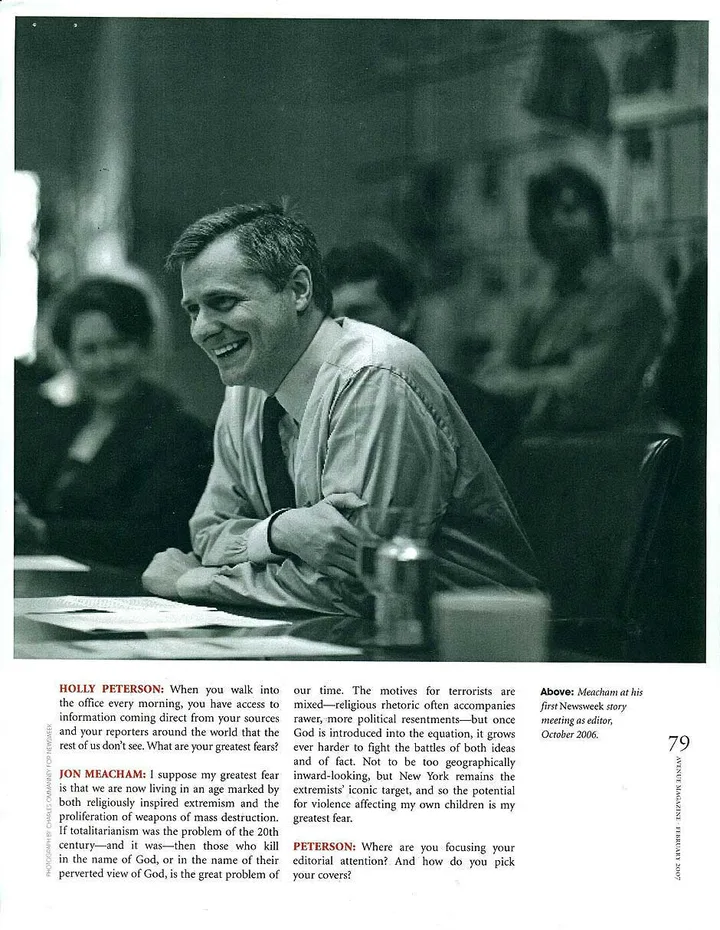
Newsweek’s new editor, Jon Meacham, is at the helm of a journalistic institution during a seminal moment in history. His colleague Holly Peterson talks with Meacham about George Bush, the future of media, and the Tennessee native’s efforts to feel at home in the big city.
He’s Southern. He’s very funny. He’s a gentleman. And, at 37, he happens to run Newsweek magazine and write bestsellers in his spare time. You might have caught his sparkling wit and wry humor as a commentator on Meet the Press or Hardball, or read his latest book, American Gospel: God, the Founding Fathers, and the Making of a Nation, and wondered: “Who is this guy? I’d like to meet him.”
As NBC Anchor Brian Williams told Avenue, “It’s nice to have known for years what so many others are just now discovering, like a wave washing over them: that Jon Meacham has a first-class intellect and is a world-class nonfiction writer and editor.” His Franklin and Winston: An Intimate Portrait of an Epic Friendship was on the New York Times best-sellers lists for 38 weeks after its release in 2003.
Jon Meacham is my boss. He’s also five years younger than me, and my little brother’s age, so it’s awfully hard for me to follow his orders. On rare occasions, I do. But only because I find him so beguiling. And for some reason, behind all those nerdy brains and archaic Brooks Brothers suits, he’s even a little hip.
PETERSON: When you walk into the office every morning, you have access to information coming direct from your sources and your reporters around the world that the rest of us don’t see. What are your greatest fears?
MEACHAM: I suppose my greatest fear is that we are now living in an age marked by both religiously inspired extremism and the proliferation of weapons of mass destruction. If totalitarianism was the problem of the 20th century—and it was—then those who kill in the name of God, or in the name of their perverted view of God, is the great problem of our time. The motives for terrorists are complex; religious rhetoric often accompanies rawer, more political resentments—but once God is introduced into the equation, it grows ever harder to fight the battles of both ideas and of fact. Not to be too geographically inward-looking, but New York remains the extremists’ iconic target, and so the potential for violence affecting my own children is my greatest fear.
PETERSON: Where are you focusing your editorial attention? And how do you pick your covers?
MEACHAM: We are in the business of telling you things you do not know, but should. A generation or two ago, newsmagazines weren’t supposed to break news, but for us that changed a long time ago. In a media climate this competitive, you can’t assume anything; that is, we have to earn people’s attention every day on Newsweek.com and every week in the pages of the magazine. We’re comfortable in our own skin; we know that we have to be both surprising and thought-provoking, with a mix of scoops and distinctive voices. Our competition is catching up to this model, but it’s been the air we’ve breathed for years. On the covers, our inclination is to do the news, especially these days. That news can come from the political world, or the medical world, or the scientific world, or the business world. It seems bleedingly obvious to say this, but it is a very serious time. We are engaged in a war that has now lasted longer than our involvement in World War II. The next election, in 2008, will be the first election without an incumbent vice president or president since 1952—that’s two-and-a-half generations. And of course we look closely at stories that tell us what our role is in the world. Is America a force for good?
PETERSON: Are we?
MEACHAM: At our best, I think we are, but we are not always at our best, and many people around the world resent us. Though it feels newly urgent—things that happen to us in the moment always do—the imperative that Americans have to be engaged in the broader world is an old one. We have always been a part of the larger global saga; we were, after all, a colony, and a pawn between Britain and France and Spain in the very beginning. An important role for journalists is to keep explaining that as the world has grown ever smaller, we have to understand the rest of the world if we are going to exercise leadership. This isn’t blinding insight; it’s common sense. Talking about America as an emerging superpower, Churchill once said that with greatness comes responsibility, and he was right. I am careful about superlatives, so I don’t want to say this is the most dangerous time in history, or the most momentous—the Civil War was pretty bad—but it is our time, so we have to do the very best we can with it.
PETERSON: Do leaders dictate history or are they controlled by events?
MEACHAM: Both. The character of individual leaders absolutely matters. I defy anyone to make a coherent case that George W. Bush’s character has not affected American policy.
PETERSON: For better or worse?
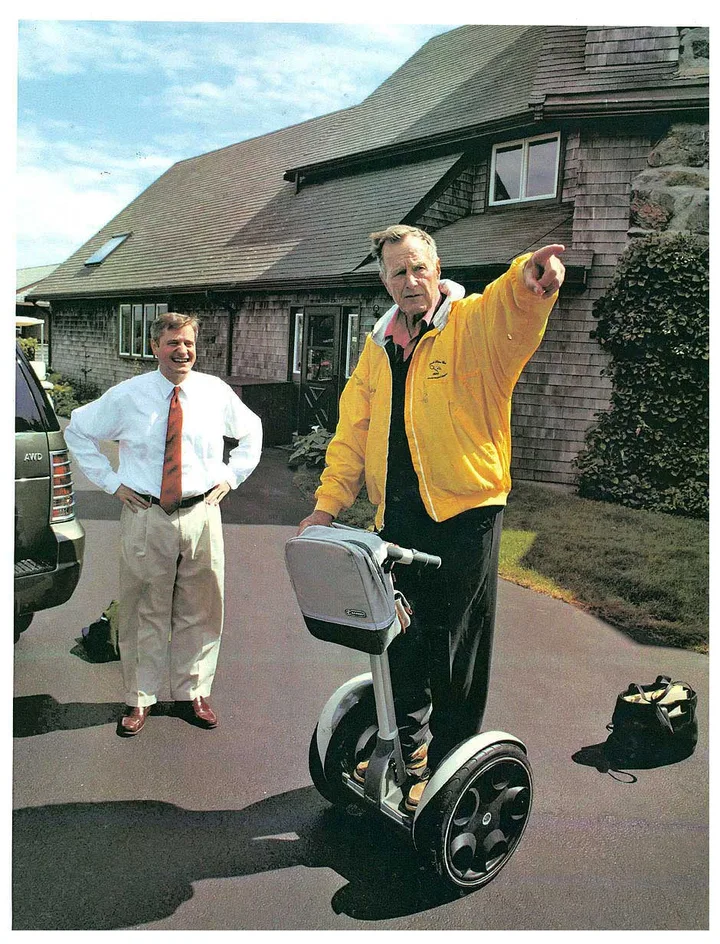
MEACHAM: I leave that to you to decide. It’s simply the case. If you look at George H. W. Bush versus George Walker Bush, you can see how character helped produce different policies. The father grew up as an internationalist, and managed the first Gulf War and the end of the Cold War in the way someone who came of age in an era of strong alliances would have. The son was shaped by what he believes to be the Reagan story: that America is strong, no matter what, and that strength is the essential virtue. President Reagan was a hell of a lot more complicated than that, of course: He was an old labor negotiator and knew how to handle his foes. He was masterful at that. Imagine going from calling the Soviet Union an “evil empire” in 1983 to strolling around Red Square with Gorbachev, holding babies, by 1988. That was an amazing journey, and an example of leadership that was both clever and courageous. Of course, what President Bush’s critics call stubbornness, his defenders would call resolve. So we will have to wait for history’s verdict, but it is clear that George Bush’s character has had a decided impact on what he’s done in the field.
Character is a compound made of elements that are inextricable from each other. It will be a great historical question: Did George Bush’s relative inexperience cause him to rely too heavily on Cheney and Rumsfeld, or was he determined to do certain things regardless of who was around him?
PETERSON: Some people argue he would have found a way to go into Iraq.
MEACHAM: I personally don’t believe that, but it is an unanswerable question. The fact is we are there, and 3,000 Americans have died, and we have to honor their sacrifice and make the best of things.
PETERSON: Do we export too much negative news about America? Because we are so self-critical, are we hurting the way people see us around the world?
MEACHAM: Probably. But that is the price of doing business in a democracy. We are a vigorous and quarrelsome family. Americans don’t hide our family quarrels. And, like most families, we are alternatively ready to kill for each other or kill each other. So yes, we’re very self-critical. Coverage of George W. Bush produces an immediate, emotional, reflexive response from both sides of the political spectrum. Those who love him are unflinching, and those who can’t stand him have a hard time accepting that he can do anything right. We are living in a time where people shape facts to suit their pre-existing worldview; they tend not to let the facts shape the view itself.
PETERSON: What’s the alternative?
MEACHAM: Americans don’t have to be so reflexive. Everything does not have to escalate to nuclear war. The political conversation has gone from being somewhat more substantive in the past to being more reflexive, because bloggers and people with vested interests in the public debate can offer their views instantly. This is partly the legacy of the Clinton War Room of Stephanopoulos and Carville, the theory being that if you don’t get out there with your side of the story immediately, you are losing. But if you believe in democracy and the free exchange of ideas, you have to be in favor of an open marketplace in which anyone can speak out at any time. I just wish we could have the conversation in a more civil and—as John Kerry would say—nuanced way.
PETERSON: Post-midterms, with a Democratic Congress and a stubborn president determined to do things his way, who is losing, the left or the right?
MEACHAM: We are in an odd situation. The right and the left are both trigger-happy, and both sides feel they are losing. For the left, it’s been 40 years since the high-water mark of the Great Society, and many liberals were disappointed in the only two Democrats to win since then, Carter and Clinton. For the right, it’s been 30 years since Roe v. Wade, and the two central claims of the cultural right—a pro-life amendment to the Constitution and a school prayer amendment—have never come remotely close to reality. Both sides think the other is winning, and that is a recipe for a corrosive national climate.
PETERSON: Ten years from now, will Newsweek be seen as a Web product or a paper product?
MEACHAM: I think it will be both, as it is today. We are in the storytelling business. We can debate all we want—and we will—about online and print, but we must remember what business we are in first and foremost. Where we end up on how we deliver the product comes second. We have to get what we do right, and if we do that then we’re going to be fine. We’ll continue to evolve on both platforms.
PETERSON: Is there a place for a general-interest newsmagazine? How does it compete with a breaking-news site?
MEACHAM: We have to ask ourselves what we bring to a headline-delivery business, which is basically what the Internet is right now.
PETERSON: And what’s the answer?
MEACHAM: We have to look at what’s distinctive about what we do—and the answer is that we break more news than almost anybody, and we have a range of unique voices. To hurl metaphors at you, in an ocean of information, people need some guidance and navigation. They need editors—it’s a way of having signposts in a strange land.
PETERSON: Americans have been interested in three kinds of stories this year: 1) Islam 2) Will Bill Clinton be the next First Lady? 3) How can Britney/Paris/Lindsay go out in miniskirts with no underwear? Is the responsible, serious press losing ground, and do you see more of the lowbrow bleeding into your product?
MEACHAM: Only since we hired Holly Peterson.
PETERSON: I’ll take that as a compliment, thank you very much. But I do know that Newsweek has always had to find the right mix of mass and class.
MEACHAM: We are now covering mostly serious things, as it is now a very serious time for America. But that doesn’t mean you don’t see things that are—how to put it—more tabloid-y. Our philosophy is pretty straightforward: A story does not have to be important to be interesting. So we will have fun along the way. But at heart, we’ve been given a great legacy, a mass audience, and we enjoy great credibility. That is a precious asset.
PETERSON: How do you decide which personalities you focus on in the cultural landscape? Do you self-select, or do they come up naturally? In other words, do you make stars or do they make themselves?
MEACHAM: We have to look very carefully at what the Hollywood PR machinery is putting in front of us versus what our really smart, interesting people—our editors, writers, reporters—think is new and fresh.
PETERSON: Do you travel with your reporters?
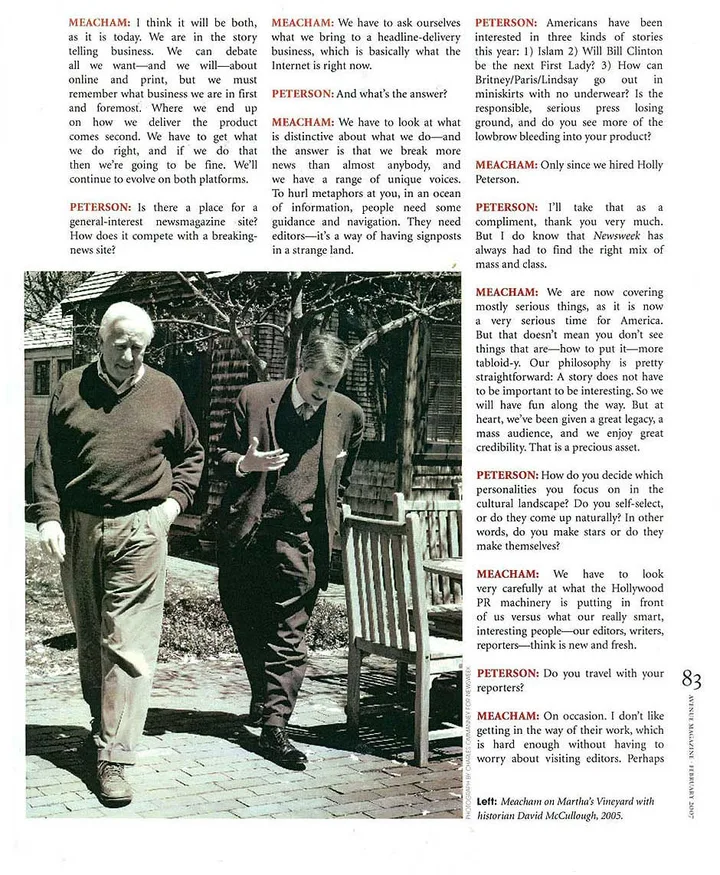
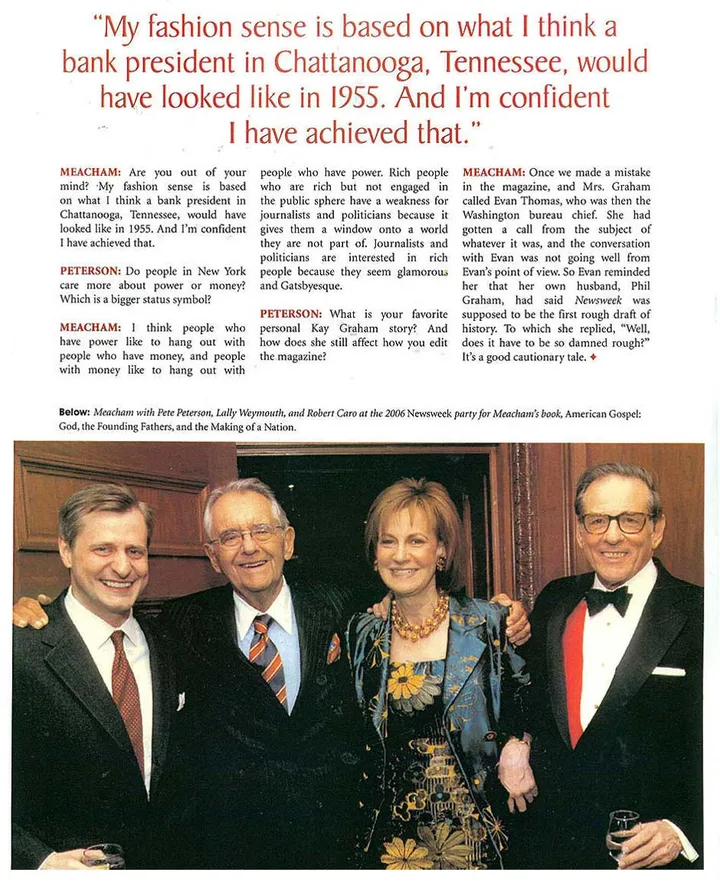
MEACHAM: On occasion. I don’t like getting in the way of their work, which is hard enough without having to worry about visiting editors. Perhaps the most interesting trip I ever took was with Lally Weymouth, who is quite simply among the finest foreign-affairs journalists at work in the world. She is also a wonderful, generous friend—when people at Newsweek have been in accidents, Lally has gone to the emergency room in the middle of the night to make sure everything that could be done was being done. On the journalism side, I don’t mean to sound obsequious, since she is also one of our owners, but look at her record of interviewing just about every major international figure of the last few decades, from Milosevic to Sharon to Chavez and beyond. I call her the Republic of Weymouth, because she’s really a principality as well as a person.
In 2000, during the New Hampshire primary, we went up to ride around for a few days with Howard Fineman, our brilliant political maestro, and we wound up spending time on both John McCain’s bus and George W. Bush’s.
There was a hugely telling difference between the two experiences. McCain’s was full of fun and doughnuts and banter; on Bush’s, Lally and I were the only two journalists there, and it was kind of dark and hushed. Then-Governor Bush sat rather glumly in a leather swivel chair, clearly unhappy that two people from Newsweek were riding along with him.
Lally and I still talk about “The Tale of Two Buses.”
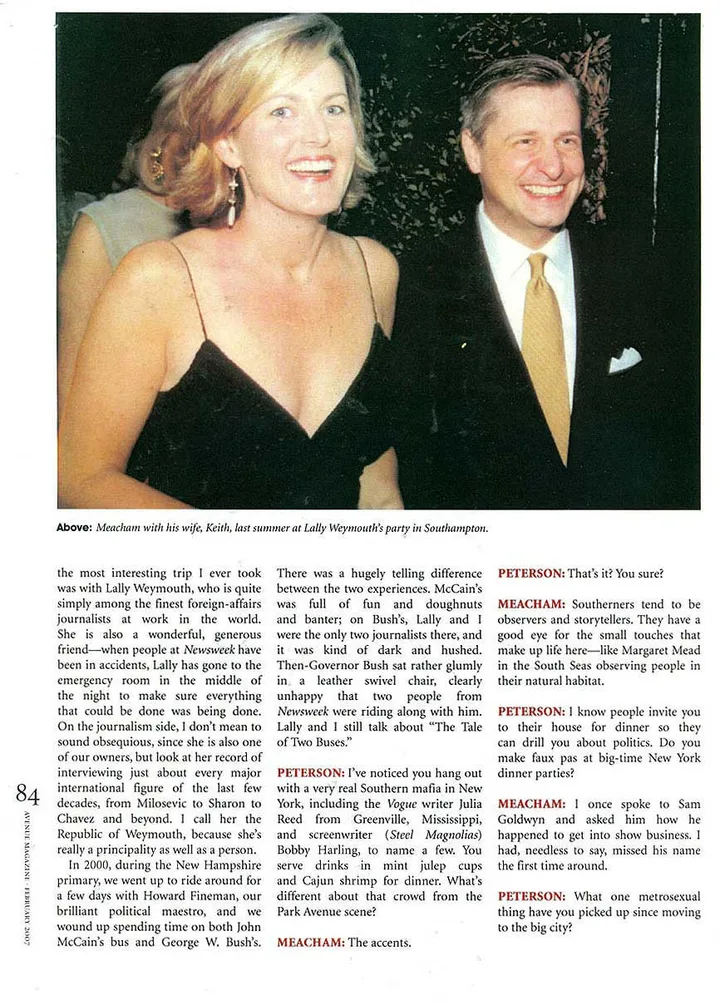
PETERSON: I’ve noticed you hang out with a very real Southern mafia in New York, including the Vogue writer Julia Reed from Greenville, Mississippi, and Steel Magnolias screenwriter Bobby Harling, to name a few. You serve drinks in mint julep cups and Cajun shrimp for dinner. What’s different about that crowd from the Park Avenue scene?
MEACHAM: The accents.
PETERSON: That’s it? You sure?
MEACHAM: Southerners tend to be observers and storytellers. They have a good eye for the small touches that make up life here—like Margaret Mead in the South Seas observing people in their natural habitat.
PETERSON: I know people invite you to their house for dinner so they can drill you about politics. Do you make faux pas at big-time New York dinner parties?
MEACHAM: I once spoke to Sam Goldwyn and asked him how he happened to get into show business. I had, needless to say, missed his name the first time around.
PETERSON: What one metrosexual thing have you picked up since moving to the big city?
MEACHAM: Are you out of your mind? My fashion sense is based on what I think a bank president in Chattanooga, Tennessee, would have looked like in 1955. And I’m confident I have achieved that.
PETERSON: Do people in New York care more about power or money? Which is the bigger status symbol?
MEACHAM: I think people who have power like to hang out with people who have money, and people with money like to hang out with people who have power. Rich people who are rich but not engaged in the public sphere have a weakness for journalists and politicians because it gives them a window onto a world they are not part of. Journalists and politicians are interested in rich people because they seem glamorous and Gatsbyesque.
PETERSON: What is your favorite personal Kay Graham story? And how does she still affect how you edit the magazine?
MEACHAM: Once we made a mistake in the magazine, and Mrs. Graham called Evan Thomas, who was then the Washington bureau chief. She had gotten a call from the subject of whatever it was, and the conversation with Evan was not going well from Evan’s point of view. So Evan reminded her that her own husband, Phil Graham, had said Newsweek was supposed to be the first rough draft of history. To which she replied, “Well, does it have to be so damned rough?” It’s a good cautionary tale.