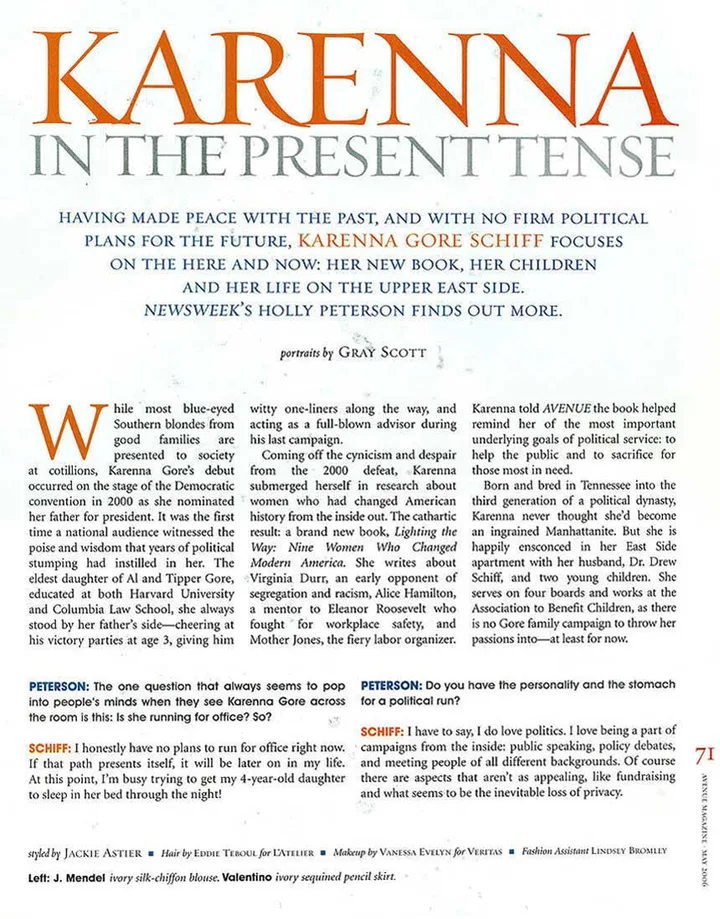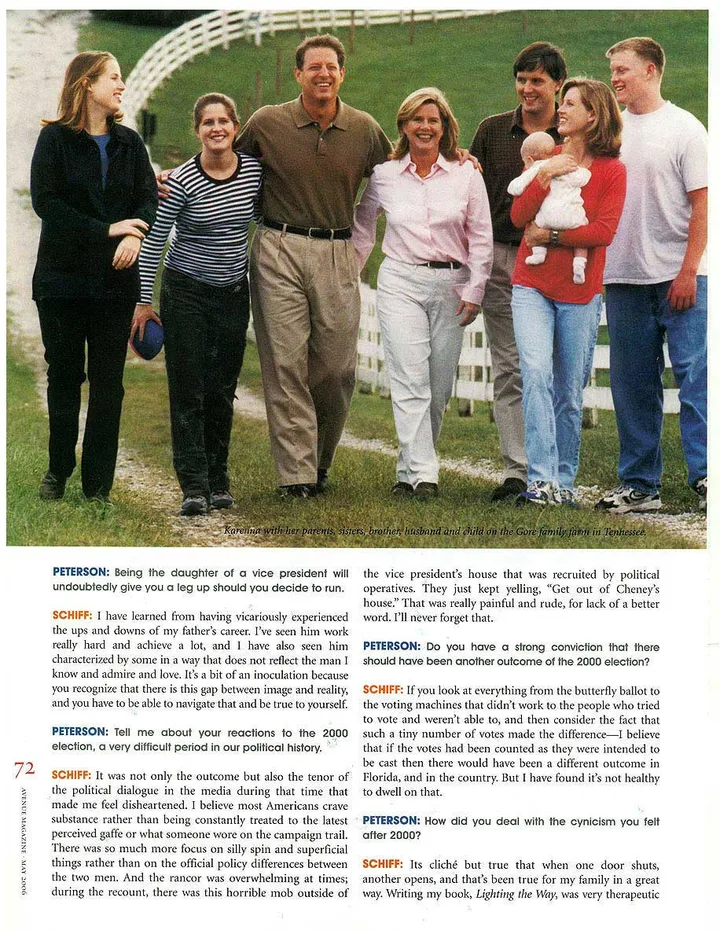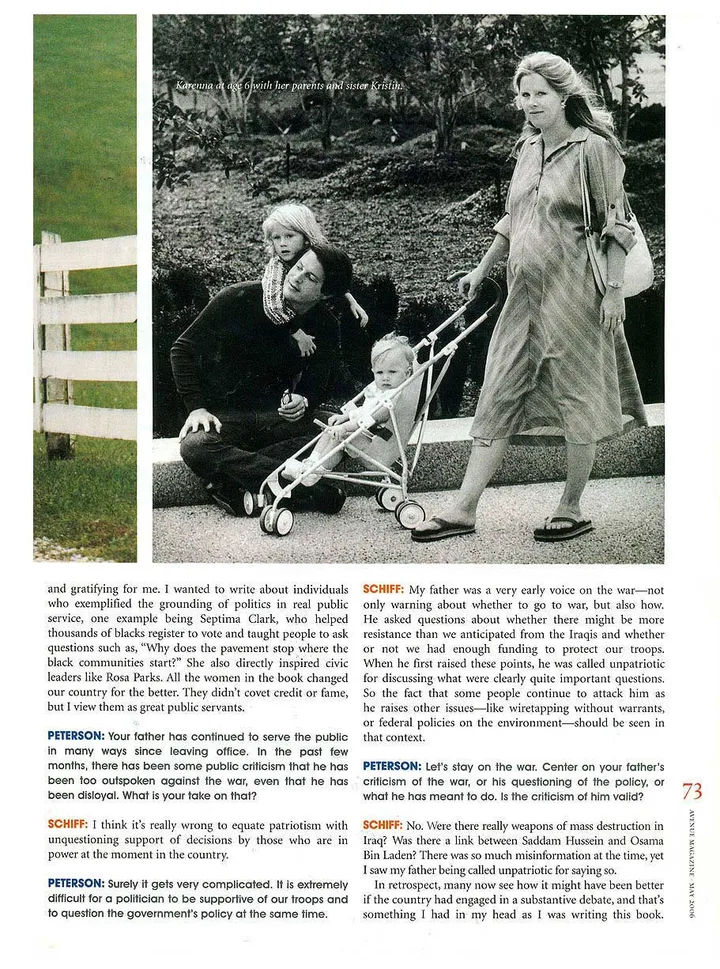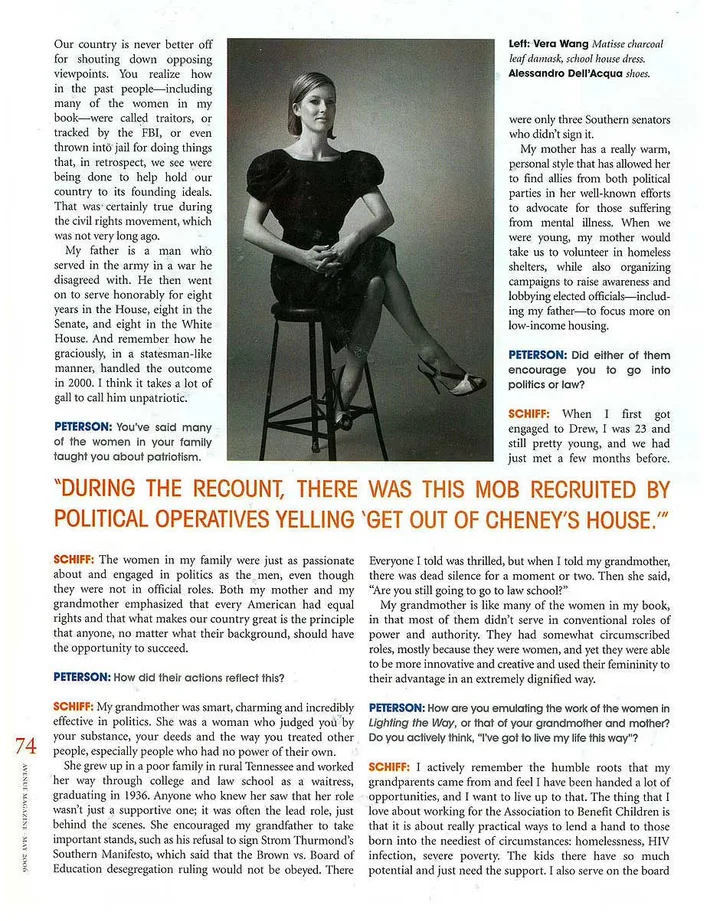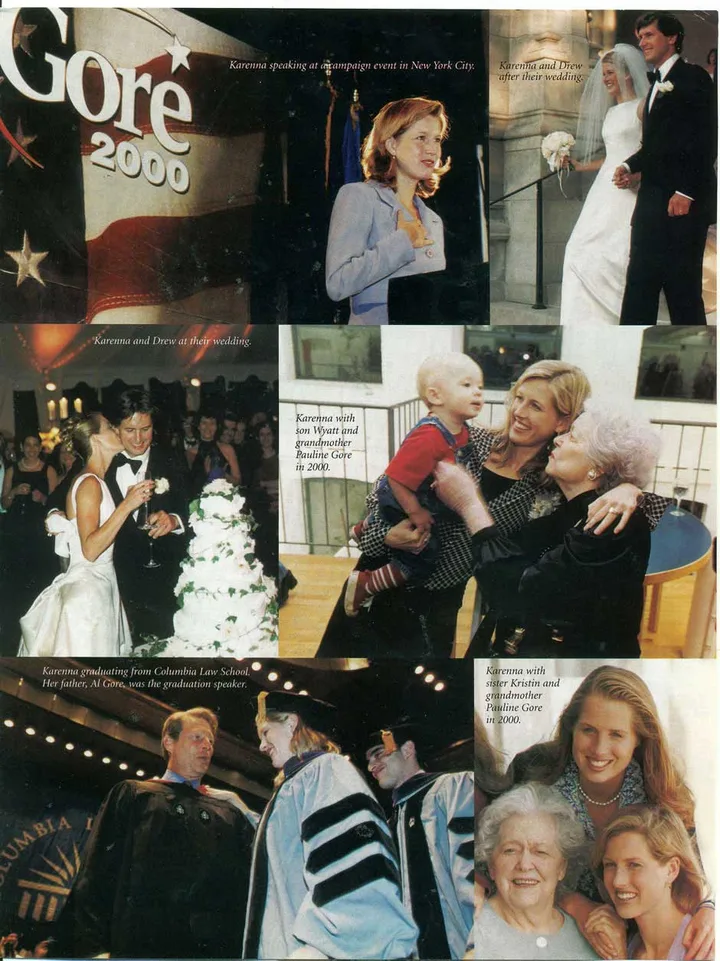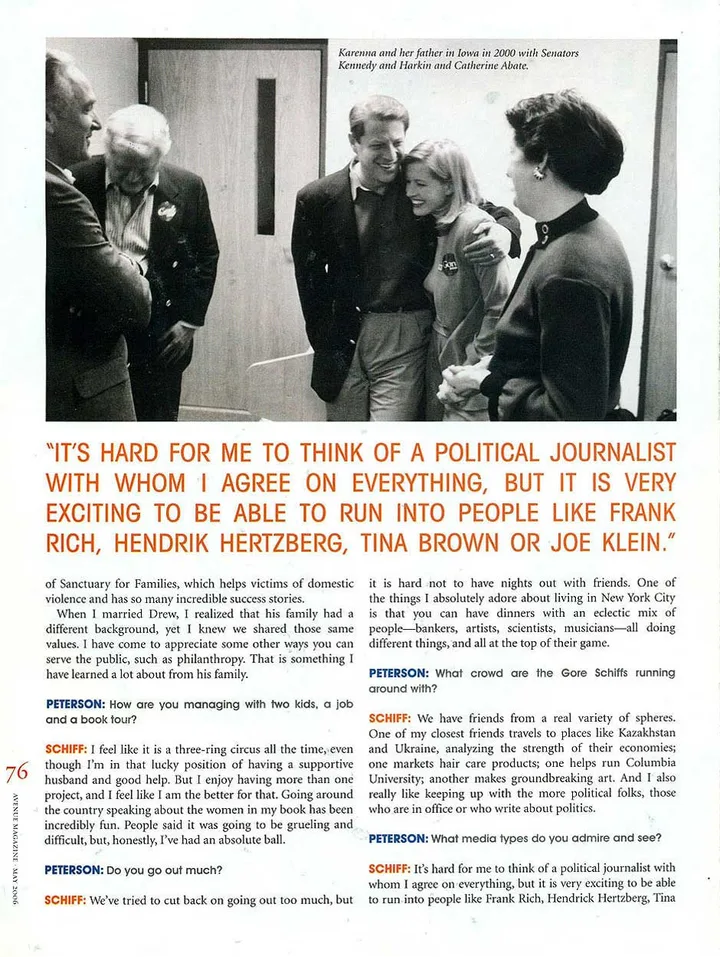
While most blue-eyed Southern blondes from good families are presented to society at cotillions, Karenna Gore’s debut occurred on the stage of the Democratic convention in 2000 as she nominated her father for president. It was the first time a national audience witnessed the poise and wisdom that years of political stumping had instilled in her. The eldest daughter of Al and Tipper Gore, educated at both Harvard University and Columbia Law School, she always stood by her father’s side—cheering at his victory parties at age 3, giving him witty one-liners along the way, and acting as a full-blown advisor during his last campaign.
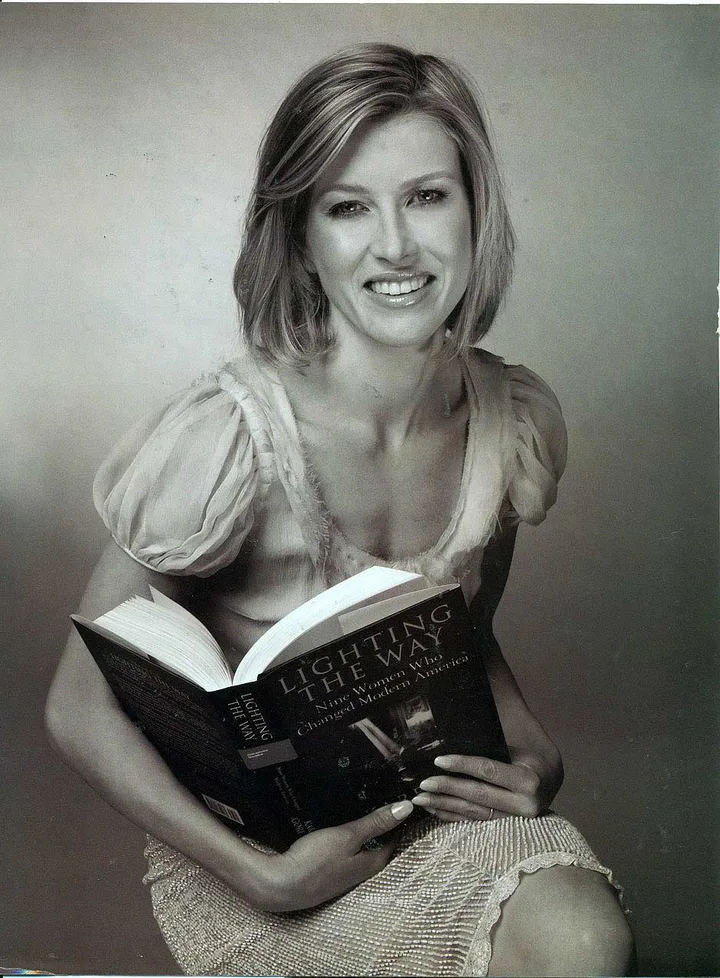
Coming off the cynicism and despair from the 2000 defeat, Karenna submerged herself in research about women who had changed American history from the inside out. The cathartic result: a brand new book, Lighting the Way: Nine Women Who Changed Modern America. She writes about Virginia Durr, an early opponent of segregation and racism, Alice Hamilton, a mentor to Eleanor Roosevelt who fought for workplace safety, and Mother Jones, the fiery labor organizer.
Karenna told Avenue the book helped remind her of the most important underlying goals of political service: to help the public and to sacrifice for those most in need.
Born and bred in Tennessee into the third generation of a political dynasty, Karenna never thought she’d become an ingrained Manhattanite. But she is happily ensconced in her East Side apartment with her husband, Dr. Drew Schiff, and two young children. She serves on four boards and works at the Association to Benefit Children, as there is no Gore family campaign to throw her passions into—at least for now.
PETERSON: The one question that always seems to pop into people’s minds when they see Karenna Gore across the room is this: Is she running for office? So?
SCHIFF: I honestly have no plans to run for office right now. If that path presents itself, it will be later on in my life. At this point, I’m busy trying to get my 4-year-old daughter to sleep in her bed through the night!
PETERSON: Do you have the personality and the stomach for a political run?
SCHIFF: I have to say, I do love politics. I love being a part of campaigns from the inside: public speaking, policy debates, and meeting people of all different backgrounds. Of course there are aspects that aren’t as appealing, like fundraising and what seems to be the inevitable loss of privacy.
PETERSON: Being the daughter of a vice president will undoubtedly give you a leg up should you decide to run.
SCHIFF: As I have learned from having vicariously experienced the ups and downs of my father’s career, I’ve seen him work really hard and achieve a lot, and I have also seen him characterized by some in a way that does not reflect the man I know and admire and love. It’s a bit of an inoculation because you recognize that there is this gap between image and reality, and you have to be able to navigate that and be true to yourself.
PETERSON: Tell me about your reactions to the 2000 election, a very difficult period in our political history.
SCHIFF: It was not only the outcome but also the tenor of the political dialogue in the media during that time that made me feel disheartened. I believe most Americans crave substance rather than being constantly treated to the latest perceived gaffe or what someone wore on the campaign trail. There was so much more focus on silly spin and superficial things rather than on the official policy differences between the two men. And the rancor was overwhelming at times; during the recount, there was this horrible mob outside of the vice president’s house that was recruited by political operatives. They just kept yelling, “Get out of Cheney’s house.” That was really painful and rude, for lack of a better word. I’ll never forget that.
PETERSON: Do you have a strong conviction that there should have been another outcome of the 2000 election?
SCHIFF: If you look at everything from the butterfly ballot to the voting machines that didn’t work to the people who tried to vote and weren’t able to, and then consider the fact that such a tiny number of votes made the difference—I believe that if the votes had been counted as they were intended to be cast then there would have been a different outcome in Florida, and in the country. But I have found it’s not healthy to dwell on that.
PETERSON: How did you deal with the cynicism you felt after 2000?
SCHIFF: It’s cliché but true that when one door shuts, another opens, and that’s been true for my family in a great way. Writing my book, Lighting the Way, was very therapeutic and gratifying for me. I wanted to write about individuals who exemplified the grounding of politics in real public service, one example being Septima Clark, who helped thousands of blacks register to vote and taught people to ask questions such as, “Why does the pavement stop where the black communities start?” She also directly inspired civic leaders like Rosa Parks. All the women in the book changed our country for the better. They didn’t covet credit or fame, but I view them as great public servants.
PETERSON: Your father has continued to serve the public in many ways since leaving office. In the past few months, there has been some public criticism that he has been too outspoken against the war, even that he has been disloyal. What is your take on that?
SCHIFF: I think it’s really wrong to equate patriotism with unquestioning support of decisions by those who are in power at the moment in the country.
PETERSON: Surely it gets very complicated. It is extremely difficult for a politician to be supportive of our troops and to question the government’s policy at the same time.
SCHIFF: My father was a very early voice on the war—not only warning about whether to go to war, but also how. He asked questions about whether there might be more resistance than we anticipated from the Iraqis and whether or not we had enough funding to protect our troops. When he first raised these points, he was called unpatriotic for discussing what were clearly quite important questions. So the fact that some people continue to attack him as he raises other issues—like wiretapping without warrants, or federal policies on the environment—should be seen in that context.
PETERSON: Let’s stay on the war. Center on your father’s criticism of the war, or his questioning of the policy, or what he has meant to do. Is the criticism of him valid?
SCHIFF: No. Were there really weapons of mass destruction in Iraq? Was there a link between Saddam Hussein and Osama Bin Laden? There was so much misinformation at the time, yet I saw my father being called unpatriotic for saying so.
In retrospect, many now see how it might have been better if the country had engaged in a substantive debate, and that’s something I had in my head as I was writing this book.
Our country is never better off for shouting down opposing viewpoints. You realize how in the past, people—including many of the women in my book—were called traitors, or tracked by the FBI, or even thrown into jail for doing things that, in retrospect, we see were being done to help hold our country to its founding ideals. That was certainly true during the civil rights movement, which was not very long ago.
My father is a man who served in the army in a war he disagreed with. He then went on to serve honorably for eight years in the House, eight in the Senate, and eight in the White House. And remember how he graciously, in a statesman-like manner, handled the outcome in 2000. I think it takes a lot of gall to call him unpatriotic.
PETERSON: You’ve said many of the women in your family taught you about patriotism.
SCHIFF: The women in my family were just as passionate about and engaged in politics as the men, even though they were not in official roles. Both my mother and my grandmother emphasized that every American had equal rights and that what makes our country great is the principle that anyone, no matter what their background, should have the opportunity to succeed.
PETERSON: How did their actions reflect this?
SCHIFF: My grandmother was smart, charming and incredibly effective in politics. She was a woman who judged you by your substance, your deeds and the way you treated other people, especially people who had no power of their own. She grew up in a poor family in rural Tennessee and worked her way through college and law school as a waitress, graduating in 1936. Anyone who knew her saw that her role wasn’t just a supportive one; it was often the lead role, just behind the scenes. She encouraged my grandfather to take important stands, such as his refusal to sign Strom Thurmond’s Southern Manifesto, which said that the Brown vs. Board of Education desegregation ruling would not be obeyed. There were only three Southern senators who didn’t sign it.
My mother has a really warm, personal style that has allowed her to find allies from both political parties in her well-known efforts to advocate for those suffering from mental illness. When we were young, my mother would take us to volunteer in homeless shelters, while also organizing campaigns to raise awareness and lobbying elected officials—including my father—to focus more on low-income housing.
PETERSON: Did either of them encourage you to go into politics or law?
SCHIFF: When I first got engaged to Drew, I was 23 and still pretty young, and we had just met a few months before. Everyone I told was thrilled, but when I told my grandmother, there was dead silence for a moment or two. Then she said, “Are you still going to go to law school?”
My grandmother is like many of the women in my book, in that most of them didn’t serve in conventional roles of power and authority. They had somewhat circumscribed roles, mostly because they were women, and yet they were able to be more innovative and creative and used their femininity to their advantage in an extremely dignified way.
PETERSON: How are you emulating the work of the women in Lighting the Way, or that of your grandmother and mother? Do you actively think, “I’ve got to live my life this way”?
SCHIFF: I actively remember the humble roots that my grandparents came from and feel I have been handed a lot of opportunities, and I want to live up to that. The thing that I love about working for the Association to Benefit Children is that it is about really practical ways to lend a hand to those born into the neediest of circumstances: homelessness, HIV infection, severe poverty. The kids there have so much potential and just need the support. I also serve on the board of Sanctuary for Families, which helps victims of domestic violence and has so many incredible success stories.
When I married Drew, I realized that his family had a different background, yet I knew we shared those same values. I have come to appreciate some other ways you can serve the public, such as philanthropy. That is something I have learned a lot about from his family.
PETERSON: How are you managing with two kids, a job and a book tour?
SCHIFF: I feel like it is a three-ring circus all the time, even though I’m in that lucky position of having a supportive husband and good help. But I enjoy having more than one project, and I feel like I am the better for that. Going around the country speaking about the women in my book has been incredibly fun. People said it was going to be grueling and difficult, but, honestly, I’ve had an absolute ball.
PETERSON: Do you go out much?
SCHIFF: We’ve tried to cut back on going out too much, but it is hard not to have nights out with friends. One of the things I absolutely adore about living in New York City is that you can have dinners with an eclectic mix of people—bankers, artists, scientists, musicians—all doing different things, and all at the top of their game.
PETERSON: What crowd are the Gore Schiffs running around with?
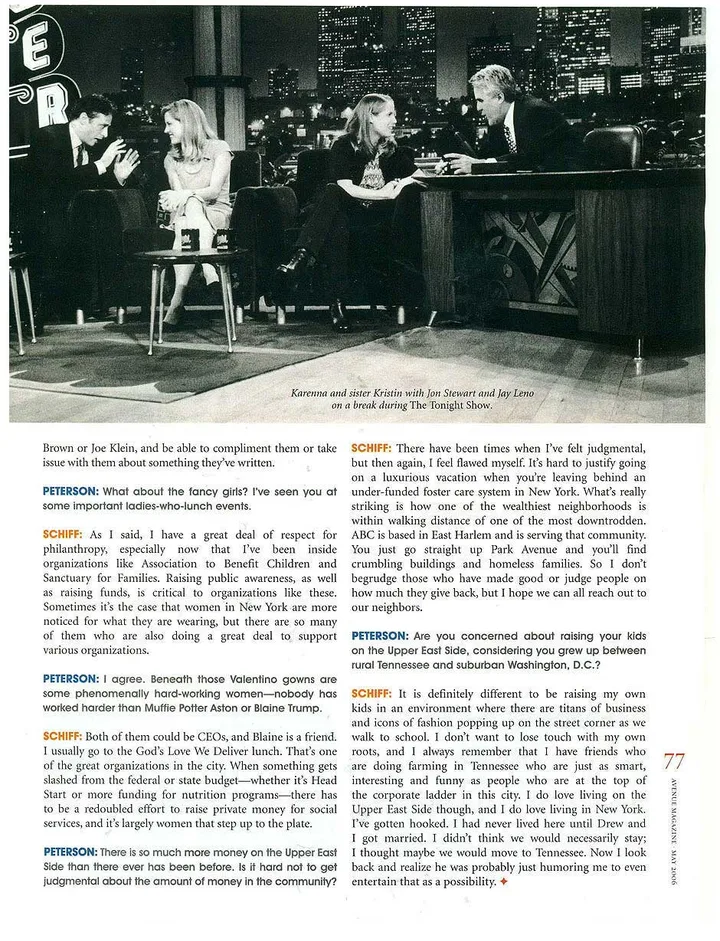
SCHIFF: We have friends from a real variety of spheres. One of my closest friends travels to places like Kazakhstan and Ukraine, analyzing the strength of their economies; one markets hair care products; one helps run Columbia University; another makes groundbreaking art. And I also really like keeping up with the more political folks, those who are in office or who write about politics.
PETERSON: What media types do you admire and see?
SCHIFF: It’s hard for me to think of a political journalist with whom I agree on everything, but it is very exciting to be able to run into people like Frank Rich, Hendrick Hertzberg, Tina Brown or Joe Klein, and be able to compliment them or take issue with them about something they’ve written.
PETERSON: What about the fancy girls? I’ve seen you at some important ladies-who-lunch events.
SCHIFF: As I said, I have a great deal of respect for philanthropy, especially now that I’ve been inside organizations like Association to Benefit Children and Sanctuary for Families. Raising public awareness, as well as raising funds, is critical to organizations like these. Sometimes it’s the case that women in New York are more noticed for what they are wearing, but there are so many of them who are also doing a great deal to support various organizations.
PETERSON: I agree. Beneath those Valentino gowns are some phenomenally hard-working women—nobody has worked harder than Muffie Potter Aston or Blaine Trump.
SCHIFF: Both of them could be CEOs, and Blaine is a friend. I usually go to the God’s Love We Deliver lunch. That’s one of the great organizations in the city. When something gets slashed from the federal or state budget—whether it’s Head Start or more funding for nutrition programs—there has to be a redoubled effort to raise private money for social services, and it’s largely women that step up to the plate.
PETERSON: There is so much more money on the Upper East Side than there ever has been before. Is it hard not to get judgmental about the amount of money in the community?
SCHIFF: There have been times when I’ve felt judgmental, but then again, I feel flawed myself. It’s hard to justify going on a luxurious vacation when you’re leaving behind an under-funded foster care system in New York. What’s really striking is how one of the wealthiest neighborhoods is within walking distance of one of the most downtrodden. ABC is based in East Harlem and is serving that community. You just go straight up Park Avenue and you’ll find crumbling buildings and homeless families. So I don’t begrudge those who have made good or judge people on how much they give back, but I hope we can all reach out to our neighbors.
PETERSON: Are you concerned about raising your kids on the Upper East Side, considering you grew up between rural Tennessee and suburban Washington, D.C.?
SCHIFF: It is definitely different to be raising my own kids in an environment where there are titans of business and icons of fashion popping up on the street corner as we walk to school. I don’t want to lose touch with my own roots, and I always remember that I have friends who are doing farming in Tennessee who are just as smart, interesting and funny as people who are at the top of the corporate ladder in this city. I do love living on the Upper East Side though, and I do love living in New York. I’ve gotten hooked. I had never lived here until Drew and I got married. I didn’t think we would necessarily stay; I thought maybe we would move to Tennessee. Now I look back and realize he was probably just humoring me to even entertain that as a possibility.