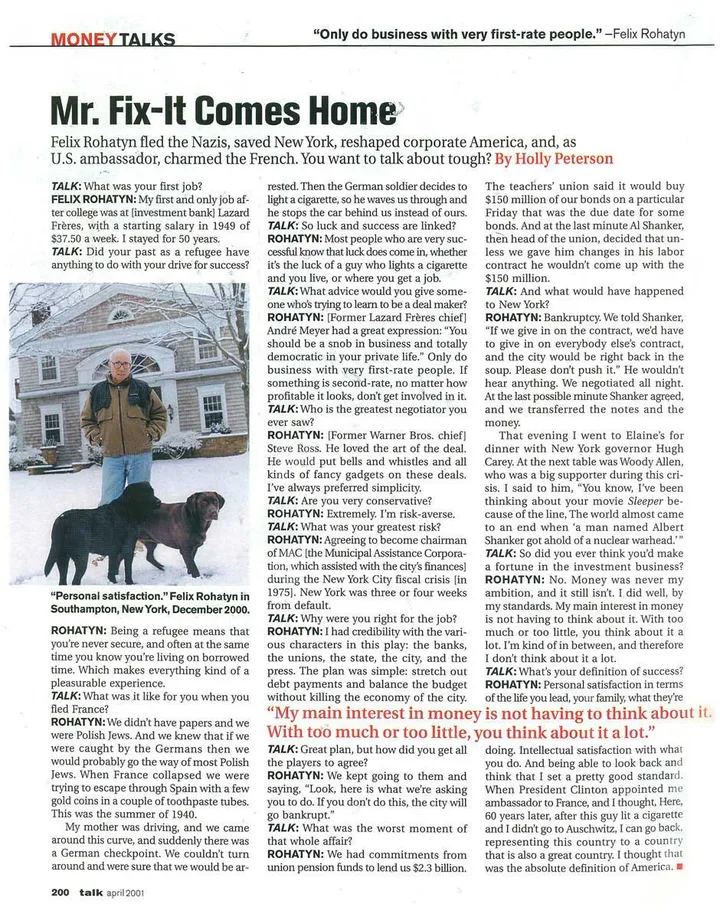
“Only do business with very first-rate people.” —Felix Rohatyn
What was your first job? My first and only job after college was at investment bank Lazard Frères, with a starting salary in 1949 of $37.50 a week. I stayed for 50 years.
Did your past as a refugee have anything to do with your drive for success? Being a refugee means that you’re never secure, and often at the same time you know you’re living on borrowed time. Which makes everything kind of a pleasurable experience.
What was it like for you when you fled France? We didn’t have papers and we were Polish Jews. And we knew that if we were caught by the Germans then we would probably go the way of most Polish Jews. When France collapsed we were trying to escape through Spain with a few gold coins in a couple of toothpaste tubes. This was the summer of 1940. My mother was driving, and we came around this curve, and suddenly there was a German checkpoint. We couldn’t turn around and were sure that we would be arrested. Then the German soldier decides to light a cigarette, so he waves us through and he stops the car behind us instead of ours.
So luck and success are linked? Most people who are very successful know that luck does come in, whether it’s the luck of a guy who lights a cigarette and you live, or where you get a job.
What advice would you give someone who’s trying to learn to be a deal maker? Former Lazard Frères chief André Meyer had a great expression: “You should be a snob in business and totally democratic in your private life.” Only do business with very first-rate people. If something is second-rate, no matter how profitable it looks, don’t get involved in it.
Who is the greatest negotiator you ever saw? Former Warner Bros. chief Steve Ross. He loved the art of the deal. He would put bells and whistles and all kinds of fancy gadgets on these deals. I’ve always preferred simplicity.
Are you very conservative? Extremely. I’m risk-averse.
What was your greatest risk? Agreeing to become chairman of MAC—the Municipal Assistance Corporation, which assisted with the city’s finances—during the New York City fiscal crisis in 1975. New York was three or four weeks from default.
Why were you right for the job? I had credibility with the various characters in this play: the banks, the unions, the state, the city, and the press. The plan was simple: stretch out debt payments and balance the budget without killing the economy of the city.
Great plan, but how did you get all the players to agree? We kept going to them and saying, “Look, here is what we’re asking you to do. If you don’t do this, the city will go bankrupt.”
What was the worst moment of that whole affair? We had commitments from union pension funds to lend us $2.3 billion. The teachers’ union said it would buy $150 million of our bonds on a particular Friday that was the due date for some bonds. And at the last minute Al Shanker, then head of the union, decided that unless we gave him changes in his labor contract he wouldn’t come up with the $150 million.
And what would have happened to New York? Bankruptcy. We told Shanker, “If we give in on the contract, we’d have to give in on everybody else’s contract, and the city would be right back in the soup. Please don’t push it.” He wouldn’t hear anything. We negotiated all night. At the last possible minute Shanker agreed, and we transferred the notes and the money. That evening I went to Elaine’s for dinner with New York governor Hugh Carey. At the next table was Woody Allen, who was a big supporter during this crisis. I said to him, “You know, I’ve been thinking about your movie Sleeper because of the line, ‘The world almost came to an end when a man named Albert Shanker got ahold of a nuclear warhead.’”
So did you ever think you’d make a fortune in the investment business? No. Money was never my ambition, and it still isn’t. I did well, by my standards. My main interest in money is not having to think about it. With too much or too little, you think about it a lot. I’m kind of in between, and therefore I don’t think about it a lot.
What’s your definition of success? Personal satisfaction in terms of the life you lead, your family, what they’re doing. Intellectual satisfaction with what you do. And being able to look back and think that I set a pretty good standard. When President Clinton appointed me ambassador to France, and I thought, Here, 60 years later, after this guy lit a cigarette and I didn’t go to Auschwitz, I can go back, representing this country to a country that is also a great country. I thought that was the absolute definition of America.