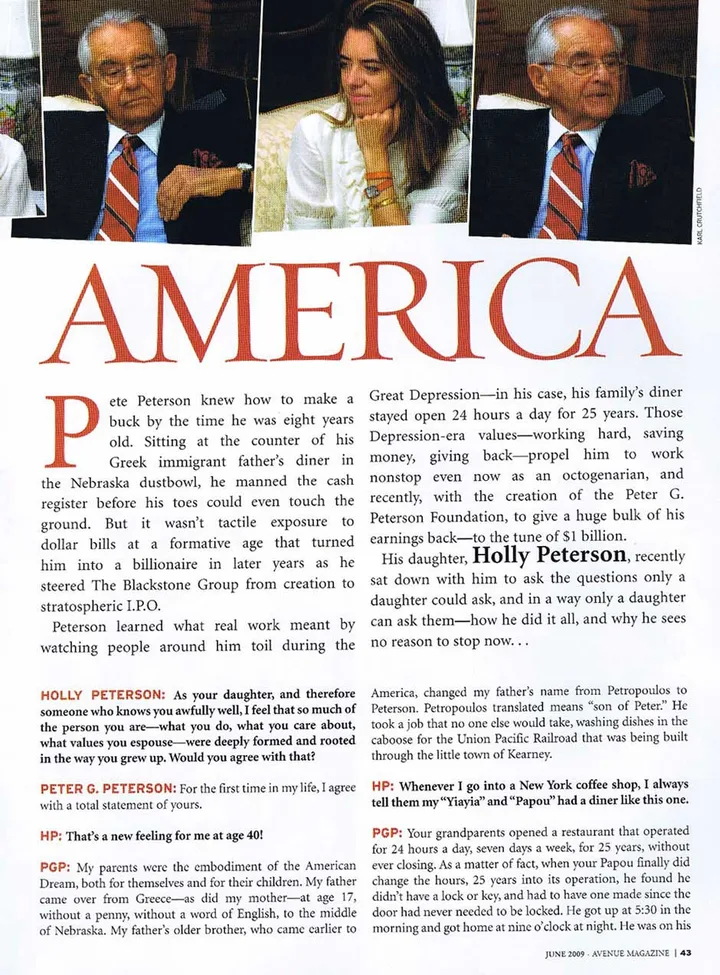
Pete Peterson knew how to make a buck by the time he was eight years old. Sitting at the counter of his Greek immigrant father’s diner in the Nebraska dustbowl, he manned the cash register before his toes could even touch the ground. But it wasn’t tactile exposure to dollar bills at a formative age that turned him into a billionaire in later years as he steered The Blackstone Group from creation to stratospheric I.P.O.
Peterson learned what real work meant by watching people around him toil during the Great Depression — in his case, his family’s diner stayed open 24 hours a day for 25 years. Those Depression-era values — working hard, saving money, giving back — propel him to work nonstop even now as an octogenarian, and recently, with the creation of the Peter G. Peterson Foundation, to give a huge bulk of his earnings back — to the tune of $1 billion.
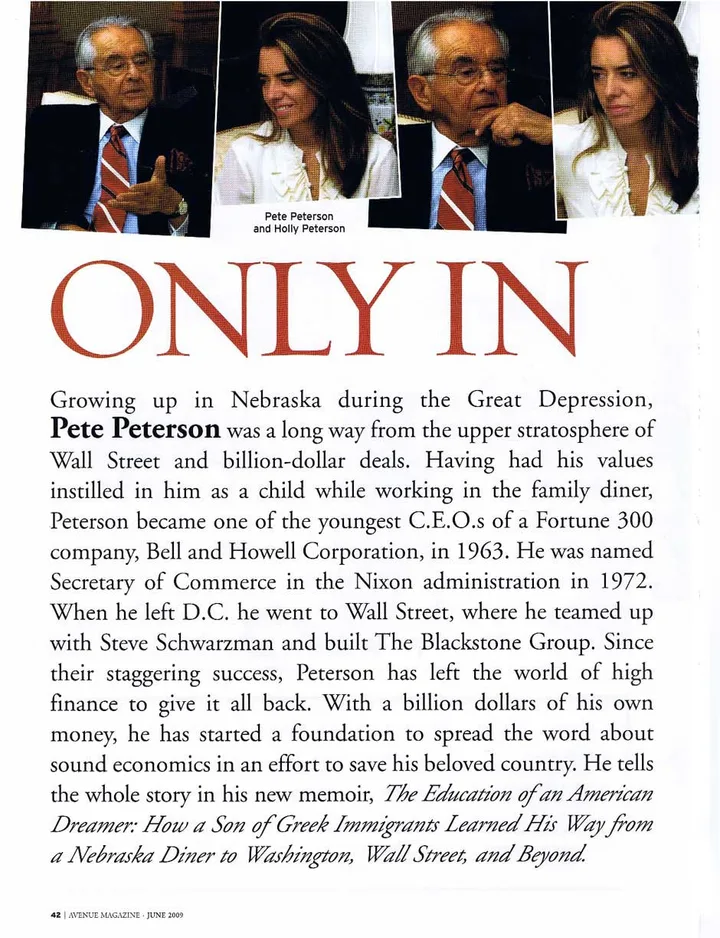
His daughter, Holly Peterson, recently sat down with him to ask the questions only a daughter could ask, and in a way only a daughter can ask them — how he did it all, and why he sees no reason to stop now…
HOLLY PETERSON: As your daughter, and therefore someone who knows you awfully well, I feel that so much of the person you are — what you do, what you care about, what values you espouse — were deeply formed and rooted in the way you grew up. Would you agree with that?
PETER G. PETERSON: For the first time in my life, I agree with a total statement of yours.
HP: That’s a new feeling for me at age 40!
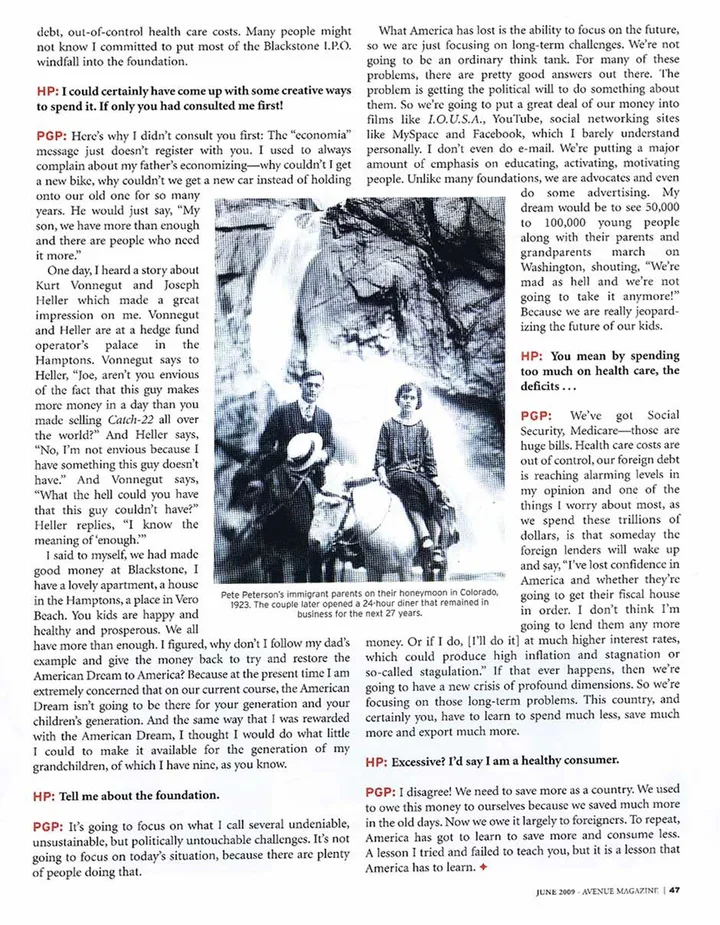
PGP: My parents were the embodiment of the American Dream, both for themselves and for their children. My father came over from Greece — as did my mother — at age 17, without a penny, without a word of English, to the middle of Nebraska. My father’s older brother, who came earlier to America, changed my father’s name from Petropoulos to Peterson. Petropoulos translated means “son of Peter.” He took a job that no one else would take, washing dishes in the caboose for the Union Pacific Railroad that was being built through the little town of Kearney.
HP: Whenever I go into a New York coffee shop, I always tell them my “Yiayia” and “Papou” had a diner like this one.
PGP: Your grandparents opened a restaurant that operated for 24 hours a day, seven days a week, for 25 years, without ever closing. As a matter of fact, when your Papou finally did change the hours, 25 years into its operation, he found he didn’t have a lock or key, and had to have one made since the door had never needed to be locked. He got up at 5:30 in the morning and got home at nine o’clock at night. He was on his feet during much of that time. As a child, I can remember the varicose veins in his legs. So he was the model of work or, more accurately, a workaholic. I started working in the restaurant taking cash at the age of eight. So I had early training in working for a living. The other thing he did, aside from establishing the notion of work and achievement, was to always emphasize “economia” — saving money. For example, he had a sign in the washroom which said to the customers: “Why use two paper towels when one will do?”
HP: Give me some examples of your economizing and saving.
PGP: Like many, I suppose, who were brought up in the Depression with the tradition of saving and economizing, I just can’t stop doing it. My wife accuses me today of neurotic economizing, where I will buy something on sale that I probably don’t even need, just to save the money. My father also generously gave back, not only to his family in Greece, but also to the community. In the middle of the Depression, I remember he would never turn away what they used to call bums — homeless, unemployed workers — who were looking for something to eat. He would have them do some work around the restaurant in exchange for the meal, his own version of work-for-welfare. So from him I learned philanthropy, I learned giving back, I learned savings and I learned hard work. And I’ve tried to apply those lessons every day of my adult life.
HP: So, if I had you as an example, how come I never learned any of these things, or applied them in any way in my own adult life?!
PGP: Well, I didn’t say I was a great father, or that you were even trainable.
HP: On the career front, I’m always fascinated with people who rise to the top rather quickly. I was in television for a long time. Jeff Zucker and I were both production assistants making $24,000 a year at network news divisions. He is now running all of NBC Universal, making millions, and we’re the same age and started at the same time. What did he have that got him to the top? And what do you have that has always got you to the top? Whether it was advertising, marketing, becoming C.E.O. of Bell and Howell at age 36 and one of the youngest C.E.O.s of a Fortune 300 company or going to the Nixon cabinet at 45. Why did you leapfrog over people? There are a lot of confident, hard-working, really smart people who don’t go above a certain level, and watch the Pete Petersons and Jeff Zuckers and ask, “What the hell are they doing that I’m not?”
PGP: I have had some psychotherapy in order to gain some understanding of what drives me. We determined that one of the things that drove me was a tragedy in our family when I was four years old. For my mother, being a Greek wife with a workaholic husband wasn’t easy. She derived enormous pleasure from her little girl named Elaine, who died at the age of one from the sudden onset of croup.
My mother then descended into a deep melancholia. I had been used to being the number one son, the prince, and all of a sudden my mother descended into loneliness and depression, which I interpreted as abandonment of me or perhaps even caused by me. I had to figure out how to get my mother’s attention. I decided on a strategy to overachieve, and to be the perfect son. So I had to get more gold stars than anybody, I had to get better grades than anybody. I had to behave better than anyone. I think I set a pattern of achievement and perfection that became a very important part of my life.
HP: We always argue whether luck played any role in your success. I say no — it was your monster-sized brain and your out-of-this-stratosphere drive.
PGP: Let me give you an example of my dumb luck. I was walking down LaSalle Street in Chicago one day when I was about 22 and working for a marketing firm at 39 South LaSalle. All of a sudden, I looked up at 19 South LaSalle and there was a sign for the University of Chicago graduate school of business downtown. I said to myself “God, that sounds far more convenient than Northwestern. The University of Chicago is a pretty good school. Why don’t I go there for my MBA?” That turned out to be one of the luckiest things that ever happened to me because I fell in love with some utterly brilliant professors, Milton Friedman and George Stigler, both Nobel Prize winners who informed my career and guided my aspirations for many years to come.
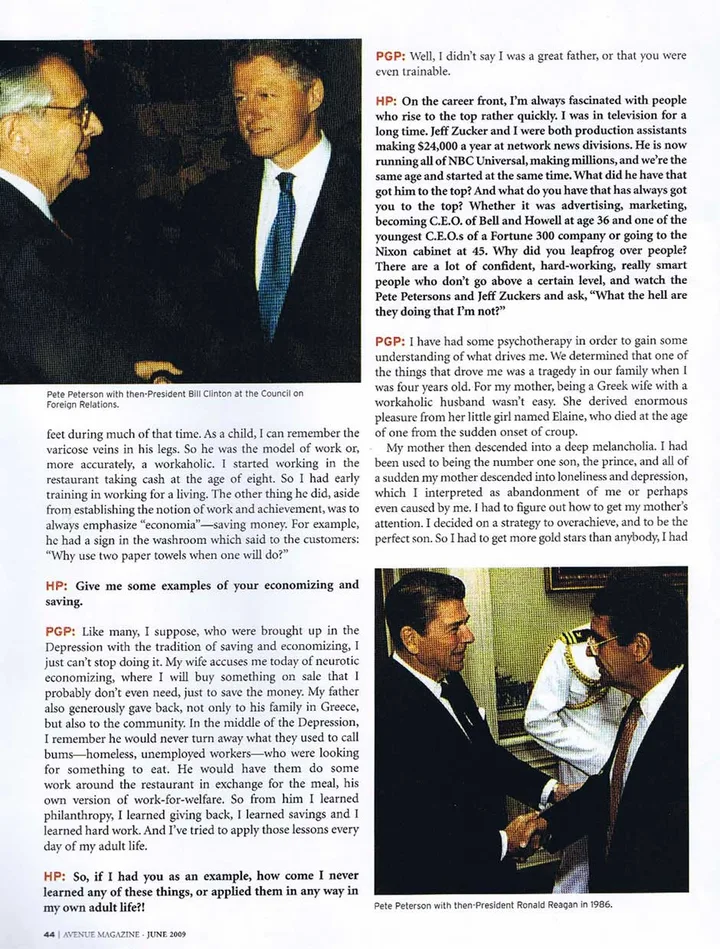
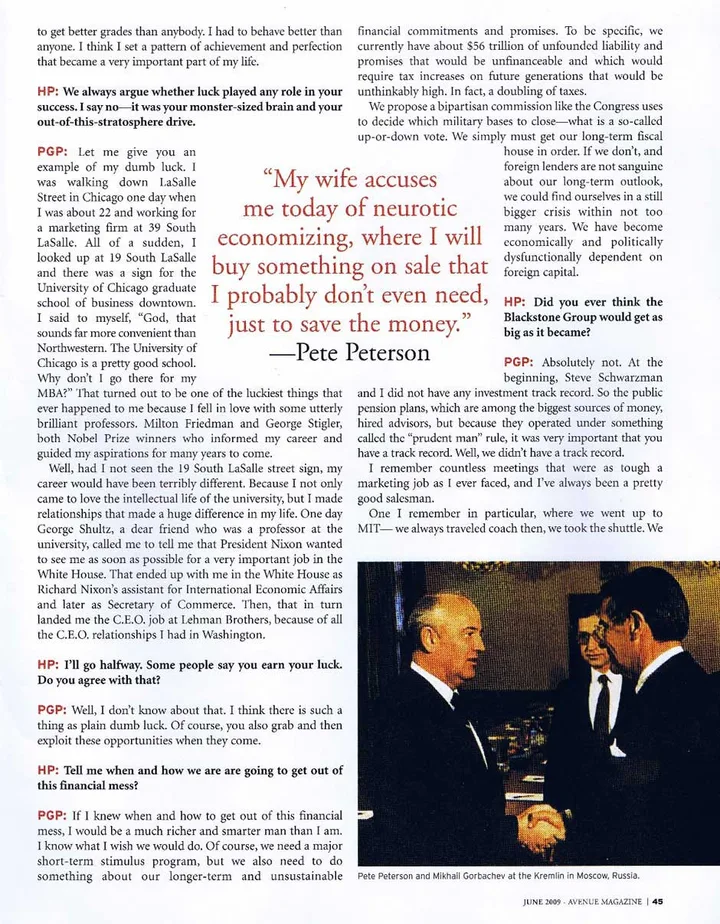
Well, had I not seen the 19 South LaSalle street sign, my career would have been terribly different. Because I not only came to love the intellectual life of the university, but I made relationships that made a huge difference in my life. One day George Shultz, a dear friend who was a professor at the university, called me to tell me that President Nixon wanted to see me as soon as possible for a very important job in the White House. That ended up with me in the White House as Richard Nixon’s assistant for International Economic Affairs and later as Secretary of Commerce. Then, that in turn landed me the C.E.O. job at Lehman Brothers, because of all the C.E.O. relationships I had in Washington.
HP: I’ll go halfway. Some people say you earn your luck. Do you agree with that?
PGP: Well, I don’t know about that. I think there is such a thing as plain dumb luck. Of course, you also grab and then exploit these opportunities when they come.
HP: Tell me when and how we are going to get out of this financial mess?
PGP: If I knew when and how to get out of this financial mess, I would be a much richer and smarter man than I am. I know what I wish we would do. Of course, we need a major short-term stimulus program, but we also need to do something about our longer-term and unsustainable financial commitments and promises. To be specific, we currently have about $56 trillion of unfunded liability and promises that would be unfinanceable and which would require tax increases on future generations that would be unthinkably high. In fact, a doubling of taxes.
We propose a bipartisan commission like the Congress uses to decide which military bases to close — what is a so-called up-or-down vote. We simply must get our long-term fiscal house in order. If we don’t, and foreign lenders are not sanguine about our long-term outlook, we could find ourselves in a still bigger crisis than the one we’ve had in many years. We have become economically and politically dangerously dependent on foreign capital.
HP: Did you ever think the Blackstone Group would get as big as it became?
PGP: Absolutely not. At the beginning, Steve Schwarzman and I did not have any investment track record. So the public pension plans, which are among the biggest sources of money, hired advisors, but because they operated under something called the “prudent man” rule, it was very important that you have a track record. Well, we didn’t have a track record.
I remember countless meetings that were as tough a marketing job as I ever faced, and I’ve always been a pretty good salesman.
One I remember in particular, where we went up to MIT — we always traveled coach then, we took the shuttle. We had sent the MIT employee pension fund a book on what Blackstone was all about, which honestly wasn’t terribly long because we hadn’t raised any money or done any investments yet. We get there and there is a woman meeting us who must have been all of 26 years old.
Now here I was, a former cabinet officer, the former chairman of Lehman Brothers, making a pitch to a 26-year-old. And that was just the beginning. She had no idea why we were there. She hadn’t read our proposal and besides, she said they weren’t interested in private equity. They were only interested in venture investments, which we didn’t do. So it was a total waste. In those days, our business couldn’t afford limousines. So Steve and I go out into Massachusetts Avenue in the middle of a terrific downpour, where we were soaked head to foot. It took us 45 minutes to hail a cab and we arrive at the airport drenched. I could tell you 10 experiences like that one.
I went to Japan for two weeks to raise money once. Do you remember that movie Lost in Translation? Just like that, I’d wake up in the middle of the night and be staring out those windows at the lights. We’d meet with the Japanese and, because of my government experience, some of them had heard of me so they would try to treat me with courtesy, but we’d end up often with certain of the Japanese falling asleep during the presentation because most of them had no interest whatsoever in private equity. They didn’t even understand it. So it was a very long, hard struggle to start up the firm.
Fortunately, we had personal relationships which had built up over the years. The Prudential Life Insurance Company, which was the biggest company in the whole business, called one day and said why don’t we come out to lunch, and at that lunch, Mr. Garnett Keith, the vice chairman, and I’ll never forget it, said that they were going to put in $100 million with us, and that was to be the lead investor. Well, that was the happiest day of our lives. But it took us two years to raise that money. It was a very, very discouraging, hard task.
HP: Did the I.P.O. surprise you?
PGP: I always assumed we would stay private. I had been in a public company and there’s a lot to be said for being private. I told Steve Schwarzman that I had been public and I had been private, and being public was a very different experience. There were a lot of security analysts who would be asking questions, quarterly reports, disclosure of compensation, and I remember telling him he would be the focal point, as C.E.O., of too much praise, perhaps, but also too much criticism. I told him his personal life will be amplified in ways that he may not like. I just wanted to be sure he was aware of the downside. He finally decided that’s what he wanted to do.
Now I had no idea what the valuation of Blackstone would be. When they came in and said that “little old Blackstone,” as I used to refer to it, was worth $31 billion, I was just totally astonished. Because I had already planned to retire at the end of 2008, this was a total windfall. So all of a sudden I found myself in a position I never thought I would be: an instant billionaire.
HP: And where did you put that money and why isn’t any of it in my shoe budget?
PGP: Why don’t you write another dirty novel and make your own money? Besides, I have lofty plans for all this money, to help you and your kids’ generations!
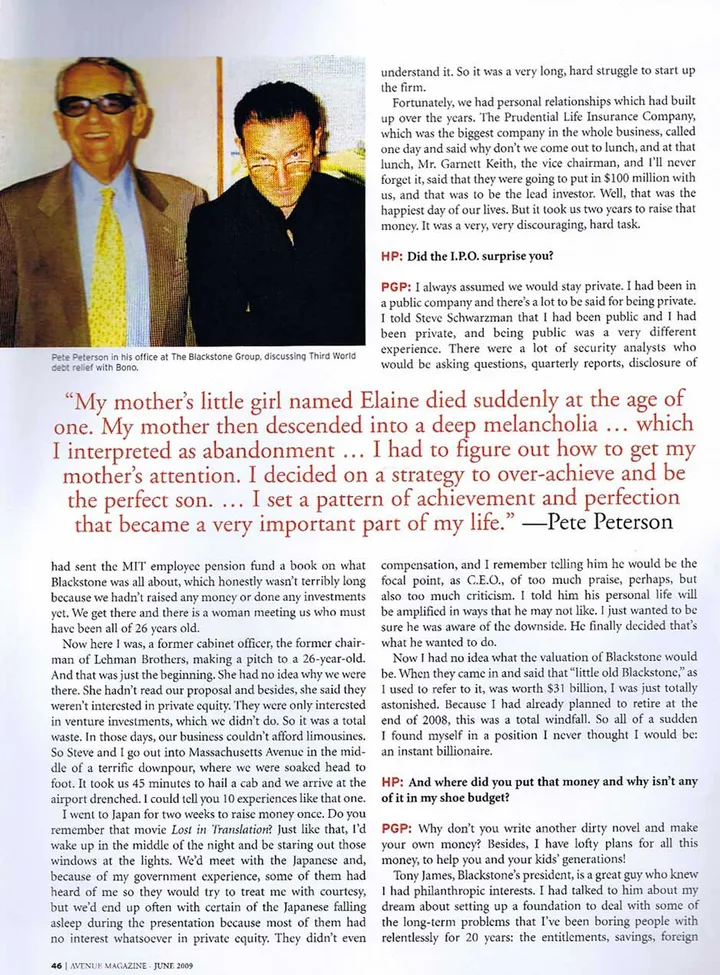
Tony James, Blackstone’s president, is a great guy who knew I had philanthropic interests. I had talked to him about my dream about setting up a foundation to deal with some of the long-term problems that I’ve been boring people with relentlessly for 20 years: the entitlements, savings, foreign debt, out-of-control health care costs. Many people might not know I committed to put most of the Blackstone I.P.O. windfall into the foundation.
HP: I could certainly have come up with some creative ways to spend it. If only you had consulted me first!
PGP: Here’s why I didn’t consult you first: The “economia” message just doesn’t register with you. I used to always complain about my father’s economizing — why couldn’t I get a new bike, why couldn’t we get a new car instead of holding onto our old one for so many years. He would just say, “My son, we have more than enough and there are people who need it more.”
One day, I heard a story about Kurt Vonnegut and Joseph Heller which made a great impression on me. Vonnegut and Heller are at a hedge fund operator’s palace in the Hamptons. Vonnegut says to Heller, “Joe, aren’t you envious of the fact that this guy makes more money in a day than you made selling Catch-22 all over the world?” And Heller says, “No, I’m not envious because I have something this guy doesn’t have.” And Vonnegut says, “What the hell could you have that this guy couldn’t have?” Heller replies, “I know the meaning of enough.”
I said to myself, we had made good money at Blackstone, I have a lovely apartment, a house in the Hamptons, a place in Vero Beach. You kids are happy and healthy and prosperous. We all have more than enough. I figured, why don’t I follow my dad’s example and give the money back to try and restore the American Dream to America? Because at the present time I am extremely concerned that on our current course, the American Dream isn’t going to be there for your generation and your children’s generation. And the same way that I was rewarded with the American Dream, I thought I would do what little I could to make it available for the generation of my grandchildren, of which I have nine, as you know.
HP: Tell me about the foundation.
PGP: It’s going to focus on what I call several undeniable, unsustainable, but politically untouchable challenges. It’s not going to focus on today’s situation, because there are plenty of people doing that. What America has lost is the ability to focus on the future, so we are just focusing on long-term challenges. We’re not going to be an ordinary think tank. For many of these problems, there are pretty good answers out there. The problem is getting the political will to do something about them. So we’re going to put a great deal of our money into films like I.O.U.S.A., YouTube, social networking sites like MySpace and Facebook, which I barely understand personally. I don’t even do e-mail. We’re putting a major amount of emphasis on educating, activating, motivating people. Unlike many foundations, we are advocates and even do some advertising. My dream would be to see 50,000 to 100,000 young people along with their parents and grandparents march on Washington, shouting, “We’re mad as hell and we’re not going to take it anymore!” Because we are really jeopardizing the future of our kids.
HP: You mean by spending too much on health care, the deficits…
PGP: We’ve got Social Security, Medicare — those are huge bills. Health care costs are out of control, our foreign debt is reaching alarming levels in my opinion and one of the things I worry about most, as we spend these trillions of dollars, is that someday the foreign lenders will wake up and say, “I’ve lost confidence in America and whether they’re going to get their fiscal house in order. I don’t think I’m going to lend them any more money. Or if I do, at much higher interest rates, which could produce high inflation and stagnation or so-called stagflation.” If that ever happens, then we’re going to have a new crisis of profound dimensions. So we’re focusing on those long-term problems. This country, and certainly you, have to learn to spend much less, save much more and export much more.
HP: Excessive? I’d say I am a healthy consumer.
PGP: I disagree! We need to save more as a country. We used to owe this money to ourselves because we saved much more in the old days. Now we owe it largely to foreigners. To repeat, America has got to learn to save more and consume less. A lesson I tried and failed to teach you, but it is a lesson that America has to learn.