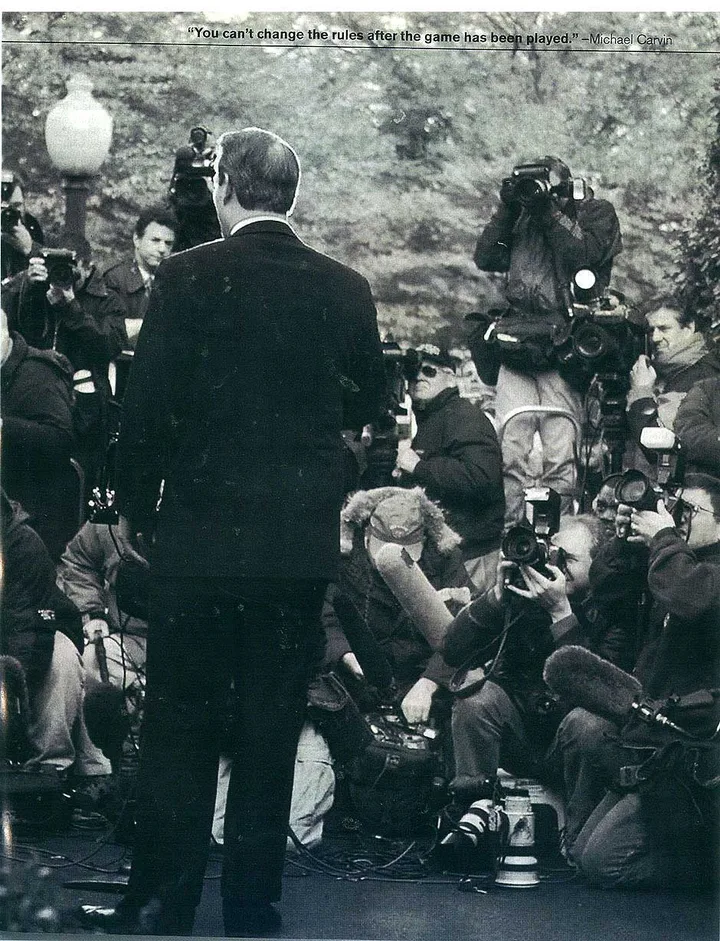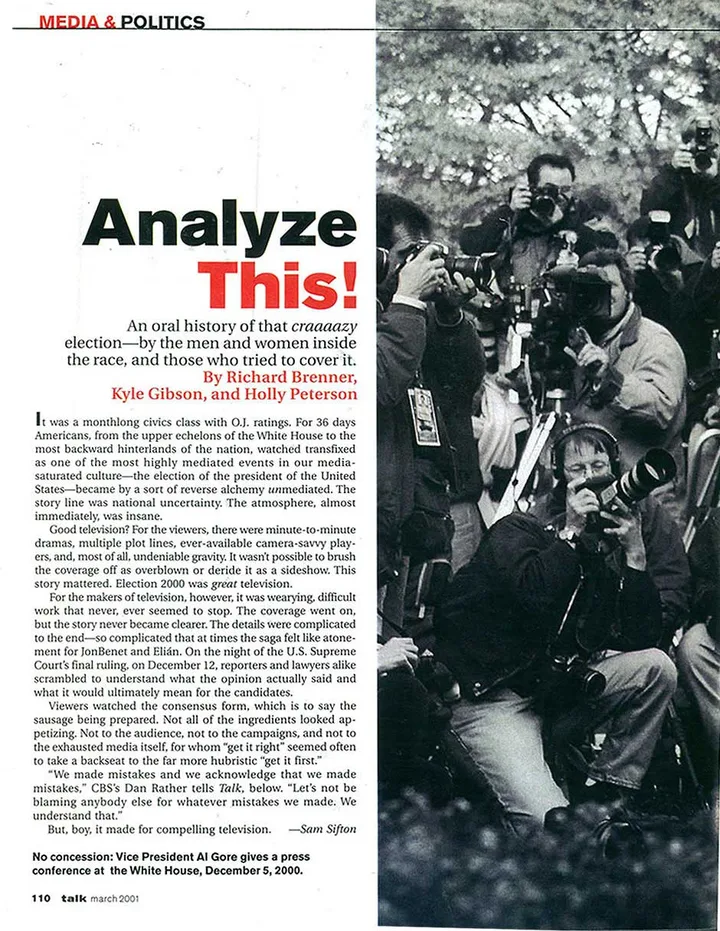
It was a monthlong civics class with O.J. ratings. For 36 days Americans, from the upper echelons of the White House to the most backward hinterlands of the nation, watched transfixed as one of the most highly mediated events in our media-saturated culture—the election of the president of the United States—became by a sort of reverse alchemy unmediated. The story line was national uncertainty. The atmosphere, almost immediately, was insane.
Good television? For the viewers, there were minute-to-minute dramas, multiple plot lines, ever-available camera-savvy players, and, most of all, undeniable gravity. It wasn’t possible to brush the coverage off as overblown or deride it as a sideshow. This story mattered. Election 2000 was great television.
For the makers of television, however, it was wearying, difficult work that never, ever seemed to stop. The coverage went on, but the story never became clearer. The details were complicated to the end—so complicated that at times the saga felt like atonement for JonBenet and Elian. On the night of the U.S. Supreme Court’s final ruling, on December 12, reporters and lawyers alike scrambled to understand what the opinion actually said and what it would ultimately mean for the candidates.
Viewers watched the consensus form, which is to say the sausage being prepared. Not all of the ingredients looked appetizing. Not to the audience, not to the campaigns, and not to the exhausted media itself, for whom “get it right” seemed often backseat to the far more hubristic “get it first.”
“We’ve made mistakes and we acknowledge that we made mistakes,” Dan Rather tells Talk, below. “Let’s not be blaming anybody else for whatever mistakes we made.”
An Election Night to Remember
CARL CAMERON, correspondent, Fox News: It was miraculous that Karen Hughes, Bush’s communications director, had not sought or seen any exit poll information until about three in the afternoon on election day. It was her 13-year-old son Robert who pressured her to call. They were getting a stream of bad news from Pennsylvania and Michigan and all these other places where they had expected to do better, and had begun to resign themselves to the possibility of losing at the highest levels. The campaign was very, very, very depressed between about four and seven.
BRIT HUME, anchor, Fox News: The now highly controversial John Ellis [George W. Bush’s cousin and the head of Fox News’ decision desk] and I had a brief private conversation, and I said, “John, what do you think is going to happen to Bush here?” I said, “Just your gut.” And he took two fingers and drew them across his throat in the classic execution motion; he went, Coccch! And that was sort of how the evening began.
TED KOPPEL, anchor of ABC’s Nightline: We had decided that we would try to follow this election night from the vantage point of the winner. Our problem was that as of eight in the evening we didn’t have a clue who the winner was going to be. We caught the last flight out of Washington to Atlanta because in Atlanta there was a 10 p.m. flight going to Austin and a 10:25 p.m. flight going to Nashville.
Once we got to Atlanta we got on the phone with our election decision desk, who said that they’d declared Florida, Pennsylvania, and Michigan for Gore. So it looked like Gore, but we weren’t sure about whether Florida was going to hold. We only had a few minutes to make a decision, so we figured, “All right, at the moment at least it looks as though Gore is going to win.” Tim and I hopped on the plane to Nashville.
TOM NIDES, campaign manager for Lieberman: I was with Gore in the hotel room when the networks flashed “Bush wins the presidency.”
It wasn’t a suite; it was basically a room with an adjoining bedroom in which we were watching a very small color television set and sitting on some folding chairs. Nothing fancy.
Gore had the clicker. He was sitting down on the floor wearing jeans and a T-shirt and flip-flops and sort of flipping channels. Then it became clear that the networks had called it. First Fox, and then the rest. The room was totally quiet. Gore was somewhat taken aback. Then he stood up, very somber, very adult. He thanked everyone and said he appreciated all the work everyone had done and he was going back to his room to talk to his family. “All right,” he said, “I’m going back to my room and finish my concession speech.”
MINDY TUCKER, press secretary for the Bush-Cheney campaign: So the first network calls it—we’re kind of hesitant—then the second one calls it, and then everybody starts celebrating, running around and hugging and crying.
MICHAEL FELDMAN, senior adviser to Gore: We were watching it in the hotel room. At some point the trend for Gore was reversed. When that happened, a lot of the oxygen was sucked out of the room. It was a body blow.
After the networks all called the race for Bush, people were crying, comforting each other. Then we had to get in the motorcade to get to the War Memorial Plaza where the vice president was going to make his concession speech.
TOM BROKAW, anchor of NBC Nightly News: We had put Florida in the Gore column, and [Bush’s chief strategist] Karl Rove called and said, “We think you’re wrong.” So that got my attention. And I started reflecting that on the air: “…the Bush headquarters has serious doubts about the Florida call.” Later we said, “Okay, we’re going to take Florida back.” We awarded it to George W., and it did seem as if he had won it.
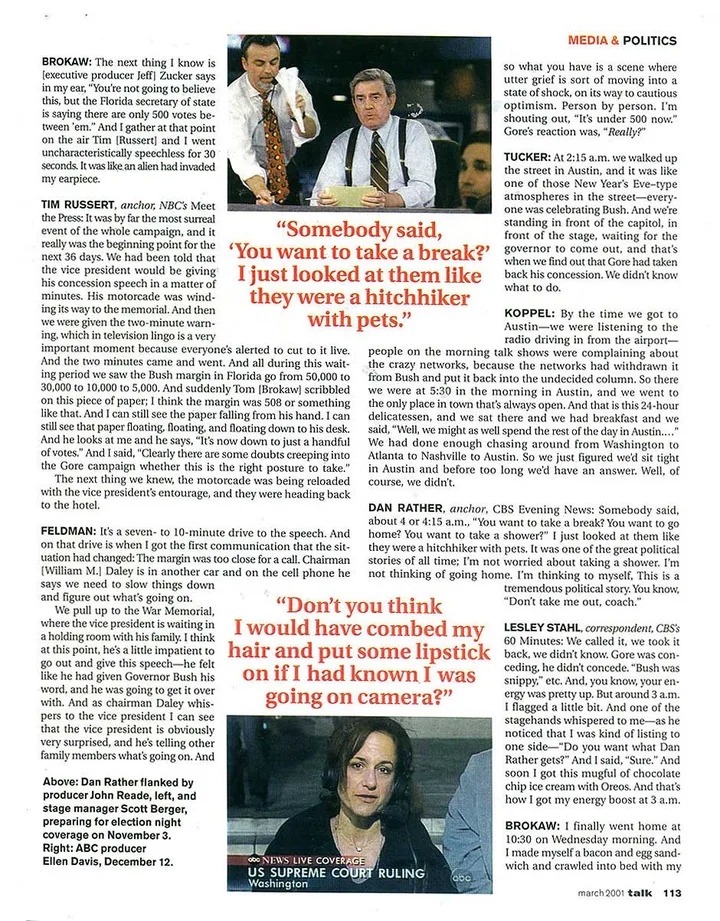
The next thing I know is [executive producer Jeff] Zucker says in my ear, “You’re not going to believe this, but the Florida secretary of state is saying there are only 500 votes between ‘em.” And I gather at that point on the air Tim [Russert] and I went uncharacteristically speechless for 30 seconds. It was like an alien had invaded my earpiece.
TIM RUSSERT, anchor, NBC’s Meet the Press: It was by far the most surreal event of the whole campaign, and it really was the beginning point for the next 36 days. We had been told that the vice president would be giving his concession speech in a matter of minutes. His motorcade was winding its way to the memorial. And then we were given the two-minute warning, which in television lingo is a very important moment because everyone’s alerted to cut to it live. And the two minutes came and went. And all during this waiting period we saw the Bush margin in Florida go from 50,000 to 30,000 to 10,000 to 5,000. And suddenly Tom [Brokaw] scribbled on this piece of paper; I think the margin was 508 or something like that. And I can still see the paper falling from his hand. I can still see that paper floating, floating, and floating down to his desk. And he looks at me and he says, “It’s now down to just a handful of votes.” And I said, “Clearly there are some doubts creeping into the Gore campaign whether this is the right posture to take.”
The next thing we knew, the motorcade was being reloaded with the vice president’s entourage, and they were heading back to the hotel.
FELDMAN: It’s a seven- to 10-minute drive to the speech. And on that drive is when I got the first communication that the situation had changed: the margin was too close for a call. Chairman [William M.] Daley is in another car and on the cell phone he says we need to slow things down and figure out what’s going on.
We pull up to the War Memorial, where the vice president is waiting in a holding room with his family. I think at this point, he’s a little impatient to go out and give this speech—he felt like he had given Governor Bush his word, and he was going to get it over with. And as Chairman Daley whispers to the vice president I can see that the vice president is obviously very surprised, and he’s telling other family members what’s going on.
KOPPEL: By the time we got to Austin—we were listening to the radio driving in from the airport—people on the morning talk shows were complaining about the crazy networks, because the networks had withdrawn it from Bush and put it back into the undecided column. So there we were at 5:30 in the morning in Austin, and we went to the only place in town that’s always open. And that is this 24-hour delicatessen, and we sat there and we had breakfast and we said, “Well, we might as well spend the rest of the day in Austin…” We had done enough chasing around from Washington to Atlanta to Nashville to Austin. So we just figured we’d sit tight in Austin and before too long we’d have an answer. Well, of course, we didn’t.
DAN RATHER, anchor, CBS Evening News: Somebody said, about 4 or 4:15 a.m., “You want to take a break? You want to go home? You want to take a shower?” I just looked at them like they were a hitchhiker with pets. It was one of the great political stories of all time; I’m not worried about taking a shower. I’m not thinking of going home. I’m thinking to myself, “This is a tremendous political story.” You know, “Don’t take me out, coach.”
LESLEY STAHL, correspondent, CBS 60 Minutes: We called it, we took it back, we didn’t know. Gore was conceding, he didn’t concede. “Bush was snippy,” etc. And, you know, your energy was pretty up. But around 3 a.m. I flagged a little bit. And one of the stagehands whispered to me—as he noticed that I was kind of listing to one side—“Do you want what Dan Rather gets?” And I said, “Sure.” And soon I got this mugful of chocolate chip ice cream with Oreos. And that’s how I got my energy boost at 3 a.m.
BROKAW: I finally went home at 10:30 on Wednesday morning. And I made myself a bacon and egg sandwich and crawled into bed with my bacon and egg sandwich. I desperately wanted a big drink, but I knew that that was going to be disastrous.
NIDES: I think the press behaved on election night probably as poorly as any time in the last 20 years in covering a story. And I think there is no question the desire and demand and need to be the first has created an environment in which being first is much more important than being right.
TUCKER ESKEW, senior communications adviser to the Bush-Cheney campaign: Specifically, in the state of Florida, where so much remained hanging in the balance, television’s early call of the election before the polls closed in the panhandle had a negative and potentially profound impact on the Bush campaign.
RATHER: We made mistakes, and we acknowledge that we made mistakes. We’re accountable for those mistakes. Let’s not be blaming anybody else for whatever mistakes we made. We understand that. And I feel very strongly that we need to evaluate what we did and how we did it in hopes of reducing the number of mistakes that we make in the future.
And I don’t excuse myself from that criticism. I specifically include myself.
Let the Recounts Begin
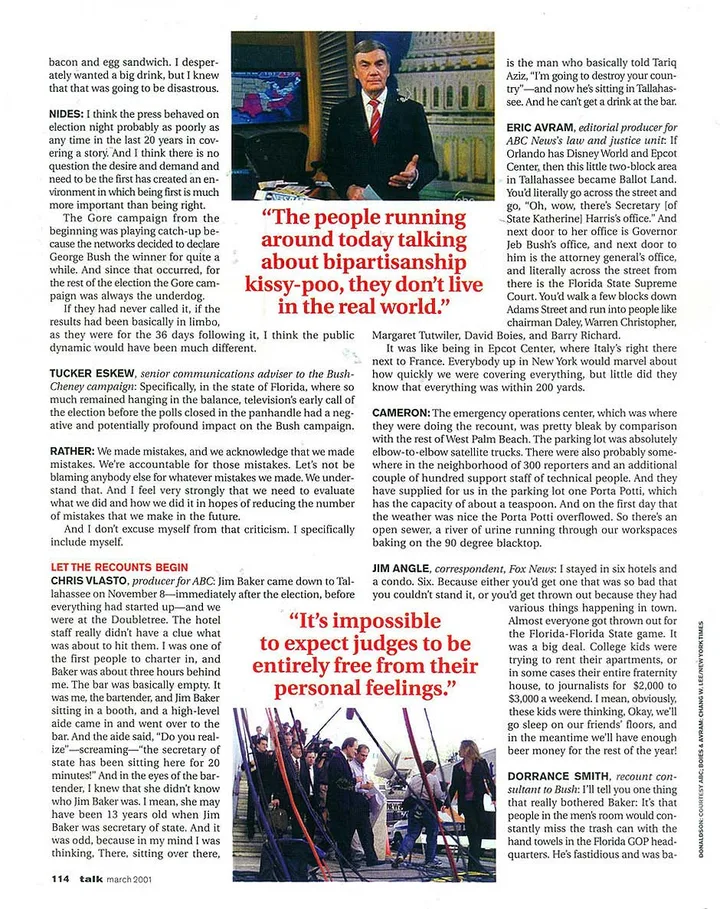
CHRIS VLASTO, producer for ABC: Jim Baker came down to Tallahassee on November 8—immediately after the election, before everything had started up—and we were at the Doubletree. The hotel staff really didn’t have a clue what was about to hit them. I was one of the first people to charter in, and Baker was about three hours behind me. The bar was basically empty. It was me, the bartender, and Jim Baker sitting in a booth, and a high-level aide came in and went over to the bar. And the aide said, “Do you realize”—screaming—“the secretary of state has been sitting here for 20 minutes!” And in the eyes of the bartender, I knew that she didn’t know who Jim Baker was. I mean, she may have been 13 years old when Jim Baker was secretary of state. And it was odd, because in my mind I was thinking, “There, sitting over there, is the man who basically told Tariq Aziz, ‘I’m going to destroy your country’—and now he’s sitting in Tallahassee. And he can’t get a drink at the bar.”
ERIC AVRAM, editorial producer for ABC News’s law and justice unit: If Orlando has Disney World and Epcot Center, then this little two-block area in Tallahassee became Ballot Land. You’d literally go across the street and go, “Oh, wow, there’s Secretary [of State] Katherine Harris’s office.” And next door to her office is Governor Jeb Bush’s office, and next door to him is the AG’s office.
Directly across the street—for those that don’t live there—is the Florida state Supreme Court. You’d walk a few blocks down Adams Street and run into people like Chairman Daley, Warren Christopher, Margaret Tutwiler, David Boies, and Barry Richard.
It was like being in Epcot Center, where Italy’s right there next to France. Everybody up in New York would marvel about how quickly we were covering everything, but little did they know that everything was within 200 yards.
CAMERON: The emergency operations center, which was where they were doing the recount, was pretty bleak by comparison with the rest of West Palm Beach. The parking lot was absolutely elbow-to-elbow satellite trucks. There were also probably somewhere in the neighborhood of 300 reporters and an additional couple of hundred support staff of technical people. And they have supplied for us in the parking lot one Porta Potti, which has the capacity of about a teaspoon. And on the first day that the weather was nice the Porta Potti overflowed. So there’s an open sewer, a river of urine running through our workspaces baking on the 90-degree blacktop.
JIM ANGLE, correspondent, Fox News: I stayed in six hotels and a condo. Six. Because either you’d get one that was so bad that you couldn’t stand it, or you’d get thrown out because they had various things happening in town. Almost everyone got thrown out for the Florida-Florida State game. It was a big deal. College kids were trying to rent their apartments, or in some cases their entire fraternity house, to journalists for $2,000 to $3,000 a weekend. I mean, obviously, these kids were thinking, “Okay, we’ll go sleep on our friends’ floors, and in the meantime we’ll have enough beer money for the rest of the year!”
DORRANCE SMITH, recount consultant to Bush: I’ll tell you one thing that really bothered Baker: it’s that people in the men’s room would constantly miss the trash can with the hand towels in the Florida GOP headquarters. He’s fastidious and was basically saying, “You know, can you believe these people keep this place such a mess?” And I walked in one day, and he’s cleaning up the men’s room.
The Hand Counts
VLASTO: The first time the picture came out of people looking at dimpled chads, that video spoke a thousand words. And I remember we all sat around saying, “You know, Gore’s in trouble now.” And Baker seized on that.
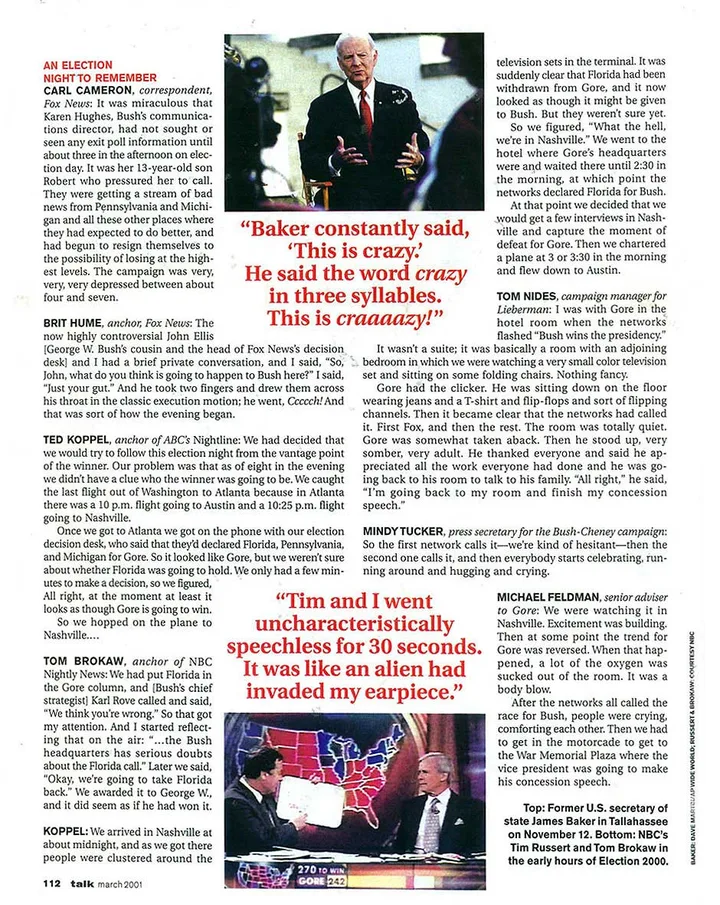
Baker constantly said, “This is crazy.” He said the word crazy in three syllables. “This is craaaazy!”
ESKEW: We saw what we called the unsettling spectacle of people bending these ballots, holding them up to the light, peering at them—and confusion creates doubt, and doubts buttressed our case.
I mean, they sent out this spokesman to start talking, really for the first time in public, about bulging chad and pregnant chad and swinging doors, and it just baffled members of the news media.
KATHERINE HARRIS, Florida’s secretary of state [from ABC News transcript, November 14, 2000]: Unless I determine in the exercise of my discretion that these facts and circumstances contained within these written statements justify an amendment to today’s official returns, the state elections canvassing commission…will certify statewide results reported to this office today.
JON BANNER, senior producer for ABC’s World News Tonight: It’s getting to be five, six o’clock, and we hear that Vice President Gore wants to address the nation. And it’s gonna happen at 5:30. It’s gonna happen at six. Now, it’s gonna happen at 6:30, right when we go on the air. He knows that all the ratings are up for all the day’s programs. People are watching like crazy. So all of a sudden we now have the situation where the vice president is trying to screw with our broadcast. He wants to manipulate us to carry him live. And this is sort of a crapshoot. Do we have to do this? Well, not necessarily. But he leaks out enough for us to know that what he’s going to say at 6:30 is going to be a major proposal. Something we would not want to ignore.
JULIA PAYNE, deputy press secretary for the Gore campaign: It was probably about four o’clock. And the vice president called [Gore spokesman] Mark Fabiani and said, “I’m gonna give the speech as soon as we can get things set up. I want to give it today.”
He wanted to say why he was calling for these recounts and wanted this process to be fair and every vote to be counted.
At about 5:30, 5:45 or so I alerted the press pool and the evening news producers, saying, “Look, he’s gonna talk, but I can tell you in simple logistics we’re not gonna be ready until maybe 6:15, 6:30.” So I gave them as much guidance as I could on the timing.
As it got closer to 6:15, and the room was close to being ready, I pulled [Gore aide] Carter Eskew aside and said, “Carter, what if we say he can’t talk till 6:30?” And Carter said, “That’s what we should do.” We knew that was gonna be the best, biggest audience on that day. So we went for it.
BANNER: You know, it’s a ballsy move. Doing it at 6:35, right in the middle of the news.
He got his message out. He made us alter our plans. He controlled the evening news for a little bit because he interrupted us.
Clinton Weighs In
JOHN KING, correspondent, CNN: I had an interview with Clinton during his trip to Vietnam in November. He was careful in what he said, but it was clear that he was supportive of Gore’s position in saying that they should count every vote. Privately he was very supportive of Gore, giving him pep talks in private about hanging in there. But he was also Bill Clinton, the president, saying, “Look, there’s no crisis here. This can all be resolved.” So he was sort of playing in both camps—trying to be supportive of Gore as much as he could be in public, but also remembering that he was the president and that he had an obligation to the system, if you will.
It was also remarkable how familiar Clinton was with the details of Florida election law. Here I’m in Ho Chi Minh City, formerly Saigon, and Clinton is saying, “You know, if you look at this part of the law, you can see this.” And then, “I think Gore’s chance is better over here doing that.”
It was just vintage Clinton. I mean, he had the book on the Florida election law.
The Court Battles Begin
AVRAM: The initial oral arguments for the Florida Supreme Court was the first real event in Tallahassee. Tickets were given out—there were these little placard cards that everyone wanted. And ABC put interns out there in line in the middle of the night because the networks were given only one ticket each and the general public got the rest. So ABC ended up with four.
Most of the legal scholars were telling the networks that it was unlikely that the U.S. Supreme Court would ever hear the case. People tend to forget this now—that there was always a feeling at the beginning that this could end at any time. People didn’t think this was going to go on for 36 days.
The Florida Supreme Court addressed a very basic question: Could the secretary of state, Katherine Harris, certify the election? Did she abuse her discretion? As it turns out, they came back with a unanimous decision saying she needed to give the counties five more days, until November 26 at 5 p.m., to get their counts in. And it was clearly a setback for the Republicans.
A Lawyer’s Allegation
MICHAEL CARVIN, postelection lawyer for Bush: Before the arguments started, someone slipped me a note. I don’t know who the source of the note was. The note said that the Florida Supreme Court justices had already written their opinion and that it was going to be unanimous, and that the opinion was going to require Katherine Harris to extend the recount deadline for another five days. That, of course, is precisely what did happen when they did issue the opinion.
Given everything else that had gone on I gave a fair amount of credence to this note, so I felt that we were probably going to lose. Let’s just say I wasn’t wildly optimistic about my chances.
The Spin Cycle
SMITH: What really drove the PR was the legal strategy. And our job was to make sure that we understood it first. I remember Baker at one point telling me that he’s a 70-year-old man and has been through a lot of legal and Middle East peace negotiations. And he said that this was as hard to get his arms around as anything he had ever seen.
BANNER: Very early on in the story, people would call me. People I did not know: “It’s so and so from Secretary Baker’s office.” “It’s so and so from Joe Lieberman’s office.” “Do you have everything you need?” In terms of what? They wanted to know what we were doing. They wanted to know if we needed any legal opinions from their side. There were more times in the beginning when Joe Lieberman offered himself up to network television every day. There were more times when Secretary Baker offered himself.
It was shocking, because here I was—Mr. Nobody—this broadcast producer getting these calls out of the blue. They were going right to the source of people who put the broadcast on. They were invading our newsroom to ask us if we had everything we needed. If they could help us produce our newscast.
BRIAN WILLIAMS, anchor, MSNBC News: After the election, and during the tense court battle, Vice President Gore was calling the network anchors. He was worried the networks were going to bury him too early.
I will always consider those conversations with him private, but I can report that he kept his sense of humor until the very end. Prior to one of his calls to me the White House operator got on the line and said, “Mr. Williams, I have the vice president for you.” To which I quickly responded, “Mr. Cheney, how are you this evening?” The laughter at the other end of the phone, inside the U.S. Naval Observatory, was an indication that Al Gore hadn’t lost his sense of humor.
BROKAW: I called Vice President Gore back from a car phone, weaving through the traffic on Route 684. I was both exceeding the speed limit and trying to carry on a conversation. It was kind of an out-of-body experience. Here he was walking through all the permutations of his appeals and his strategies. And on that trip he said to me, “But you know, Tom, I’m having fun.” And I said, “Mr. Vice President, I can’t believe you’re having fun.”
The Candidates Wait It Out
ALEXANDRA PELOSI, NBC producer covering Bush: For a year we were sitting on the same airplane. For a year he was “Full-Access George.” That’s what he called himself. We could talk to him. You knew he was there.
Then all of a sudden we were like stalkers. We built a tent on the sidewalk across the street from the governor’s mansion. And we lived there from the crack of dawn through the nightly news.
Every time he would come out of the mansion we’d scream at him, and he’d pretend he didn’t see us, or stop for a moment. But that was three seconds of video, and television is an insatiable beast.
CAMERON: We would also stake out across the street from the entrance to the gym. And one day he came out of the gym more sweaty than normal. The Secret Service was talking us up, essentially distracting us. This time [Bush] looked at us and waved and noticed that my cameraman was distracted by the Secret Service guy, at which point he put his hands up in the air and kind of did a little end-zone jig, bowed a few times, and started blowing us kisses, knowing that we didn’t have the camera rolling.
As soon as we got the camera up on the tripod and turned it on, he immediately stood bolt-straight and then walked on with an exaggerated sort of gait over to the car and got in.
KOPPEL: I did an interview with Joe Lieberman during which he told me that on a Friday afternoon he needed to speak to the vice president. As an Orthodox Jew he couldn’t drive up to the Naval Observatory. At first the vice president suggested walking, then he said, “Look, I think it’s 25 minutes to shabbes. Why don’t you hop into a car right now and come up here and do your sabbath observance here at the Naval Observatory?” So, as Lieberman puts it, he and his wife Hadassah put wine and challah and salt in a bag and quickly drove up to the Naval Observatory. They did their sabbath observance, and when it was over Hadassah looked at him and said, “You know, I think this is the first time we’ve done it in the same room as a Christmas tree.”
Playing Hardball
JIM NICHOLSON, outgoing chairman of the Republican National Committee: I remember vividly—I think it was on November 11—I was on what is now called Evans, Novak, Hunt, and Shields on CNN, and during a commercial break Bob Novak whispered to me in kind of an irritated fashion. He said, “They’re going to steal this election, and you’re going to let them.” And I said, “No, we’re not.” Exclamation. And we didn’t.
CARVIN: The new deadline for all recounts to be submitted to Katherine Harris was 5 p.m. Sunday, November 26. Now, that Sunday afternoon you could watch any of the television coverage and see that Palm Beach was still counting. And by late afternoon you heard various officials in Palm Beach acknowledging that they were not going to be finished by five. So the canvassing board had decided to give partial results in time for the deadline. Now, we maintain that was completely illegal, because the law said you had to manually recount all ballots.
But as five o’clock approached, we heard that the secretary of state was going to accept the Palm Beach partial recount—even though the partial recount was blatantly illegal. We were told that the secretary of state’s view was that unless Palm Beach actually informed her—in writing or otherwise—that the returns were only a partial recount, she could not infer that on her own.
So we made some calls to a few Republicans overseeing the Palm Beach recount. We told them to gently suggest to the canvassing board that it might as well put PARTIAL RETURN on the front of the returns that were to be faxed up in time for the deadline. The reason we gave was clarity—that the words PARTIAL RETURN would distinguish those returns from the full count that would be coming in later that night. I’m not exactly sure what happened, but I think the Palm Beach board did in the end write PARTIAL RECOUNT on the faxed returns. We all know that the secretary of state, in the end, rejected them.
I think the board members probably agreed to write the PARTIAL RECOUNT notation for two reasons. First of all, I think they hadn’t slept in 48 hours, so I think they’d sort of do anything. Second of all, I don’t think they or anybody else would ever have suspected that it would actually make any difference. Who could imagine that without that simple notation of PARTIAL RETURNS the partial count would have been accepted as a complete count by the secretary of state? Even while television showed them still counting?
But I don’t think it was Machiavellian to suggest to the board that it write PARTIAL RECOUNT, because that is what it was. I think it would have been sort of Machiavellian to pretend they were not partial returns.
The Florida Supremes Say “Count!” The U.S. Supremes Say “Stop!”
CRAIG WATERS, spokesman for the Florida Supreme Court [from a CBS News transcript, December 8, 2000]: By a vote of four to three the majority of the court has reversed the decision of the trial court in part. It has further ordered that the Circuit Court of the Second Judicial Circuit in Tallahassee shall immediately begin a manual recount.
AVRAM: The night before the Florida Supreme Court decision, David Boies went out to dinner with Phil Beck, one of the main Republican guys; Irv Terrell, one of Baker’s partners; and Steve Zack, who worked for Gore. And they’re all there and they’re hooting and hollering, having a great time. There really was a bond between these attorneys.
And that night there was definitely a feeling that the Republicans had the upper hand. They were predicting—to Boies—that they were going to win the next day by at least a majority of one vote. And Boies predicted that he was going to win by one, which at the time seemed at best to be wishful thinking.
Then the next day Craig Waters came out of these big, metal silver doors that sort of swing open. ABC was live, NBC was live, CBS was live. And when he said that they were going to be doing full recounts, there were gasps—audible gasps—in the air from, I think, both the Bush and Gore camps and from the media.
Those next few hours everything went haywire.
CHARLES BURSON, Gore’s chief of staff: After the second Florida Supreme Court decision, which we considered a major victory, the vice president got on the phone.
He said, “This is good, but let’s keep our eye on what we need to do.” He was really steady and realistic about things. He was saying, “Look, this is not near the end—a win is a long way to go here.” He cautioned that they had given us a relatively short time frame to repeat the count.
RUSSERT: And then into the morning—Americans were turning on their sets, watching the voting, and the holding up of the ballots to the light was happening all over again. We were obviously heading toward some finality. Do you think this recount will be finished? Will Gore overcome Bush? That became the story line.
Then boom! The Supreme Court stayed the count at 2:40 in the afternoon and suddenly the champagne is popping in Austin and gloom descends upon the Naval Observatory. And there were no warnings for these clouds. They just came.
U.S. Supremes Make Final Decision
PETE WILLIAMS, NBC’s justice correspondent: We waited all day in the press room and well into the evening. And then at 9:52 we got it. We were told, basically, “Okay, we have the decision, but we’re not handing it out until you form a line like nice ladies and gentlemen.”
And everyone just snapped right to: “Whatever you say. Yes, sir.” Boom and get into the line. We’ll take it. So one by one we grabbed the opinion and went running into the cold night air and the glare of the lights, and I immediately said into the cell phone, “Reversed and remanded.”
But then we had to figure out what that meant. Was this thing over or not? And that’s when this agonizing chore began that you watched, trying to define the ruling. Because of course you wanted very much to get it out quickly, but it did occur to you that, after all, this was not just some routine insurance case—it would also be nice to get it right.
BOB SCHIEFFER, CBS anchor: Normally on a Supreme Court decision, they put right at the top what they have done. Here they didn’t say at the top what they’d done. You had to pore through just page after page of real legalese to try to come to determine how many of them had been in on that decision and exactly what it meant. It was one of the hardest things I’ve ever done.
MARC BURSTEIN, executive producer of special events for ABC News: Just seconds before 10 o’clock our producer Ellen Davis said, “I have got the decision. And the U.S. Supreme Court has reversed the lower court decision in Florida by a vote of five to four.”
A few minutes later we looked up and we saw other news organizations saying, “U.S. Supreme Court remands decision back to the Florida Supreme Court.” Well, we had just reported that it had been reversed. Ellen needed to clarify it for us.
ELLEN DAVIS, producer for ABC News’ law and justice unit: The opinion came down. I was sitting vigil in this pressroom. Which was mobbed. Mobbed. You almost couldn’t breathe. And then what happened was they reversed and remanded. But the remand meant nothing.
I then called in to ABC. And I was shaking. My stomach was in my throat. And I said, “It’s reversed.” And I ran outside and a producer said to me, “Burstein wants you to put a headset on.”
So I put this headset on, and I heard Marc Burstein in my ear saying, “Can you explain this decision?” And I didn’t have time to be nervous. I said, “I can try.” And all of a sudden I was on national television explaining what the Supreme Court had just done in this election.
My hair was all over the place and my coat was half on and half off because I had just run out of the court. People afterward said, “Did you know you were going to be on national television?” And I said, “Don’t you think I would have combed my hair and put some lipstick on if I had known I was going on camera?”
I said to Peter Jennings, “They gave with one hand and took away with the other.”
They said, “We’re going to send it back so you can try and fix these equal protection problems.” And then they said, “Oh, and by the way you can’t keep recounting because the December 12 deadline sticks.” And then I said, “It’s over, Peter.”
RATHER: There isn’t anybody who has more respect for the Supreme Court than I do, but excuse me. This is ridiculous. Whatever they decide it should be clear what they have decided. Clarity is very important with the court. And if their decisions are not to be clear, then there needs to be clarity about exactly what the confusion is: “Here are the ones that we’ve had the most difficulty with, but here’s the bottom line.”
Or hold a press conference. They can figure out a way to do it in about five minutes. I do think this indicates a certain amount of arrogance, frankly. You know, that “we’re just above all this. We’re going to dump it in here, and you figure it out.”
It’s almost impossible on the fly. I described it as trying to change a tire on a moving truck. And that’s what it was.
BENJAMIN GINSBERG, national counsel to the Bush-Cheney campaign: There they were in front of a watching world on the biggest political story that any of us had ever seen, trying to make sense out of it, and we were struck by how different everyone’s opinion was.
We certainly wanted to know what the decision was, but flipping from channel to channel before we had a copy of the opinion, they were all saying different things.
[Campaign chairman] Don Evans and Jim Baker had offices right next to each other. And I was sort of going between the two offices. One network was sort of saying it looked like it was good for us. And another was saying it was good for Gore. And they were talking about a fractured court, and it was difficult for them to really divine what the opinion said.
I was thinking, “Why can’t we get a straight answer here? This is kind of important.”
NIDES: Truth be known, when the Supreme Court ruled, there was this pathetic scene of reporters running down the Supreme Court steps making predictions before they even read the decision. One network saying, you know, we’ve lost; another network saying it was being sent back to the Florida Supreme Court. It was pathetic. Because everyone wanted to be first. Everyone wanted to be the first reporter to declare that Al Gore was either dead or alive.
And I don’t know what it’s going to take, and maybe we’re being unrealistic to expect that people should get their facts straight before they open their mouths. If I were with the Bush campaign I would feel the same way.
DAVID BOIES, Gore’s trial counsel: At exactly the point in time [the reporters] were trying to flip through those pages and figure it out, we were trying to flip through the same pages and figure the same thing out for the vice president. And for ourselves. What I would try to do is figure it out as quickly as I could and then call him with my bottom-line judgment.
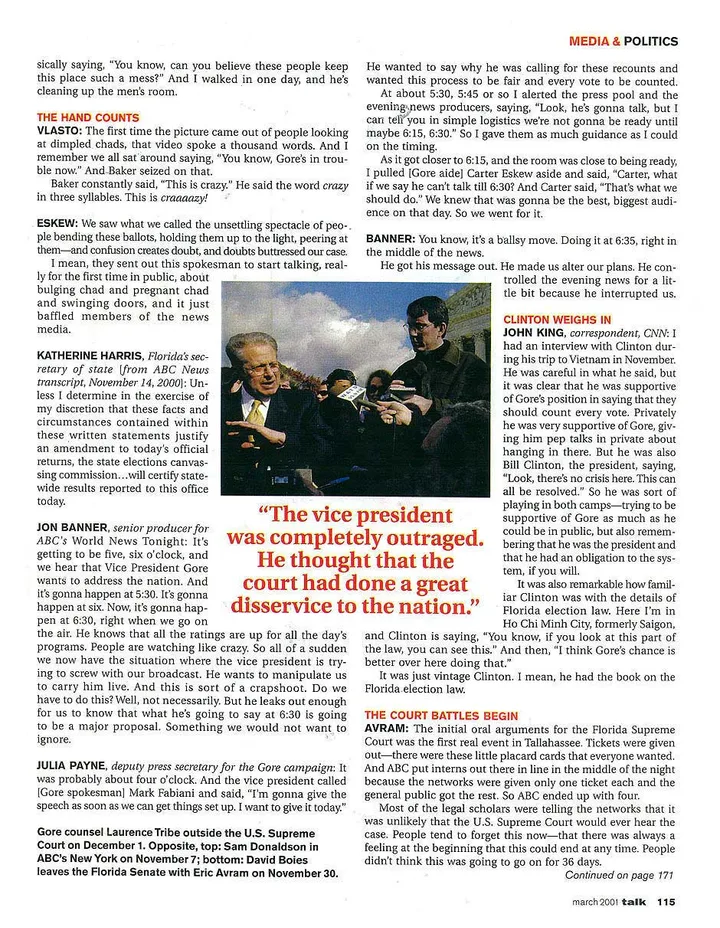
LAURENCE TRIBE, chief counsel for federal constitutional litigation for the Gore-Lieberman campaign: The only time in all of my dealings with the vice president that he was, I would say, emotionally at a very high pitch was after the Supreme Court ruled against us on December 12. He was just completely outraged. He thought that the court had done a great disservice to the nation and to its own history and its own role. And quite apart from its impact on him, he thought that what the court had done was just a completely unwarranted and kind of disgusting thing. The vice president was pretty exercised. I mean, he was under control. He wasn’t yelling. But I’ve rarely heard a more passionate and powerful indictment of an action by one of the branches of the American government than the indictment that he delivered.
He had Ron Klain, David Boies, Bill Daley, Walter Dellinger, and me—all on conference call after the decision. The vice president wanted to go around the circle, as it were, having each person express candidly what he thought about the exact meaning of the opinion and what latitude, if any, was left for further action. So we went around.
I don’t think there was anybody whose view was radically different. I mean, there was nobody who was really saying, “We’ve got to do it. You’ve got to go down there and take advantage of the loophole, and it will make you president.”
And what was most interesting, in a way, was how quickly he moved from that high-pitched outrage to a fairly tranquil acceptance of the situation.
BURSON: I was in the room when Gore actually made the concession statement, and it was very, very difficult. It was kind of the final phase of a double campaign. I mean, we’d all been very, very committed for more than two years, through his candidacy, to seeing him as president. And this was the end of it. For now. And it was difficult watching the family behind him that he’s so close to, and I know how they feel toward one another and what they have gone through on this.
TUCKER: Don Evans had received a call from Bill Daley saying, “You know, this is basically over and here’s what he’s going to do.” So Margaret Tutwiler walked in and said, “Okay, you can be excited now. It’s official, you can tell everybody.” I didn’t think it was over literally until Gore called—because Gore didn’t call till right before he went out. And I got a call from a friend after the governor’s speech that night, and he said, “I’m so proud of you and I’m so excited for you,” and it started to sink in at that moment.