Zoë is a perfectly healthy little girl. But her parents, Scott and Blake Fintz, aren’t taking any chances. Compelled by a pamphlet in their doctor’s office, they decided to store Zoë’s umbilical-cord blood, banking its precious stem cells for potentially lifesaving medical use in the future. Signing up with the private Cord Blood Registry—a “once in a lifetime opportunity,” the pamphlet insists—set them back $1,300, with an extra $95 due each year for storage. But the Fintzes didn’t balk at the price. “We’re glad to know there’s a medical safety net for our daughter,” Scott says. “Should anything ever happen in the future, we’d pay 10 times that for a cure.”
How could any parent refuse the offer of biological insurance? It turns out that the issue is more complicated than the industry’s marketing machine would have you believe. And, as with all insurance, you should carefully assess your risks first, because the cost is considerable. There are more than 125,000 units of cord blood stored at private and public banks in the United States. So far, there have been only 2,500 cord-blood transplants worldwide—and it’s still considered a risky and experimental procedure. Doctors say it’s extremely unlikely a healthy child would ever need to use his own cord blood.
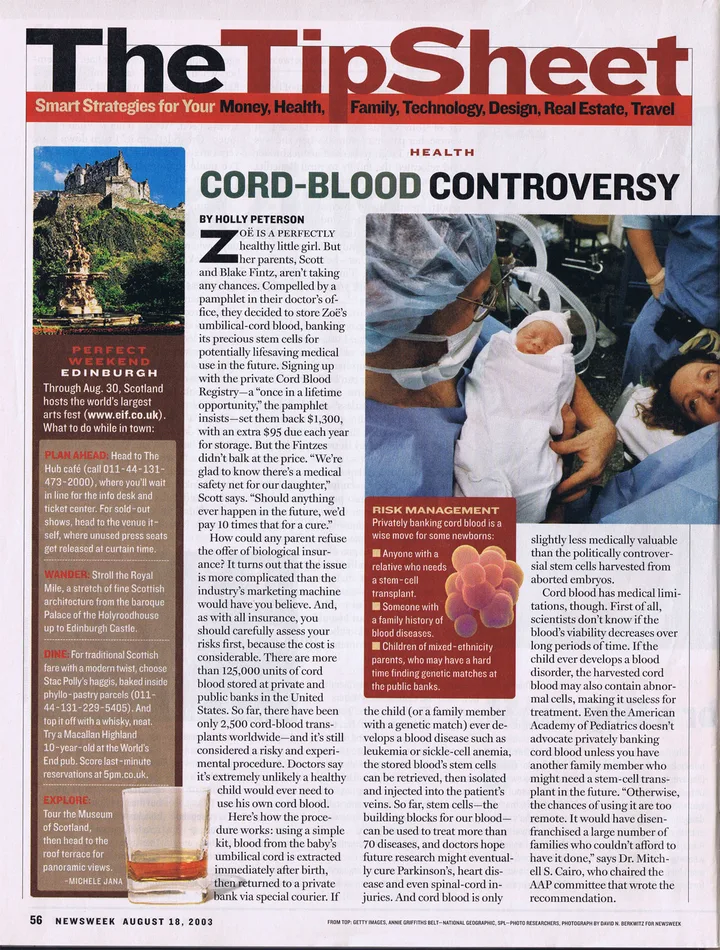
Here’s how the procedure works: using a simple kit, blood from the baby’s umbilical cord is extracted immediately after birth, then returned to a private bank via special courier. If the child (or a family member with a genetic match) ever develops a blood disease such as leukemia or sickle-cell anemia, the stored blood’s stem cells can be retrieved, then isolated and injected into the patient’s veins. So far, stem cells—the building blocks for our blood—can be used to treat more than 70 diseases, and doctors hope future research might eventually cure Parkinson’s, heart disease and even spinal-cord injuries. And cord blood is only slightly less medically valuable than the politically controversial stem cells harvested from aborted embryos.
Cord blood has medical limitations, though. First of all, scientists don’t know if the blood’s viability decreases over long periods of time. If the child ever develops a blood disorder, the harvested cord blood may also contain abnormal cells, making it useless for treatment. Even the American Academy of Pediatrics doesn’t advocate privately banking cord blood unless you have another family member who might need a stem-cell transplant in the future. “Otherwise, the chances of using it are too remote. It would have disenfranchised a large number of families who couldn’t afford to have it done,” says Dr. Mitchell S. Cairo, who chaired the AAP committee that wrote the recommendation.
There are, however, several key exceptions. For example, it may be prudent for anyone with a family history of blood disease to bank his blood privately. Mixed-ethnicity parents might also consider it, since they may have a hard time finding genetic matches at the public banks. For reviews of private cord-blood banks, see parentsguidecordblood.com. But when choosing, look for firms that have actually used their stored cord blood for transplants and facilities that store blood in the United States free of charge. And if you’re lucky enough to find a genetic match, “in ideal scenarios, we recommend donating for public banks, where it can actively save lives,” says Dr. Pablo Rubinstein, who founded the first public bank.