“I was a hustler from the time I could walk.” —Bob Davis
What was your first job? Loading trucks at Boston Italian Groceries for $1.25 an hour when I was 14. I thought I was rich.
What was your neighborhood like? Irish Catholic, lower-middle-class. My street was one of two- and three-family houses. I could literally lean out my window and touch fingertips with the person next door. It gave me street smarts.
What do you mean by that? A sense of survival, fending for oneself. I was a hustler from the time I could walk.
How did you start Lycos? I was at Cambex, a data storage company, in early 1995, itching for a smaller-company environment. A friend was about to invest in this little search engine technology called Lycos. There was no company at that point in time, and my buddy was lamenting about building a management team. I said, “What about me?”
Did you have a feeling that you were going to hit it big? I believed the Internet could be big, but I had no idea what we might have for ourselves.
What was it like at first? We had no money by traditional standards: $2 million.
But you had timing. And timing is everything. We took a $2 million investment and generated a 300,000 percent return in five and a half years.
You just wrote a book, Speed Is Life (Doubleday), about your business philosophy. When did you begin to see the need for new and old media to merge? As far back as ‘96. Content is not cheap. As a young business we were a long way from being able to generate any content or, more importantly, any earnings.
In February 1999 you announced a groundbreaking deal to merge with Barry Diller’s vast and profitable media empire. How did that happen? I think Barry Diller was very bold and brave. There was no combination prior to that of traditional assets and online assets. Traditional media was looking at the valuation of the Internet companies and saying no way. Barry was the first and the only executive who was willing to put real assets into a combination. He was willing to put in Home Shopping Network, Ticketmaster, and all of his Internet assets into a combination to be called USA Lycos. On February 9 we announced the USA-Lycos deal, and Lycos’s stock bombed. Investors liked it from Diller’s standpoint. They thought I was making a mistake, that my asset was worth more than his.
So why didn’t the deal come off? We got the kiss of death when Dave Wetherell, who was the chairman of Internet investment firm CMGI and our largest shareholder, made it clear that he would not support it unconditionally. As a Lycos board member, he had initially voted for the deal. I think he was panicked because of the stock price erosion. He was probably greedy. The deal was really dead a couple of days after we announced it. Then Wetherell resigned from Lycos’s board. Barry worked the process aggressively. He met with Wetherell, suggesting ways we might put this together. But it wasn’t meant to be.
What happened when the deal died? Wetherell came back. He wanted to buy Lycos for less than the share price at the time the USA merger was announced. It never got to the stage of a hostile takeover. He suggested that I let the shareholders decide. I let him know that if he took this to the shareholders, I would voice my belief that CMGI was grossly overvalued. With that, this whole mess just sort of died down.
So you threatened him back. Very strongly.
Did you learn that on the streets? Probably. Yeah.
Why did you leave Lycos after you sold it last May to Spanish portal Terra Networks? I didn’t feel I had the control of the business that was necessary.
May I ask how much you’re worth now? Over a billion dollars? No.
More than a half-billion? It’s safe to say I don’t need to clip food coupons anymore.
Is money important to you? It’s important to me, but it hasn’t changed my life much.
What does it get you? With my competitiveness, maybe it’s just another check on the scorecard.
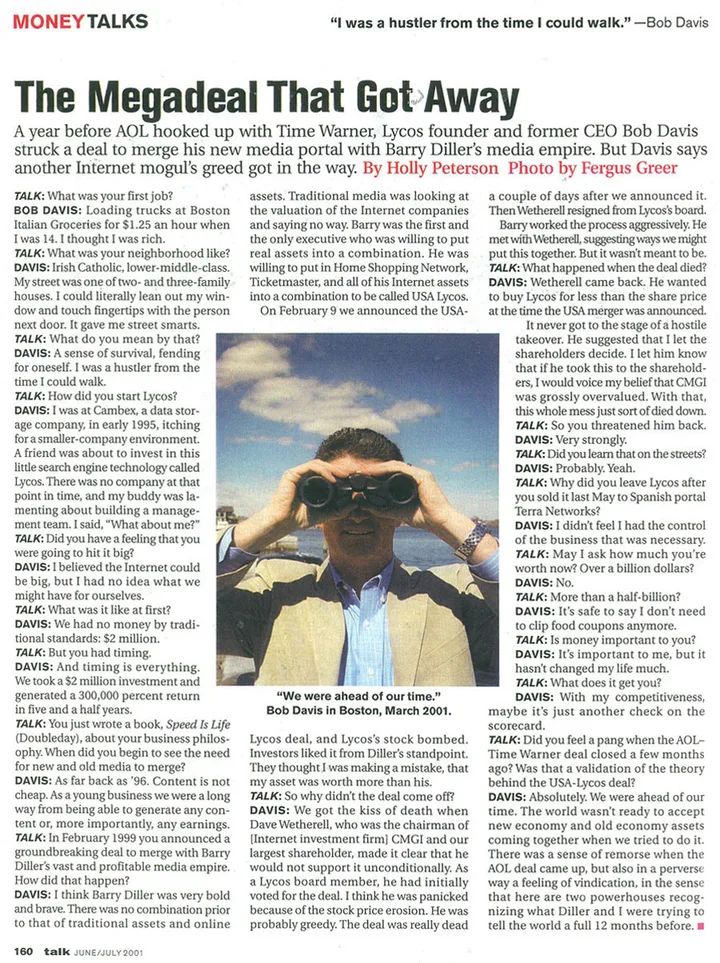
Did you feel a pang when the AOL–Time Warner deal closed a few months ago? Was that a validation of the theory behind the USA-Lycos deal? Absolutely. We were ahead of our time. The world wasn’t ready to accept new economy and old economy assets coming together when we tried to do it. There was a sense of remorse when the AOL deal came up, but also in a perverse way a feeling of vindication, in the sense that here are two powerhouses recognizing what Diller and I were trying to tell the world a full 12 months before.