TALK: What was your first job?
PETER PETERSON: At age eight I started to work in my father’s restaurant, the Central Cafe, which stayed open 24 hours a day for 25 years. I handled the cash register, if you can believe that. When I got older my father relegated me to washing dishes, mopping the floor. The cash compensation was a dollar a day.
TALK: Did you set out to make a fortune?
PETERSON: No. I was brought up in Nebraska—an agricultural area plagued not only by the Depression but also by drought and grasshopper storms, scorching summers, and numbing winters. I was hardly thinking about making a fortune.
TALK: Ten years after graduating from the University of Chicago Graduate School of Business, you were, at the age of 34, the youngest president of a Fortune 500 company, Bell & Howell. How did your parents react?
PETERSON: My mother said, “My boy, why do you want to work in a big company for someone else, when you could have your own restaurant in Kearney, Nebraska?”
TALK: What was your biggest career mistake?
PETERSON: Wasting several years of college on the absurd premise that I should go into retailing. Why retailing? Because my father owned a restaurant. So I ended up in a Portland, Oregon, store in the toy department at Christmas. It was a disaster.
TALK: What was the greatest risk you ever took?
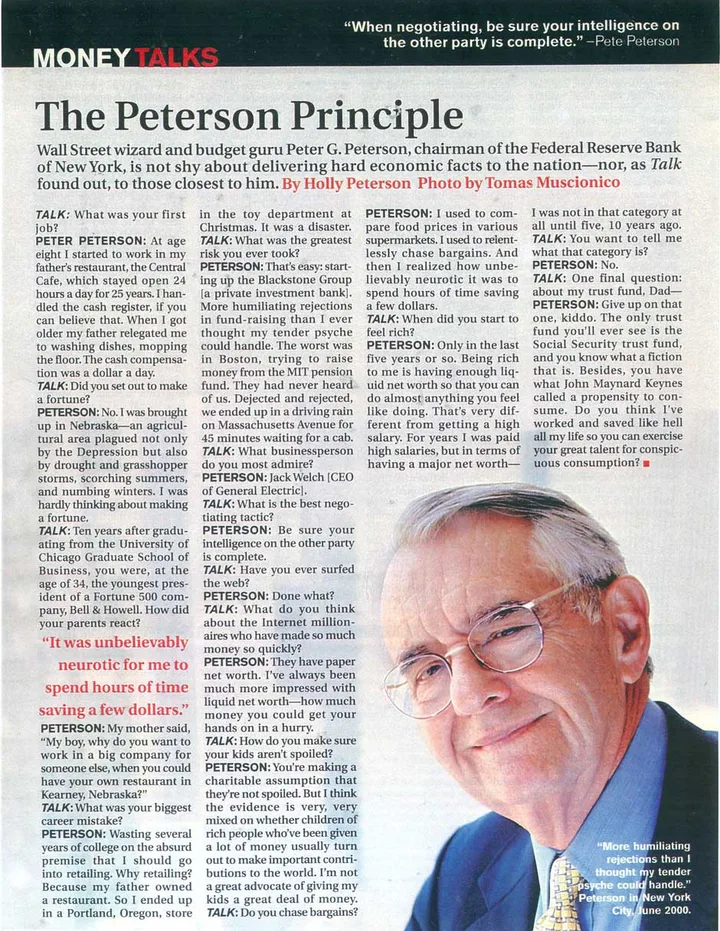
PETERSON: That’s easy: starting up the Blackstone Group [a private investment bank]. More humiliating rejections in fund-raising than I ever thought my tender psyche could handle. The worst was in Boston, trying to raise money from the MIT pension fund. They had never heard of us. Dejected and rejected, we ended up in a driving rain on Massachusetts Avenue for 45 minutes waiting for a cab.
TALK: What businessperson do you most admire?
PETERSON: Jack Welch [CEO of General Electric].
TALK: What is the best negotiating tactic?
PETERSON: Be sure your intelligence on the other party is complete.
TALK: Have you ever surfed the web?
PETERSON: Done what?
TALK: What do you think about the Internet millionaires who have made so much money so quickly?
PETERSON: They have paper net worth. I’ve always been much more impressed with liquid net worth—how much money you could get your hands on in a hurry.
TALK: How do you make sure your kids aren’t spoiled?
PETERSON: You’re making a charitable assumption that they’re not spoiled. But I think the evidence is very, very mixed on whether children of rich people who’ve been given a lot of money usually turn out to make important contributions to the world. I’m not a great advocate of giving my kids a great deal of money.
TALK: Do you chase bargains?
PETERSON: I used to compare food prices in various supermarkets. I used to relentlessly chase bargains. And then I realized how unbelievably neurotic it was to spend hours of time saving a few dollars.
TALK: When did you start to feel rich?
PETERSON: Only in the last five years or so. Being rich to me is having enough liquid net worth so that you can do almost anything you feel like doing. That’s very different from getting a high salary. For years I was paid high salaries, but in terms of having a major net worth—I was not in that category at all until five, 10 years ago.
TALK: You want to tell me what that category is?
PETERSON: No.
TALK: One final question: about my trust fund, Dad—
PETERSON: Give up on that one, kiddo. The only trust fund you’ll ever see is the Social Security trust fund, and you know what a fiction that is. Besides, you have what John Maynard Keynes called a propensity to consume. Do you think I’ve worked and saved like hell all my life so you can exercise your great talent for conspicuous consumption?