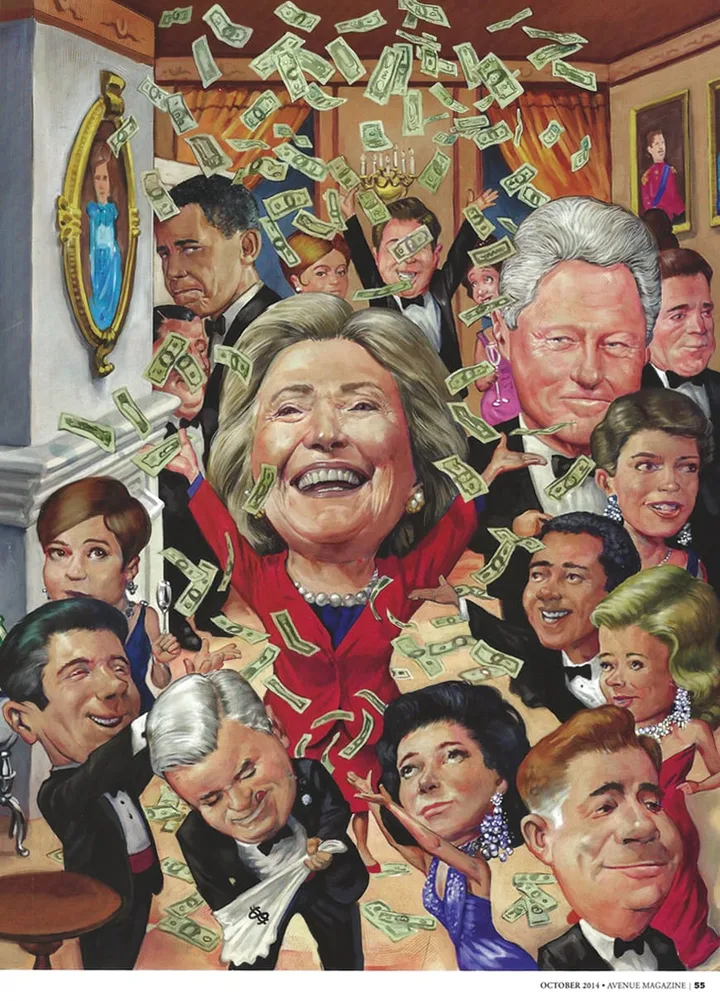
In the grand parlors designed for entertaining, of co-ops dating back to the 1920s, Manhattan’s power players regularly host fund-raising events to provide support for local, state and national candidates.
No surprise, then, that four of the nation’s top five zip codes for political contributions of all types are in Manhattan, and that the top zip code for campaign cash in the country is 10021.
But New York is a curious town. One might assume the epicenter of the financial world would tilt Republican, but that just isn’t so. The largely secular, liberal political philosophy that reigns on the Northeast coast regularly launches Democrats into office. Headlines may hound us about the excess spending by the right wing in targeted races and by less-transparent interest groups across the country. Yet, many of the most prominent one-percenters in this town—a group that conventional wisdom normally associates with arguing for bigger tax cuts and less government spending—are the most effective campaigners and fund-raisers for Democrats.
Certainly, candidates appreciate the devotion of the Upper East Side Democratic fund-raising circuit. “I think they stick with it and they understand it’s not a one-time, one-election-cycle thing,” says New Jersey Senator Cory Booker, a frequent beneficiary of this largess, who first came to national attention as mayor of Newark. “Their persistent involvement in the democratic process is very effective over time.”
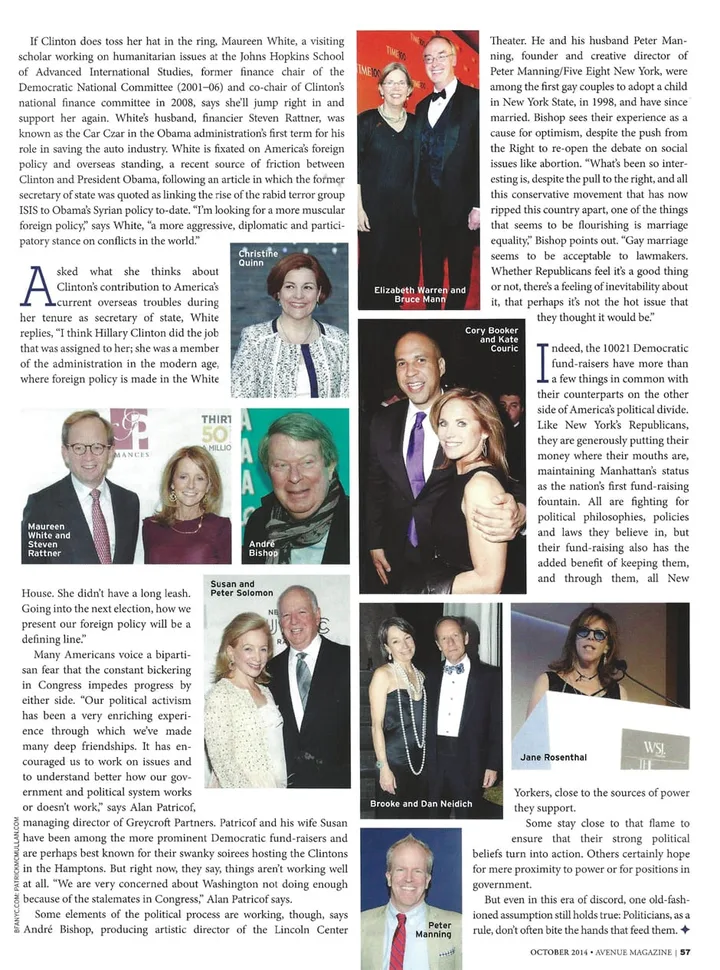
Who are the left-leaning heavyweights? One very active couple is Brooke Neidich, co-founder and chair of the Child Mind Institute, co-chair of the Whitney Museum and a vice chair of Lincoln Center Theater boards, together with her husband Daniel, CEO of Dune Real Estate Partners and a former Goldman Sachs partner. The couple held the first fund-raiser in New York City for a then-unknown Barack Obama. The then-candidate was so new, Brooke says, that her husband read Obama’s name from a piece of paper to make sure he got it right while introducing him.
But the Neidichs’ connection to a future young president made sense: The couple have great convening power that they generously use to help candidates meet and greet the right people. Explains Dan, “New York State is always going to be Democratic in national elections, so if you want to have anything to do with helping Democratic politics, then it’s all about fund-raising. Ultimately, it’s not about voting.”
What propels a couple like the Neidichs into constant political motion? Brooke Neidich works tirelessly on numerous Democratic campaigns because she says everything about the recent conservative agenda worries her, especially the rightward evolution of the Supreme Court. “We used to say they were ‘Rockefeller Republicans’; now we would be grateful for ‘Reagan Republicans,’” she says. “The tide turned with Bush 43 and has only gotten worse.”
If all politics is personal, wouldn’t the wealthier classes in New York tend to support candidates whose tax policies would fatten up their bottom line? This reporter was a guest at a recent dinner filled with one-percenters, where this fundamental question was asked in the following manner: “Why would anyone with serious cash vote a Democrat into office? What about their taxes? What about their kids’ estates? Think about how much that costs!”
Peter Solomon, for one, has a ready response. “You have to think more about civil society than your own taxes,” says Solomon, chairman of Peter J. Solomon Company, an investment-banking advisory-services group, and a prominent Democratic fund-raiser who started off as a Javits Republican. “The gulf between rich and poor is more destructive than a bump in tax cuts for the wealthy,” the executive says.
Solomon restricts his fund-raising to Senate races where 200,000 votes can be decisive, and focuses on those political fights where special interests are less likely to affect the outcome. “The number-one issue is the increasing divide between rich and poor,” he explains. “The policies of the past years, oddly enough, low interest rates in particular, have exacerbated and widened the divide. The rich have been made richer in this economy. The low return on savings, the low inflationary rate, the low increases in wages, the higher commodity prices on food and energy have crushed disposable income.”
Solomon and other major fund-raisers maintain that income disparity is often the first topic of conversation at political events these days.
Gene Sperling maintains that tinkering with tax policy is an overly simplistic solution to the problem. “There are several components to help fix this disparity, including spending on education, job training and infrastructure, which is down. No single fix will do,” he says.
Says Dan Neidich, who also closely studies disparity: “Policies aimed at redistribution are not going to get us where we want. Face it, a better education will allow people to participate in whatever is going to get created. It isn’t about redistributing wealth; it’s about preparing people.”
Jane Rosenthal, a producer and co-founder of the Tribeca Film Festival, lives on the Upper West Side and works downtown but has spent her fair share of time at fund-raisers in the living rooms of the Upper East. She has actively supported Christine Quinn, Debbie Wasserman Schultz, the DNC in general and Hillary Clinton for Senate. “The one thing you can say is that the New York strategists believe in our country,” Rosenthal asserts. “They believe in change; they are passionate people; they believe in making our city, our country, the best they can be.”
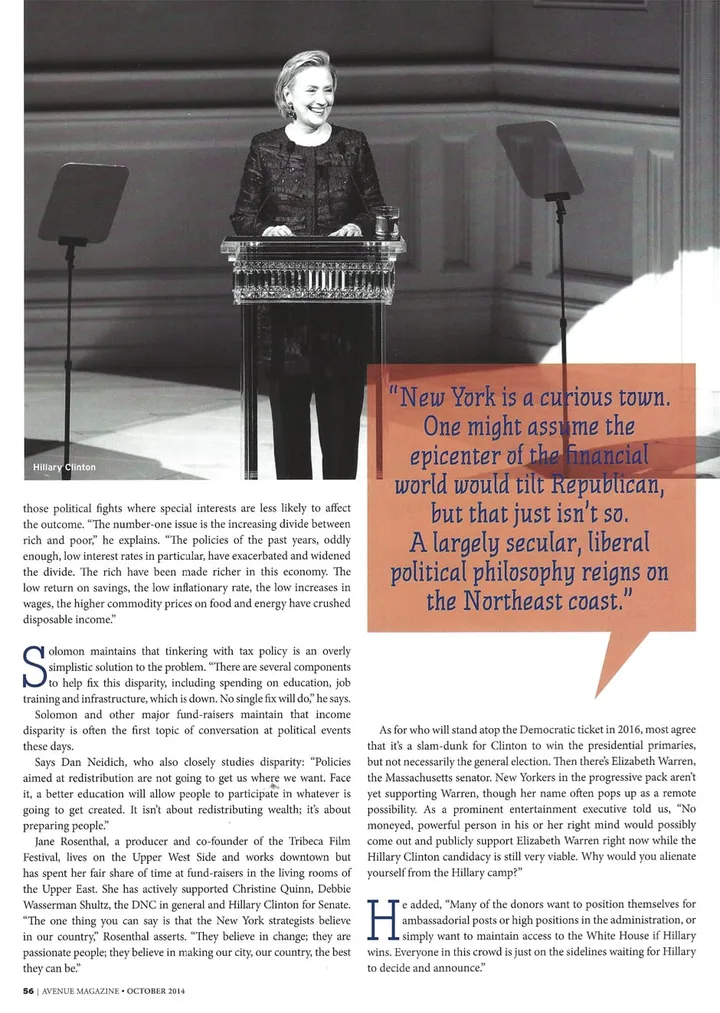
As for who will stand atop the Democratic ticket in 2016, most agree that it’s a slam-dunk for Clinton to win the presidential primaries, but not necessarily the general election. Then there’s Elizabeth Warren, the Massachusetts senator. New Yorkers in the progressive pack aren’t yet supporting Warren, though her name often pops up as a remote possibility. As a prominent entertainment executive told us, “No moneyed, powerful person in his or her right mind would possibly come out and publicly support Elizabeth Warren right now while the Hillary Clinton candidacy is still very viable. Why would you alienate yourself from the Hillary camp?”
He added, “Many of the donors want to position themselves for ambassadorial posts or high positions in the administration, or simply want to maintain access to the White House if Hillary wins. Everyone in this crowd is just on the sidelines waiting for Hillary to decide and announce.”
If Clinton does toss her hat in the ring, Maureen White, a visiting scholar working on humanitarian issues at the Johns Hopkins School of Advanced International Studies, former finance chair of the Democratic National Committee (2001-06) and co-chair of Clinton’s national finance committee in 2008, she’ll jump right in and support her again. White’s husband, financier Steven Rattner, was known as the Car Czar in the Obama administration’s first term for his role in saving the auto industry. White is fixated on America’s foreign policy and overseas standing, a recent source of friction between Clinton and President Obama, following an article in which the former secretary of state was quoted as linking the rise of the rabid terror group to Obama’s Syrian policy to date. “I’m looking for a more muscular foreign policy,” says White, “a more aggressive, diplomatic and participatory stance on conflicts in the world.”
Asked what she thinks about Clinton’s contribution to America’s current overseas troubles during her tenure as secretary of state, White replies, “I think Hillary Clinton did the job that was assigned to her. She was a member of the administration in the modern age, where foreign policy is made in the White House. She didn’t have a long leash. Going into the next election, how we present our foreign policy will be a defining line.”
Many Americans voice a partisan fear that the constant bickering in Congress impedes progress by either side. “Our political activism has been a very enriching experience through which we’ve made many deep friendships. It has encouraged us to work on issues and to understand better how our government and political system works—or doesn’t work,” says Alan Patricof, managing director of Greycroft Partners. Patricof and his wife Susan have been among the more prominent Democratic fund-raisers and are perhaps best known for their swanky soirees hosting the Clintons in the Hamptons. But right now, they say, things aren’t working well at all. “We are very concerned about Washington not doing enough because of the stalemates in Congress,” Alan Patricof says.
Some elements of the political process are working, though, says Andre Bishop, producing artistic director of the Lincoln Center Theater. He and his husband Peter Manning, founder and creative director of Peter Manning/Five Eight New York, were among the first gay couples to adopt a child in New York State, in 1998, and have since married. Bishop sees their experience as a cause for optimism, despite the push from the Right to re-open the debate on social issues like abortion. “What’s been so interesting is, despite the pull to the right, and all this conservative movement that has now ripped this country apart, one of the things that seems to be flourishing is marriage equality,” Bishop points out. “Gay marriage seems to be acceptable to lawmakers. Whether Republicans feel it’s a good thing or not, there’s a feeling of inevitability about it, that perhaps it’s not the hot issue that they thought it would be.”
Indeed, the 10021 Democratic fund-raisers have more than a few things in common with their counterparts on the other side of America’s political divide. Like New York’s Republicans, they are generously putting their money where their mouths are, maintaining Manhattan’s status as the nation’s first fund-raising fountain. All are fighting for political philosophies, policies and laws they believe in, but their fund-raising also has the added benefit of keeping them, and through them, all New Yorkers, close to the sources of power they support.
Some stay close to that flame to ensure that their strong political beliefs turn into action. Others certainly hope for mere proximity to power or for positions in government.
But even in this era of discord, one old-fashioned assumption still holds true: Politicians, as a rule, don’t often bite the hands that feed them.