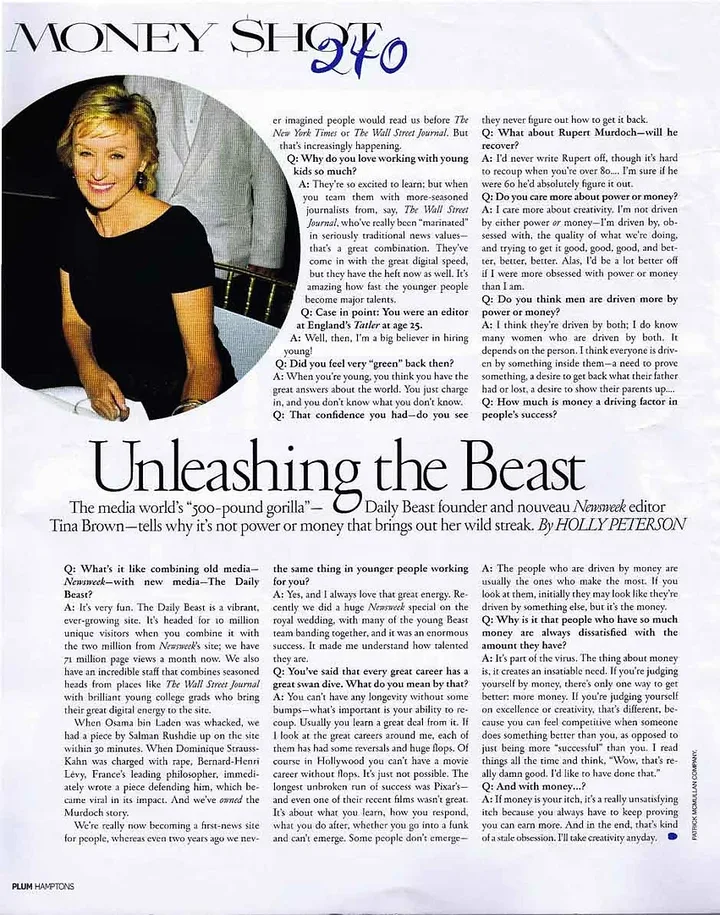
Q: What’s it like combining old media — Newsweek — with new media — The Daily Beast?
A: Very fun. The Daily Beast is a vibrant, ever-growing site. It’s headed for 10 million unique visitors who combined it with the two million from Newsweek’s site; we have 14 million page views a month now. We also have an incredible staff that combines seasoned people from places like The Wall Street Journal to brilliant young college grads who bring their great digital energy to the site.
Q: Case in point. You were an editor at England’s Tatler at age 25.
A: Well, then, I’m a big believer in hiring young.
Q: Did you feel very “green back then”?
A: When you’re young, you think you have the great answers about the world. You just charge in, and you don’t know what you don’t know.
Q: That confidence you had — do you see the same thing in younger people working for you?
A: Yes, and I always love that great energy. Recently we did a huge Newsweek special on the royal wedding, with many of the young Beast members band together, and it was an enormous success. It made one understand how talented they are.
Q: You’ve said that every great career has a great rotten side. What do you mean by that?
A: You can’t have any longevity without some bumps — what’s important is your ability to re-coup. Frankly you learn a great deal from it. If I look at the great careers around me, each of them has had some reversals and huge flops. Of course in Hollywood you can’t have a movie career without flops; it’s just not possible. The longest unbroken run of success was Pixar — and even one of their recent films wasn’t great. It’s about what you learn, how you respond, what you do after, whether you go into a funk and can’t emerge. Some people don’t emerge — they never figure out how to get it back.
Q: What about Rupert Murdoch — will he recover?
A: I’d never write Rupert off, though it’s hard to recoup when you’re over 80… I’m sure if he were 60 he’d absolutely figure it out.
Q: Do you care more about power or money?
A: I care more about creativity. I’m not driven by either power or money — I’m driven by, obsessed with, the quality of what we’re doing, and trying to get it good, good, good, and better, better, better. Also, I’d be a lot better off if I were more obsessed with power or money than I am.
Q: Do you think men are driven more by power or money?
A: I think they’re driven by both. I do know many women who are driven by both. It depends on the person. I think everyone is driven by something inside them — a need to prove something, a desire to get back what their father had or lost, a desire to show their parents up…
Q: How much is money a driving factor in people’s success?
A: The people who are driven by money are usually the ones who make the most. If you look at them, initially they may look like they’re driven by something else, but it’s the money.
Q: Why is it that people who have so much money are always dissatisfied with the amount they have?
A: It’s part of the game. The thing about money is, it creates an insatiable need. If you’re judging yourself by money, there’s only one way to get better: more money. If you’re judging yourself on excellence or creativity, that’s different, because you can feel compensated when something does something better than you, as opposed to just being more “successful” than you. I find clinging all the time and think, “Wow, that’s a damn good job. I’d like to have done that.”
Q: And with power?
A: If money is your itch, it’s a really unsatisfying itch because you always have to keep proving you can earn more. And the need, frankly, to be of a stale obsession. I’d take creativity anyday.
Q: Why do you love working with young kids so much?
A: They’re so excited to learn; but when you team them with more seasoned journalists from, say, The Wall Street Journal, who’ve really been “marinated” in seriously traditional news values — that’s a great combination. They’ve come to work with the great digital speed, but they have the heft now as well. It’s amazing how fast the younger people become major talents.
Q: Imagined people would read us before The New York Times or The Wall Street Journal. But that’s increasingly happening, right?
A: Yes, it is.