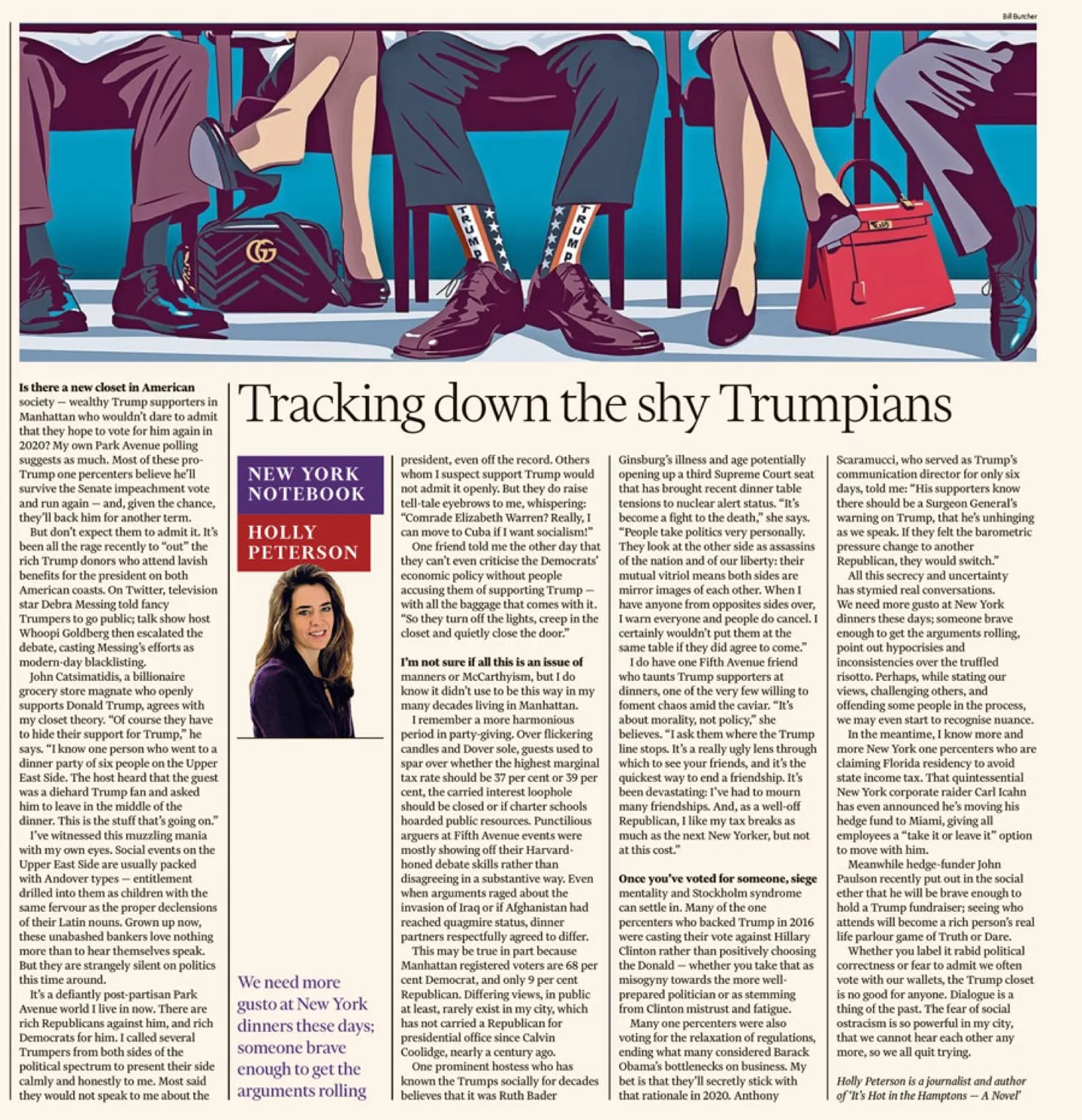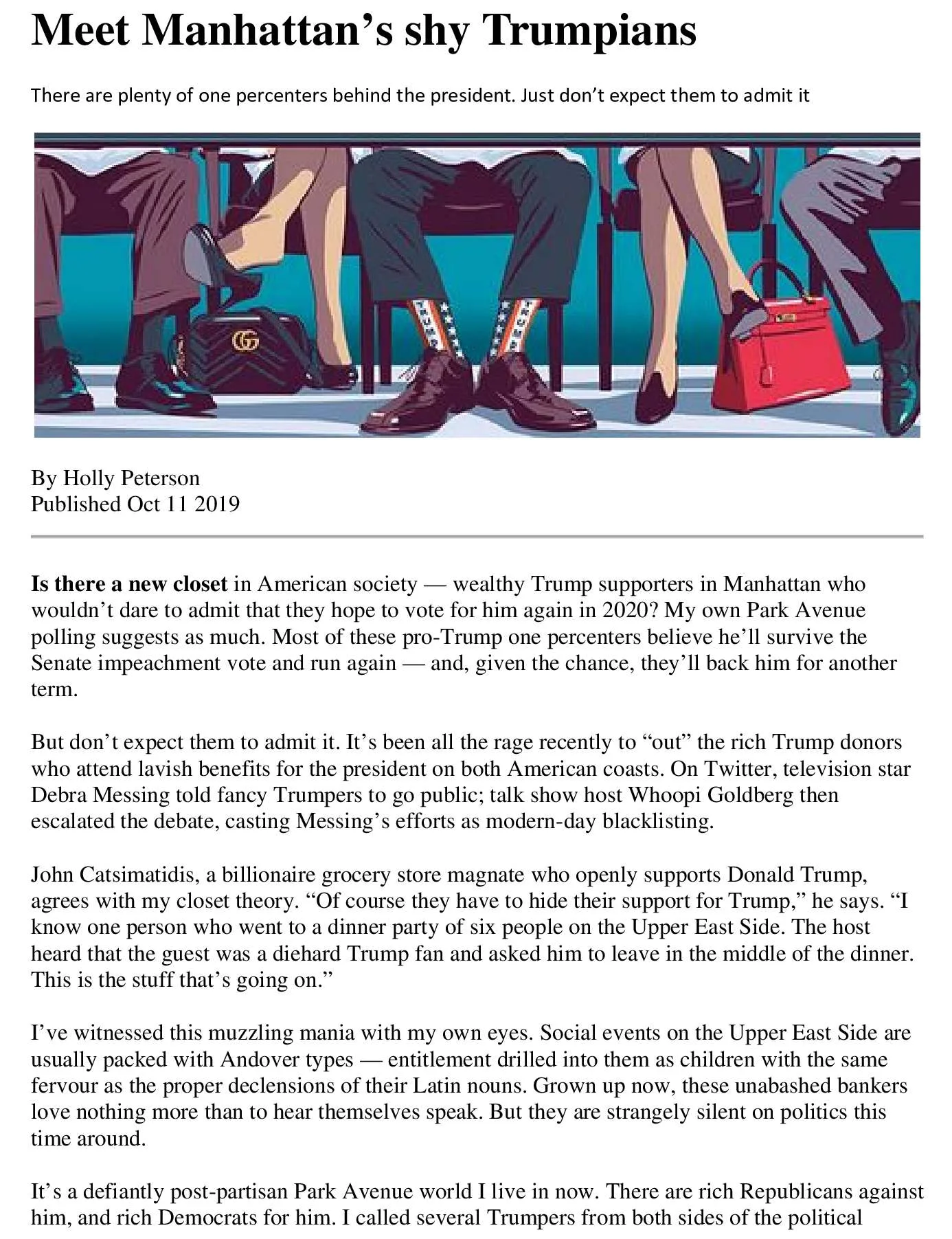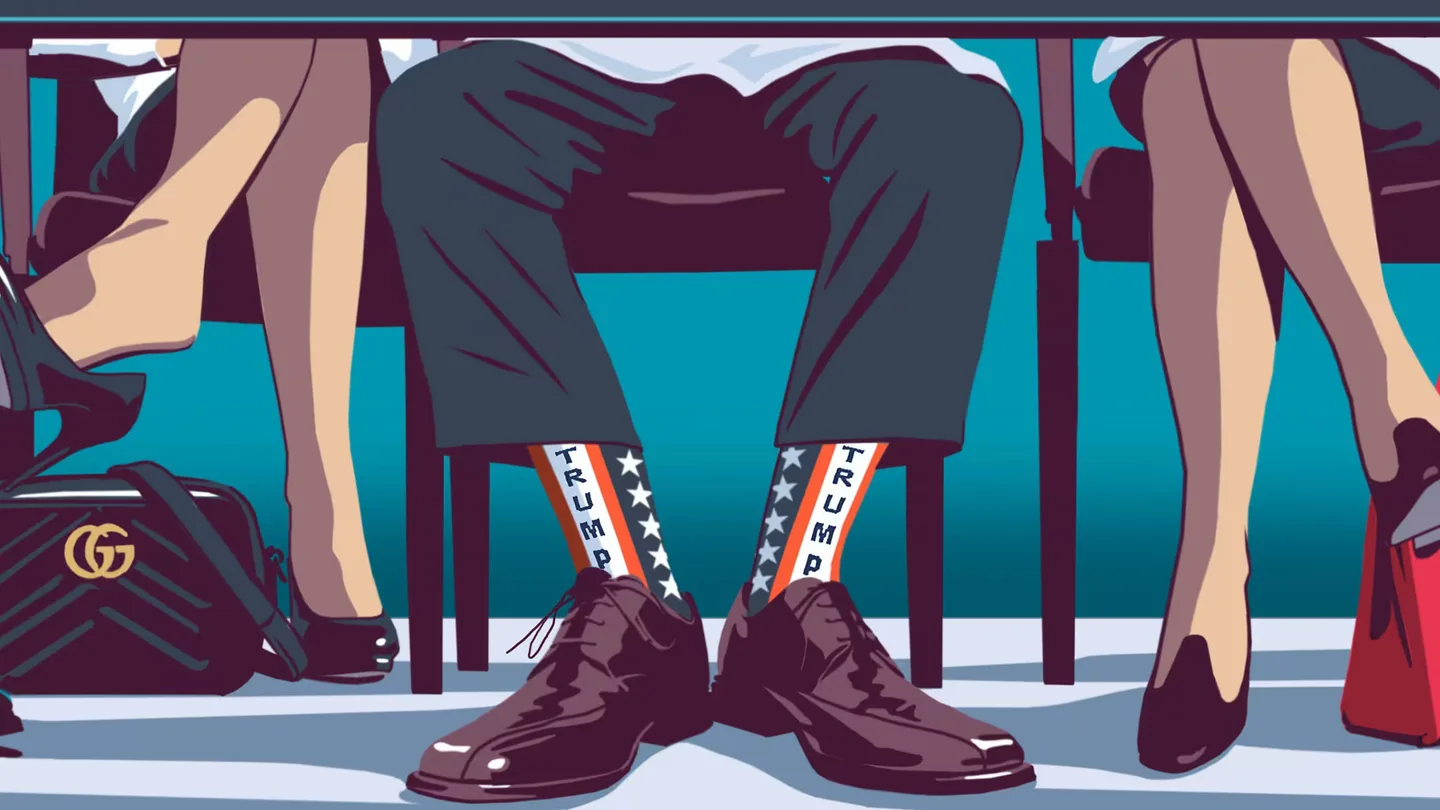
Is there a new closet in American society — wealthy Trump supporters in Manhattan who wouldn’t dare to admit that they hope to vote for him again in 2020? My own Park Avenue polling suggests as much. Most of these pro-Trump one percenters believe he’ll survive the Senate impeachment vote and run again — and, given the chance, they’ll back him for another term.
But don’t expect them to admit it. It’s been all the rage recently to “out” the rich Trump donors who attend lavish benefits for the president on both American coasts. On Twitter, television star Debra Messing told fancy Trumpers to go public; talk show host Whoopi Goldberg then escalated the debate, casting Messing’s efforts as modern-day blacklisting.
John Catsimatidis, a billionaire grocery store magnate who openly supports Donald Trump, agrees with my closet theory. “Of course they have to hide their support for Trump,” he says. “I know one person who went to a dinner party of six people on the Upper East Side. The host heard that the guest was a diehard Trump fan and asked him to leave in the middle of the dinner. This is the stuff that’s going on.”
I’ve witnessed this muzzling mania with my own eyes. Social events on the Upper East Side are usually packed with Andover types — entitlement drilled into them as children with the same fervour as the proper declensions of their Latin nouns. Grown up now, these unabashed bankers love nothing more than to hear themselves speak. But they are strangely silent on politics this time around.
It’s a defiantly post-partisan Park Avenue world I live in now. There are rich Republicans against him, and rich Democrats for him. I called several Trumpers from both sides of the political spectrum to present their side calmly and honestly to me. Most said they would not speak to me about the president, even off the record. Others whom I suspect support Trump would not admit it openly. But they do raise tell-tale eyebrows to me, whispering: “Comrade Elizabeth Warren? Really, I can move to Cuba if I want socialism!”
One friend told me the other day that they can’t even criticise the Democrats’ economic policy without people accusing them of supporting Trump — with all the baggage that comes with it. “So they turn off the lights, creep in the closet and quietly close the door.”
I’m not sure if all this is an issue of manners or McCarthyism, but I do know it didn’t use to be this way in my many decades living in Manhattan.
I remember a more harmonious period in party-giving. Over flickering candles and Dover sole, guests used to spar over whether the highest marginal tax rate should be 37 per cent or 39 per cent, the carried interest loophole should be closed or if charter schools hoarded public resources. Punctilious arguers at Fifth Avenue events were mostly showing off their Harvard-honed debate skills rather than disagreeing in a substantive way. Even when arguments raged about the invasion of Iraq or if Afghanistan had reached quagmire status, dinner partners respectfully agreed to differ.
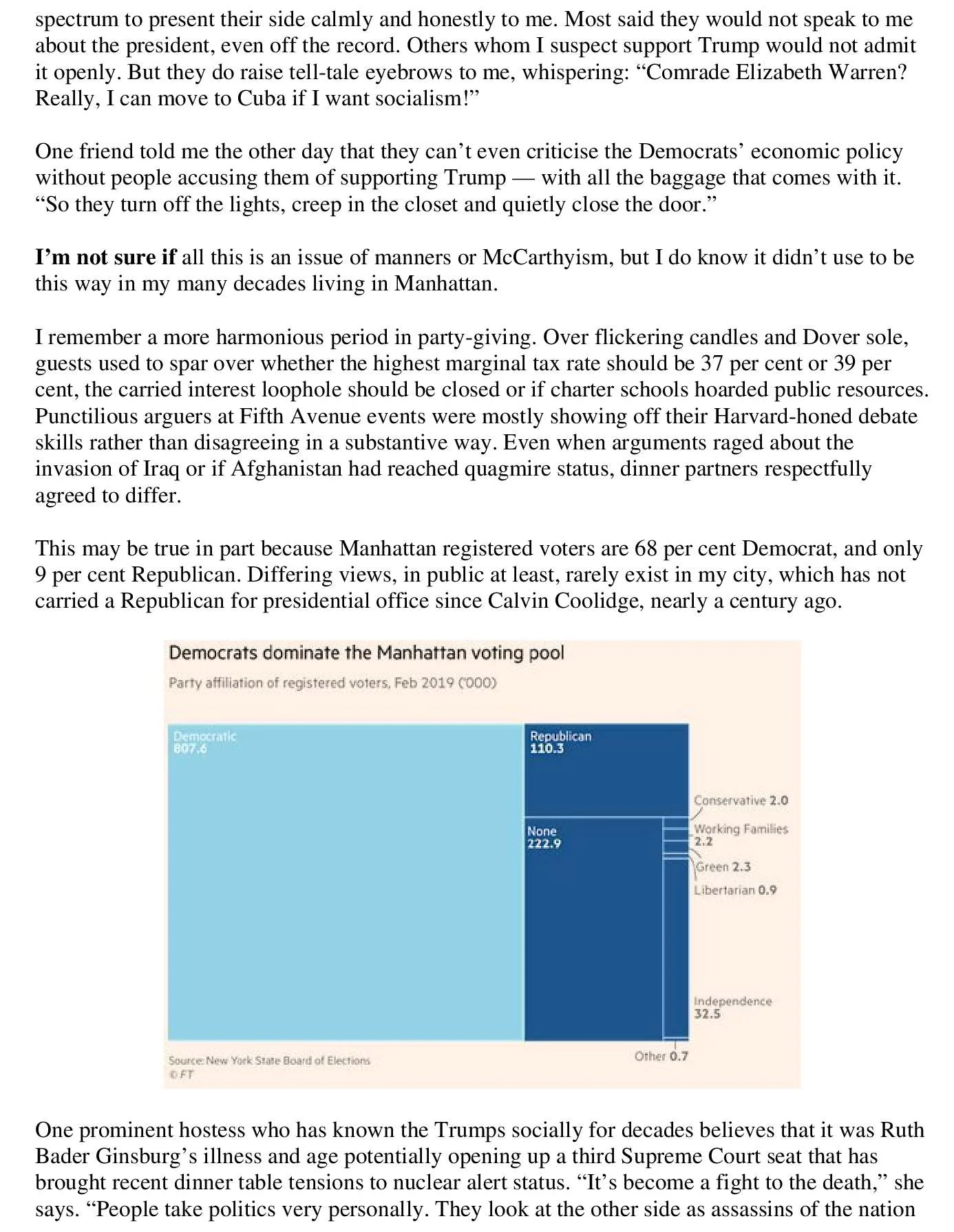
This may be true in part because Manhattan registered voters are 68 per cent Democrat, and only 9 per cent Republican. Differing views, in public at least, rarely exist in my city, which has not carried a Republican for presidential office since Calvin Coolidge, nearly a century ago.
One prominent hostess who has known the Trumps socially for decades believes that it was Ruth Bader Ginsburg’s illness and age potentially opening up a third Supreme Court seat that has brought recent dinner table tensions to nuclear alert status. “It’s become a fight to the death,” she says. “People take politics very personally. They look at the other side as assassins of the nation and of our liberty: their mutual vitriol means both sides are mirror images of each other. When I have anyone from opposites sides over, I warn everyone and people do cancel. I certainly wouldn’t put them at the same table if they did agree to come.”
I do have one Fifth Avenue friend who taunts Trump supporters at dinners, one of the very few willing to foment chaos amid the caviar. “It’s about morality, not policy,” she believes. “I ask them where the Trump line stops. It’s a really ugly lens through which to see your friends, and it’s the quickest way to end a friendship. It’s been devastating: I’ve had to mourn many friendships. And, as a well-off Republican, I like my tax breaks as much as the next New Yorker, but not at this cost.”
Once you’ve voted for someone, siege mentality and Stockholm syndrome can settle in. Many of the one percenters who backed Trump in 2016 were casting their vote against Hillary Clinton rather than positively choosing the Donald — whether you take that as misogyny towards the more well-prepared politician or as stemming from Clinton mistrust and fatigue.
Many one percenters were also voting for the relaxation of regulations, ending what many considered Barack Obama’s bottlenecks on business. My bet is that they’ll secretly stick with that rationale in 2020. Anthony Scaramucci, who served as Trump’s communication director for only six days, told me: “His supporters know there should be a Surgeon General’s warning on Trump, that he’s unhinging as we speak. If they felt the barometric pressure change to another Republican, they would switch.”
All this secrecy and uncertainty has stymied real conversations. We need more gusto at New York dinners these days; someone brave enough to get the arguments rolling, point out hypocrisies and inconsistencies over the truffled risotto. Perhaps, while stating our views, challenging others, and offending some people in the process, we may even start to recognise nuance.
In the meantime, I know more and more New York one percenters who are claiming Florida residency to avoid state income tax. That quintessential New York corporate raider Carl Icahn has even announced he’s moving his hedge fund to Miami, giving all employees a “take it or leave it” option to move with him.
Meanwhile hedge-funder John Paulson recently put out in the social ether that he will be brave enough to hold a Trump fundraiser; seeing who attends will become a rich person’s real life parlour game of Truth or Dare.
Whether you label it rabid political correctness or fear to admit we often vote with our wallets, the Trump closet is no good for anyone. Dialogue is a thing of the past. The fear of social ostracism is so powerful in my city, that we cannot hear each other any more, so we all quit trying.