Oprah Winfrey
Media entrepreneur
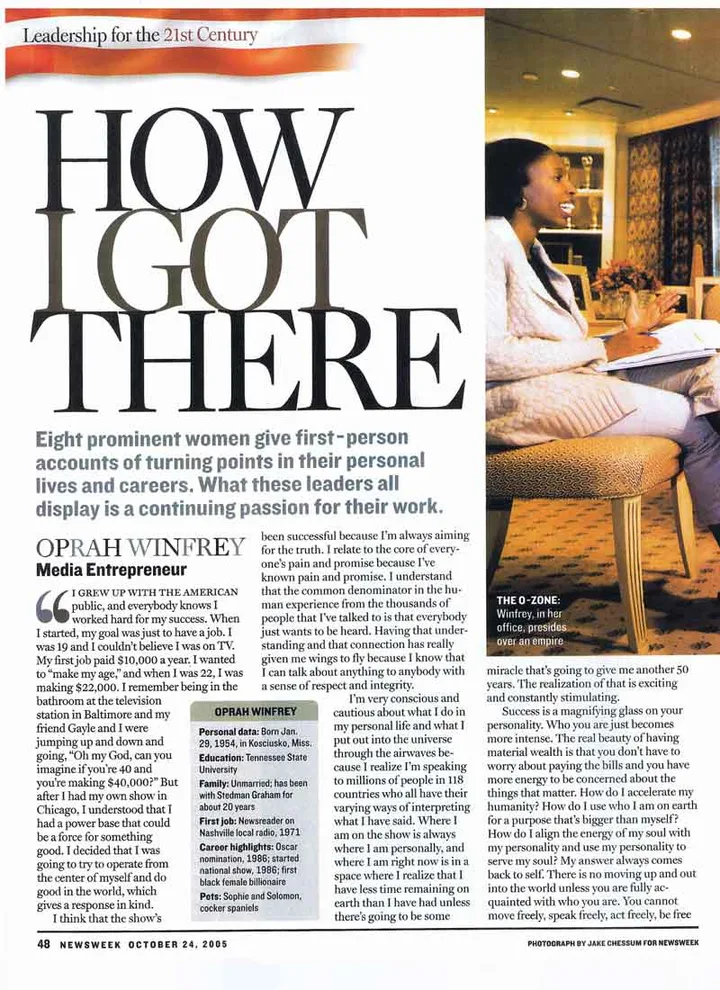
I grew up with the American public, and everybody knows I worked hard for my success. When I started, my goal was just to have a job. I was 19 and I couldn’t believe I was on TV. My first job paid $10,000 a year. I wanted to “make my age,” and when I was 22, I was making $22,000. I remember being in the bathroom at the television station in Baltimore and my friend Gayle and I were jumping up and down and going, “Oh my God, can you imagine if you’re 40 and you’re making $40,000?” But after I had my own show in Chicago, I understood that I had a power base that could be a force for something good. I decided that I was going to try to operate from the center of myself and do good in the world, which gives a response in kind.
I think that the show’s been successful because I’m always aiming for the truth. I relate to the core of everyone’s pain and promise because I’ve known pain and promise. I understand that the common denominator in the human experience from the thousands of people that I’ve talked to is that everybody just wants to be heard. Having that understanding and that connection has really given me wings to fly because I know that I can talk about anything to anybody with a sense of respect and integrity.
I’m very conscious and cautious about what I do in my personal life and what I put out into the universe through the airwaves because I realize I’m speaking to millions of people in 118 countries who all have their varying ways of interpreting what I have said. Where I am on the show is always where I am personally, and where I am right now is in a space where I realize that I have less time remaining on earth than I have had unless there’s going to be some miracle that’s going to give me another 50 years. The realization of that is exciting and constantly stimulating.
Success is a magnifying glass on your personality. Who you are just becomes more intense. The real beauty of having material wealth is that you don’t have to worry about paying the bills and you have more energy to be concerned about the things that matter. How do I accelerate my humanity? How do I use who I am on earth for a purpose that’s bigger than myself? How do I align the energy of my soul with my personality and use my personality to serve my soul? My answer always comes back to self.
There is no moving up and out into the world unless you are fully acquainted with who you are. You cannot move freely, speak freely, act freely, be free unless you are comfortable with yourself.
All the women leaders I have met led with a greater sense of intuition than men. I am almost completely intuitive. The only time I’ve made a bad business decision is when I didn’t follow my instinct. My favorite phrase is: “Let me pray on it.” Sometimes I literally do pray, but sometimes I just wait to see if I wake up and feel the same way in the morning. For me, doubt normally means don’t. Doubt means do nothing until you know what to do. And I’m really, really, really attuned to that.
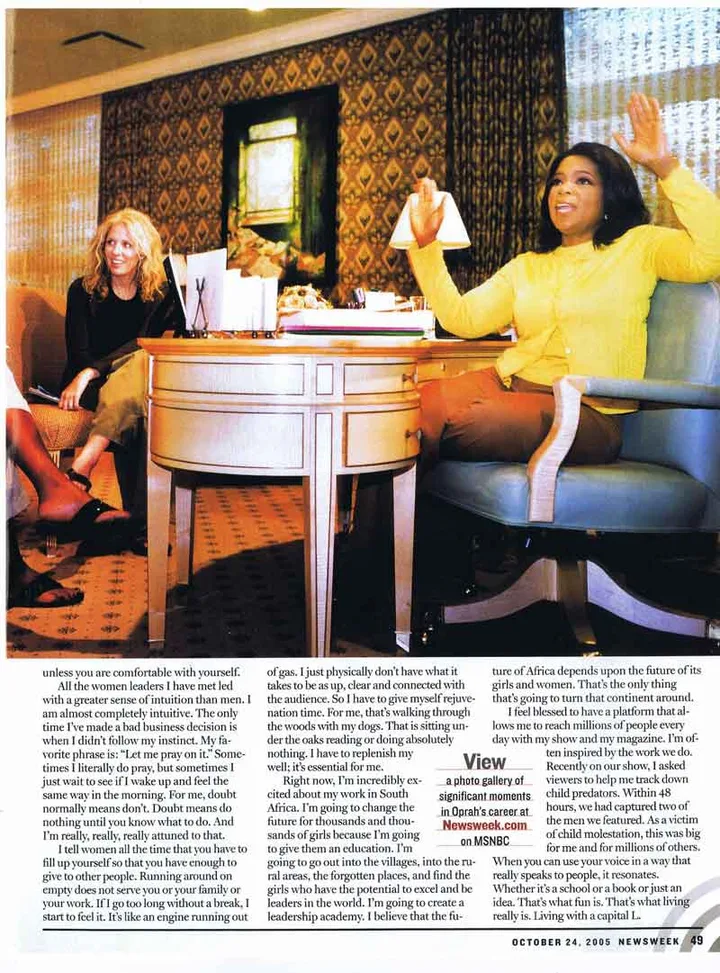
I tell women all the time that you have to fill up yourself so that you have enough to give to other people. Running around on empty does not serve you or your family or your work. If I go too long without a break, I start to feel it. It’s like an engine running out of gas. I just physically don’t have what it takes to be as up, clear and connected with the audience. So I have to give myself rejuvenation time. For me, that’s walking through the woods with my dogs. That is sitting under the oaks reading or doing absolutely nothing. I have to replenish my well; it’s essential for me.
Right now, I’m incredibly excited about my work in South Africa. I’m going to change the future for thousands and thousands of girls because I’m going to give them an education. I’m going to go out into the villages, into the rural areas, the forgotten places, and find the girls who have the potential to excel and be leaders in the world. I’m going to create a leadership academy. I believe that the future of Africa depends upon the future of its girls and women. That’s the only thing that’s going to turn that continent around.
I feel blessed to have a platform that allows me to reach millions of people every day with my show and my magazine. I’m often inspired by the work we do. Recently on our show, I asked viewers to help me track down child predators. Within 48 hours, we had captured two of the men we featured. As a victim of child molestation, this was big for me and for millions of others. When you can use your voice in a way that really speaks to people, it resonates. Whether it’s a school or a book or just an idea. That’s what fun is. That’s what living really is. Living with a capital L.
Vera Wang
Fashion designer
I knew the world I wanted to be in, but I wasn’t sure I could break into that world. My mother was an incredible clotheshorse, so I grew up loving fashion. I lived in Paris during my junior and senior years at Sarah Lawrence. When you’re in Paris, you can’t help but notice fashion. I wanted something to do with fashion. I would have done anything. I would have swept floors. I would have licked envelopes. I just wanted to be part of it.
In the summers, I worked for Yves Saint Laurent — as a salesgirl in the boutique on Madison Avenue. I met Frances Patiky Stein, an editor at Vogue. She told me to give her a call when I got out of college. I did and I got a job. She felt I had a special something. On my first day at Vogue, I wore Saint Laurent and my nails were painted black or red, which was very much the rage in Paris at the time for young women. The editors looked at me and said, “Go home and get changed because you’re going to be doing dirt work.” I came back wearing jeans. It was a dream come true.
Vogue is a seductive place because of what you get to see and what you’re privy to; it’s a world that I can’t even explain. I thought I would do it for a year or two and I ended up staying 16 years. During that time, I rose to be one of the youngest editors ever in the history of Vogue. By 23, I was a senior editor, and then I became European editor for American Vogue in Paris.
I think I always had an eye and Vogue made that eye even sharper. An eye is a new way of viewing something old. Everything’s been done in fashion. It’s how you bring newness to the concept. I mean, a white shirt is a white shirt, but how do you wear it? Those are the things that editors are always searching for, particularly in a picture because you only have so long to capture the magic of fashion.
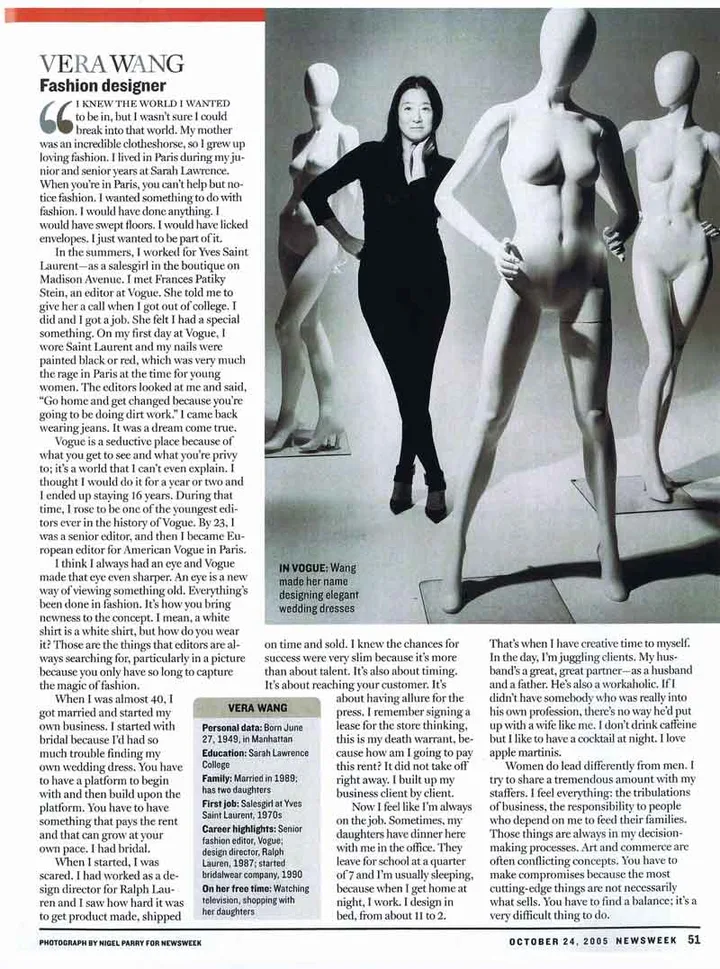
When I was almost 40, I got married and started my own business. I started with bridal because I’d had so much trouble finding my own wedding dress. You have to have a platform to begin with and then build upon the platform. You have to have something that pays the rent and that can grow at your own pace. I had bridal.
When I started, I was scared. I had worked as a design director for Ralph Lauren and I saw how hard it was to get product made, shipped on time and sold. I knew the chances for success were very slim because it’s more than about talent. It’s also about timing. It’s about reaching your customer. It’s about having allure for the press. I remember signing a lease for the store thinking, this is my death warrant, because how am I going to pay this rent? It did not take off right away. I built up my business client by client.
Now I feel like I’m always on the job. Sometimes, my daughters have dinner here with me in the office. They leave for school at a quarter of 7 and I’m usually sleeping, because when I get home at night, I work. I design in bed, from about 11 to 2. That’s when I have creative time to myself. In the day, I’m juggling clients. My husband’s a great, great partner — as a husband and a father. He’s also a workaholic. If I didn’t have somebody who was really into his own profession, there’s no way he’d put up with a wife like me. I don’t drink caffeine but I like to have a cocktail at night. I love apple martinis.
Women do lead differently from men. I try to share a tremendous amount with my staffers. I feel everything: the tribulations of business, the responsibility to people who depend on me to feed their families. Those things are always in my decision-making processes. Art and commerce are often conflicting concepts. You have to make compromises because the most cutting-edge things are not necessarily what sells. You have to find a balance; it’s a very difficult thing to do.
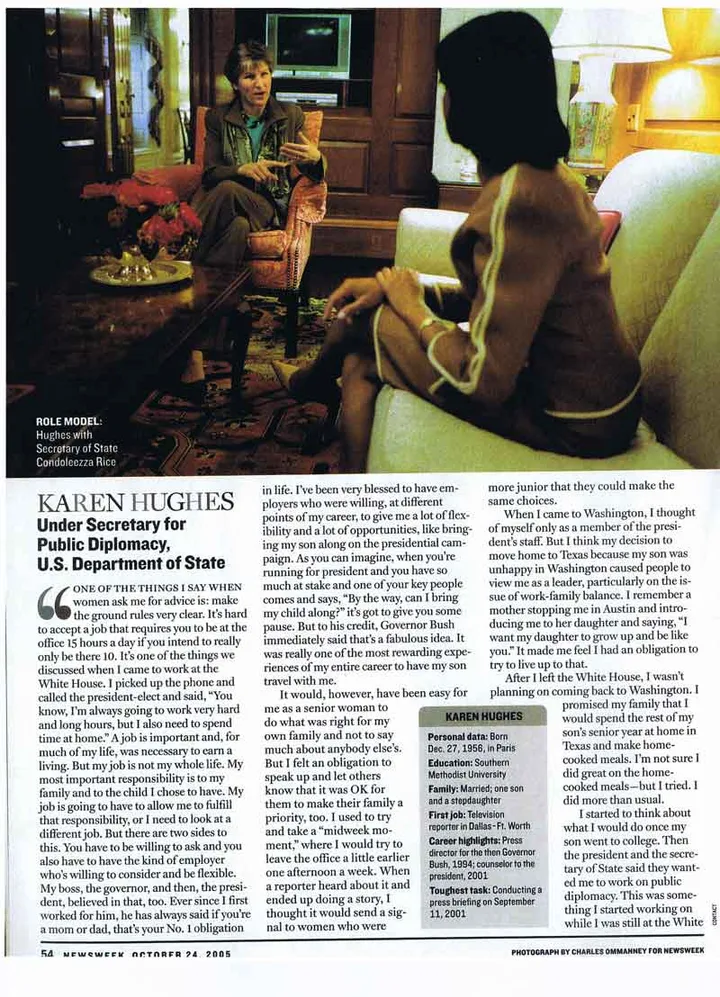
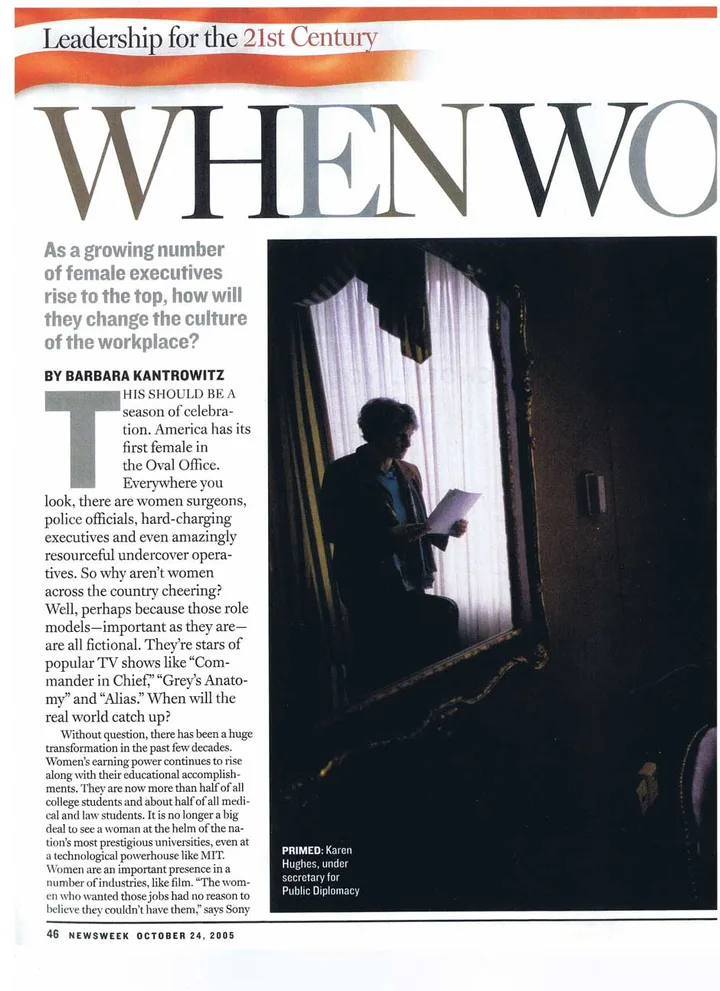
Karen Hughes
Under secretary for public diplomacy, U.S. Department of State
One of the things I say when women ask me for advice is: make the ground rules very clear. It’s hard to accept a job that requires you to be at the office 15 hours a day if you intend to really only be there 10. It’s one of the things we discussed when I came to work at the White House.
I picked up the phone and called the president-elect and said, “You know, I’m always going to work very hard and long hours, but I also need to spend time at home.” A job is important and, for much of my life, was necessary to earn a living. But my job is not my whole life. My most important responsibility is to my family and to the child I chose to have. My job is going to have to allow me to fulfill that responsibility, or I need to look at a different job. But there are two sides to this. You have to be willing to ask and you also have to have the kind of employer who’s willing to consider and be flexible.
My boss, the governor, and then, the president, believed in that, too. Ever since I first worked for him, he has always said if you’re a mom or dad, that’s your No. 1 obligation in life. I’ve been very blessed to have employers who were willing, at different points of my career, to give me a lot of flexibility and a lot of opportunities, like bringing my son along on the presidential campaign. As you can imagine, when you’re running for president and you have so much at stake and one of your key people comes and says, “By the way, can I bring my child along?” it’s got to give you some pause. But to his credit, Governor Bush immediately said that’s a fabulous idea. It was really one of the most rewarding experiences of my entire career to have my son travel with me.
It would, however, have been easy for me as a senior woman to do what was right for my own family and not to say much about anybody else’s. But I felt an obligation to speak up and let others know that it was OK for them to make their family a priority, too. I used to try and take a “midweek moment,” where I would try to leave the office a little earlier one afternoon a week. When a reporter heard about it and ended up doing a story, I thought it would send a signal to women who were more junior that they could make the same choices.
When I came to Washington, I thought of myself only as a member of the president’s staff. But I think my decision to move home to Texas because my son was unhappy in Washington caused people to view me as a leader, particularly on the issue of work-family balance. I remember a mother stopping me in Austin and introducing me to her daughter and saying, “I want my daughter to grow up and be like you.” It made me feel I had an obligation to try to live up to that.
After I left the White House, I wasn’t planning on coming back to Washington. I promised my family that I would spend the rest of my son’s senior year at home in Texas and make home-cooked meals. I’m not sure I did great on the home-cooked meals — but I tried. I did more than usual.
I started to think about what I would do once my son went to college. Then the president and the secretary of State said they wanted me to work on public diplomacy. This was something I started working on while I was still at the White House. After September 11, I realized that we were not doing a very effective job as a government in communicating with the world. I said I couldn’t start until later in the year, after my son left. But I compromised on that. When I was in Washington for the Inaugural, I had breakfast with my son and asked him what he thought about it. He said, “I think you ought to do it. You really care about it and it’s really important to my generation.” That just really hit me. It is important to his generation.
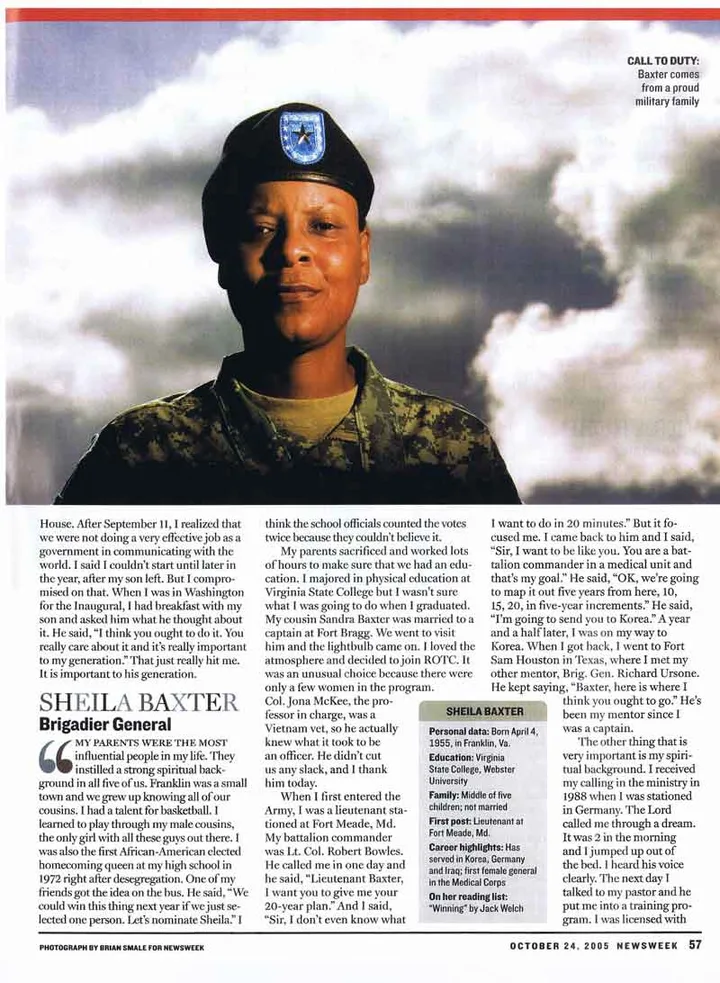
Sheila Baxter
Brigadier general
My parents were the most influential people in my life. They instilled a strong spiritual background in all five of us. Franklin was a small town and we grew up knowing all of our cousins. I had a talent for basketball. I learned to play through my male cousins, the only girl with all these guys out there. I was also the first African-American elected homecoming queen at my high school in 1972 right after desegregation. One of my friends got the idea on the bus. He said, “We could win this thing next year if we just selected one person. Let’s nominate Sheila.” I think the school officials counted the votes twice because they couldn’t believe it.
My parents sacrificed and worked lots of hours to make sure that we had an education. I majored in physical education at Virginia State College but I wasn’t sure what I was going to do when I graduated. My cousin Sandra Baxter was married to a captain at Fort Bragg. We went to visit him and the lightbulb came on. I loved the atmosphere and decided to join ROTC. It was an unusual choice because there were only a few women in the program. Col. Jona McKee, the professor in charge, was a Vietnam vet, so he actually knew what it took to be an officer. He didn’t cut us any slack, and I thank him today.
When I first entered the Army, I was a lieutenant stationed at Fort Meade, Md. My battalion commander was Lt. Col. Robert Bowles. He called me in one day and he said, “Lieutenant Baxter, I want you to give me your 20-year plan.” And I said, “Sir, I don’t even know what I want to do in 20 minutes.” But it focused me. I came back to him and I said, “Sir, I want to be like you. You are a battalion commander in a medical unit and that’s my goal.” He said, “OK, we’re going to map it out five years from here, 10, 15, 20, in five-year increments.” He said, “I’m going to send you to Korea.” A year and a half later, I was on my way to Korea. When I got back, I went to Fort Sam Houston in Texas, where I met my other mentor, Brig. Gen. Richard Ursone. He kept saying, “Baxter, here is where I think you ought to go.” He’s been my mentor since I was a captain.
The other thing that is very important is my spiritual background. I received my calling in the ministry in 1988 when I was stationed in Germany. The Lord called me through a dream. It was 2 in the morning and I jumped up out of the bed. I heard his voice clearly. The next day I talked to my pastor and he put me into a training program. I was licensed with the Church of God in Christ. When I retire, I plan to go to seminary and pursue a divinity degree.
I’m the commanding general at Madigan. We are responsible for the health care for six surrounding states and also for soldiers coming back from Iraq and Afghanistan. Every week we go up on the wards and talk to the soldiers. You look them in the eye and they say, “Hey, I was just doing my job and I want to go back and be with my buddies.” That’s an incredible inspiration.
My sister Nadine and my other siblings have always been there for me. Being promoted to brigadier was huge. We had the ceremony at the Women’s Memorial in Washington, D.C. All of my family members were there, my brothers and sisters, my uncles and aunts. My father was an infantryman in World War II and two of my uncles have served. One of my brothers was Air Force, three cousins were Air Force, one was in the Marines and two were in the Navy. I have a niece who is in Iraq today. I’m very proud of her.
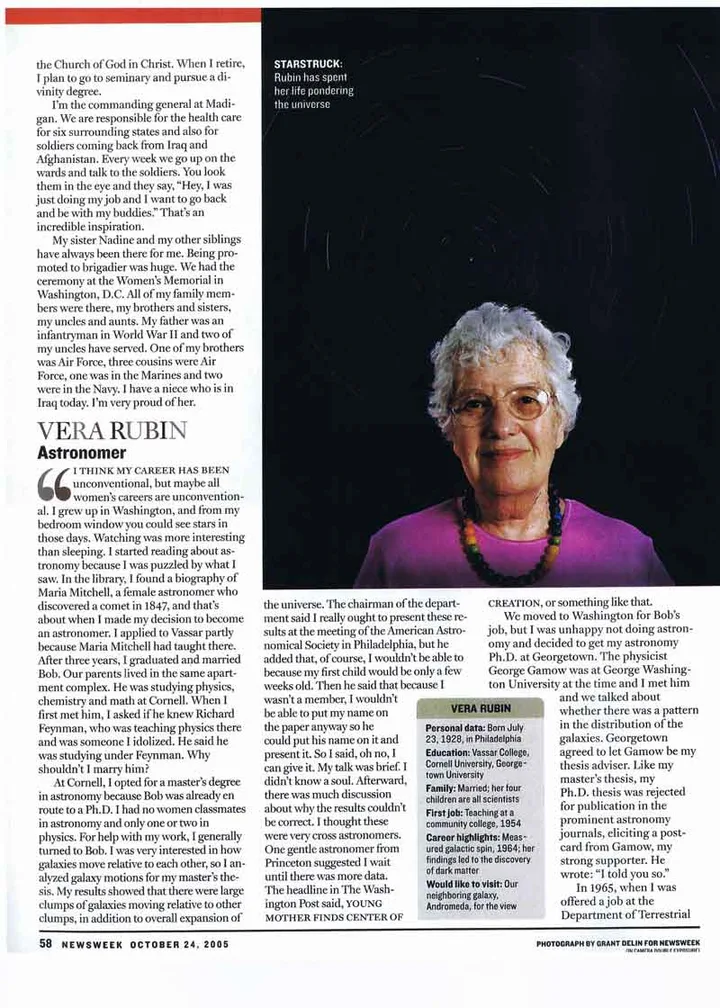
Vera Rubin
Astronomer
I think my career has been unconventional, but maybe all women’s careers are unconventional. I grew up in Washington, and from my bedroom window you could see stars in those days. Watching was more interesting than sleeping. I started reading about astronomy because I was puzzled by what I saw. In the library, I found a biography of Maria Mitchell, a female astronomer who discovered a comet in 1847, and that’s about when I made my decision to become an astronomer.
I applied to Vassar partly because Maria Mitchell had taught there. After three years, I graduated and married Bob. Our parents lived in the same apartment complex. He was studying physics, chemistry and math at Cornell. When I first met him, I asked if he knew Richard Feynman, who was teaching physics there and was someone I idolized. He said he was studying under Feynman. Why shouldn’t I marry him?
At Cornell, I opted for a master’s degree in astronomy because Bob was already en route to a Ph.D. I had no women classmates in astronomy and only one or two in physics. For help with my work, I generally turned to Bob. I was very interested in how galaxies move relative to each other, so I analyzed galaxy motions for my master’s thesis. My results showed that there were large clumps of galaxies moving relative to other clumps, in addition to overall expansion of the universe.
The chairman of the department said I really ought to present these results at the meeting of the American Astronomical Society in Philadelphia, but he added that, of course, I wouldn’t be able to because my first child would be only a few weeks old. Then he said that because I wasn’t a member, I wouldn’t be able to put my name on the paper anyway so he could put his name on it and present it. So I said, oh no, I can give it. My talk was brief. I didn’t know a soul. Afterward, there was much discussion about why the results couldn’t be correct. I thought these were very cross astronomers. One gentle astronomer from Princeton suggested I wait until there was more data. The headline in The Washington Post said, young mother finds center of creation, or something like that.
We moved to Washington for Bob’s job, but I was unhappy not doing astronomy and decided to get my astronomy Ph.D. at Georgetown. The physicist George Gamow was at George Washington University at the time and I met him and we talked about whether there was a pattern in the distribution of the galaxies. Georgetown agreed to let Gamow be my thesis adviser. Like my master’s thesis, my Ph.D. thesis was rejected for publication in the prominent astronomy journals, eliciting a postcard from Gamow, my strong supporter. He wrote: “I told you so.”
In 1965, when I was offered a job at the Department of Terrestrial Magnetism at the Carnegie Institution of Washington, I said I wanted to go home at 3 every day. So they offered two thirds of the salary I was getting teaching at Georgetown. There had never been a woman staff member. Ten years later I asked to be paid full time, and I was. Then I said, “I’m still going home at 3.”
With Kent Ford, a staff member who had built a telescope instrument that could measure accurate motions of the galaxies, I spent my observing times over the next 25 years measuring speeds of stars in galaxies and motions of galaxies in the universe. Night after night, with my eye at the telescope eyepiece, I wondered if someone was looking down on our galaxy. Some exposures were six hours each, only two exposures on a long winter night. It could get very boring and almost disorienting. Every 20 minutes or so, I would flash a light just to show where the floor was. I always feel like I’m racing the sunrise when I’m observing. Now, you’re at the computer, not in the dome. It’s very unromantic. On the other hand, you learn a lot more each night.
When Kent and I discovered that the motions of stars within a galaxy showed that most of the matter in a galaxy is invisible and not radiating, I expected we’d soon learn what dark matter is. That was 30 years ago, and I’m impatient. We still don’t understand what dark matter consists of.
I’m also impatient about the progress of women in academia, which has been much worse than industry. The statistics for women scientists are pathetic. This is a battle young women may have to fight. Thirty years ago we thought the battle would be over soon, but equality is as elusive as dark matter.
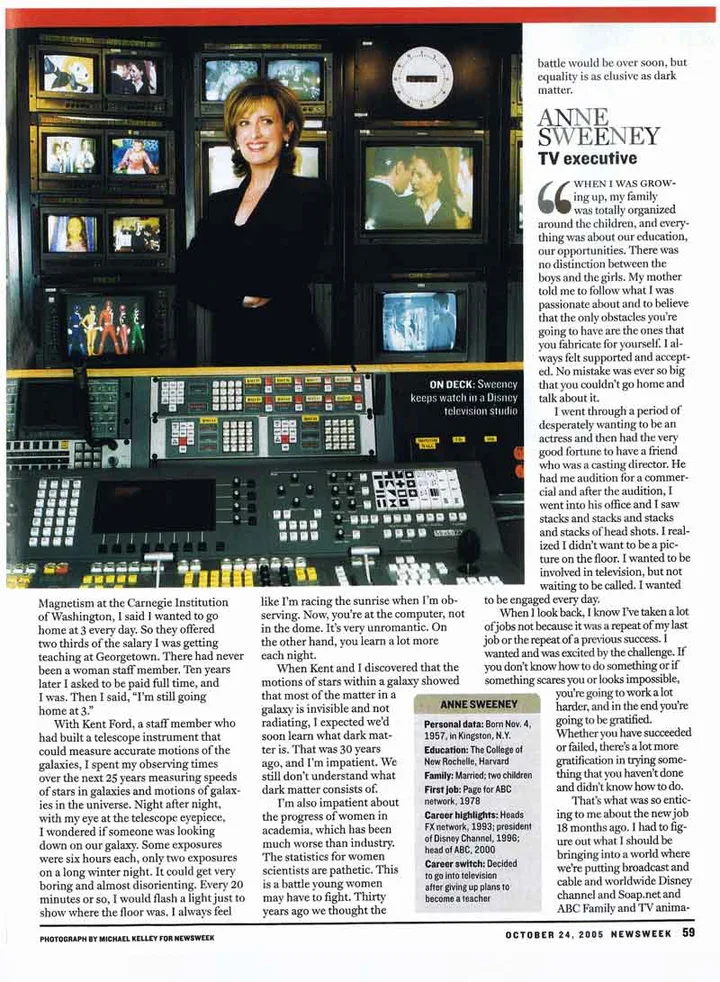
Anne Sweeney
TV executive
When I was growing up, my family was totally organized around the children, and everything was about our education, our opportunities. There was no distinction between the boys and the girls. My mother told me to follow what I was passionate about and to believe that the only obstacles you’re going to have are the ones that you fabricate for yourself. I always felt supported and accepted. No mistake was ever so big that you couldn’t go home and talk about it.
I went through a period of desperately wanting to be an actress and then had the very good fortune to have a friend who was a casting director. He had me audition for a commercial and after the audition, I went into his office and I saw stacks and stacks and stacks and stacks of head shots. I realized I didn’t want to be a picture on the floor. I wanted to be involved in television, but not waiting to be called. I wanted to be engaged every day.
When I look back, I know I’ve taken a lot of jobs not because it was a repeat of my last job or the repeat of a previous success. I wanted and was excited by the challenge. If you don’t know how to do something or if something scares you or looks impossible, you’re going to work a lot harder, and in the end you’re going to be gratified. Whether you have succeeded or failed, there’s a lot more gratification in trying something that you haven’t done and didn’t know how to do.
That’s what was so enticing to me about the new job 18 months ago. I had to figure out what I should be bringing into a world where we’re putting broadcast and cable and worldwide Disney Channel and SoapNet and ABC Family and TV animation and all of these pieces together. How do you make that stronger and how do you make that a more powerful segment for the company? That excited me. But it was also the great unknown. When that particular bell goes off, I’m hooked.
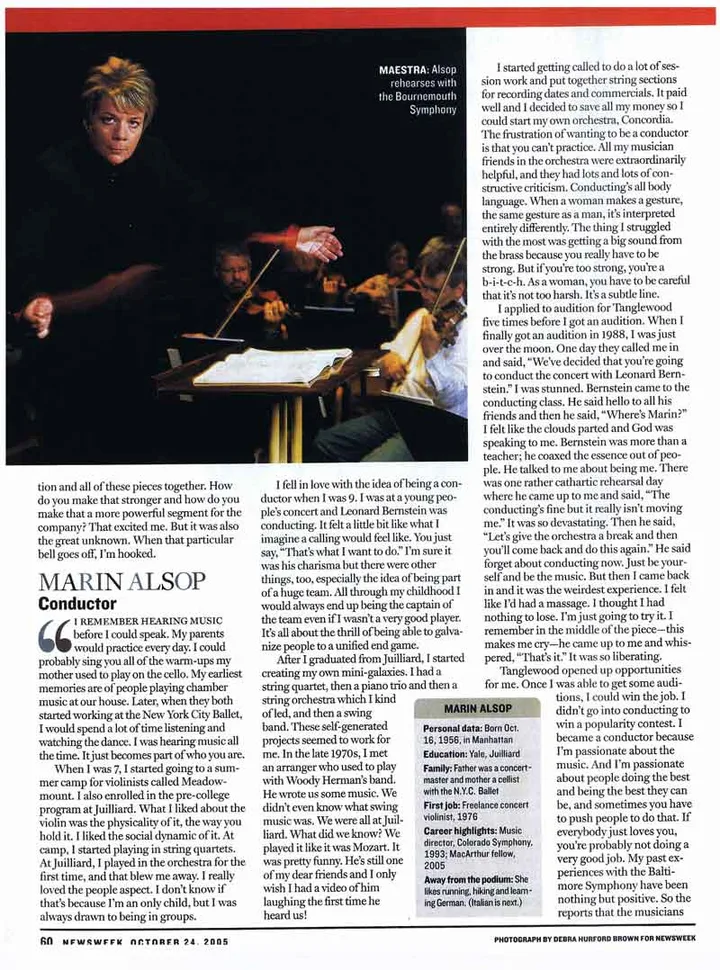
Marin Alsop
Conductor
I remember hearing music before I could speak. My parents would practice every day. I could probably sing you all of the warm-ups my mother used to play on the cello. My earliest memories are of people playing chamber music at our house. Later, when they both started working at the New York City Ballet, I would spend a lot of time listening and watching the dance. I was hearing music all the time. It just becomes part of who you are.
When I was 7, I started going to a summer camp for violinists called Meadowmount. I also enrolled in the pre-college program at Juilliard. What I liked about the violin was the physicality of it, the way you hold it. I liked the social dynamic of it. At camp, I started playing in string quartets. At Juilliard, I played in the orchestra for the first time, and that blew me away. I really loved the people aspect. I don’t know if that’s because I’m an only child, but I was always drawn to being in groups.
I fell in love with the idea of being a conductor when I was 9. I was at a young people’s concert and Leonard Bernstein was conducting. It felt a little bit like what I imagine a calling would feel like. You just say, “That’s what I want to do.” I’m sure it was his charisma but there were other things, too, especially the idea of being part of a huge team. All through my childhood I would always end up being the captain of the team even if I wasn’t a very good player. It’s all about the thrill of being able to galvanize people to a unified end game.
After I graduated from Juilliard, I started creating my own mini-galaxies. I had a string quartet, then a piano trio and then a string orchestra which I kind of led, and then a swing band. These self-generated projects seemed to work for me. In the late 1970s, I met an arranger who used to play with Woody Herman’s band. He wrote us some music. We didn’t even know what swing music was. We were all at Juilliard. What did we know? We played it like it was Mozart. It was pretty funny. He’s still one of my dear friends and I only wish I had a video of him laughing the first time he heard us!
I started getting called to do a lot of session work and put together string sections for recording dates and commercials. It paid well and I decided to save all my money so I could start my own orchestra, Concordia. The frustration of wanting to be a conductor is that you can’t practice. All my musician friends in the orchestra were extraordinarily helpful, and they had lots and lots of constructive criticism. Conducting’s all body language. When a woman makes a gesture, the same gesture as a man, it’s interpreted entirely differently. The thing I struggled with the most was getting a big sound from the brass because you really have to be strong. But if you’re too strong, you’re a b-i-t-c-h. As a woman, you have to be careful that it’s not too harsh. It’s a subtle line.
I applied to audition for Tanglewood five times before I got an audition. When I finally got an audition in 1988, I was just over the moon. One day they called me in and said, “We’ve decided that you’re going to conduct the concert with Leonard Bernstein.” I was stunned. Bernstein came to the conducting class. He said hello to all his friends and then he said, “Where’s Marin?” I felt like the clouds parted and God was speaking to me. Bernstein was more than a teacher; he coaxed the essence out of people. He talked to me about being me. There was one rather cathartic rehearsal day where he came up to me and said, “The conducting’s fine but it really isn’t moving me.” It was so devastating. Then he said, “Let’s give the orchestra a break and then you’ll come back and do this again.” He said forget about conducting now. Just be yourself and be the music. But then I came back in and it was the weirdest experience. I felt like I’d had a massage. I thought I had nothing to lose. I’m just going to try it. I remember in the middle of the piece — this makes me cry — he came up to me and whispered, “That’s it.” It was so liberating.
Tanglewood opened up opportunities for me. Once I was able to get some auditions, I could win the job. I didn’t go into conducting to win a popularity contest. I became a conductor because I’m passionate about the music. And I’m passionate about people doing the best and being the best they can be, and sometimes you have to push people to do that. If everybody just loves you, you’re probably not doing a very good job. My past experiences with the Baltimore Symphony have been nothing but positive. So the reports that the musicians were unhappy with me took me by surprise. A small group of people probably felt very disenfranchised. I have a responsibility to try to heal this orchestra and be a real champion for these musicians. I need to set an artistic agenda that will hopefully carry everybody above the turbulence.
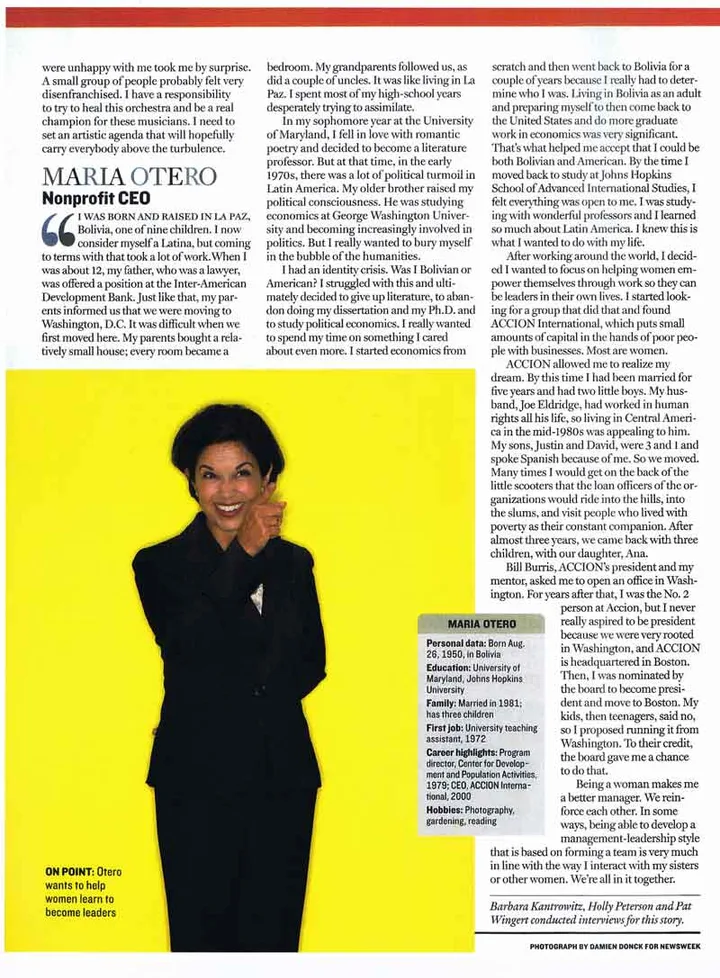
Maria Otero
Nonprofit CEO
I was born and raised in La Paz, Bolivia, one of nine children. I now consider myself a Latina, but coming to terms with that took a lot of work. When I was about 12, my father, who was a lawyer, was offered a position at the Inter-American Development Bank. Just like that, my parents informed us that we were moving to Washington, D.C. It was difficult when we first moved here. My parents bought a relatively small house; every room became a bedroom. My grandparents followed us, as did a couple of uncles. It was like living in La Paz. I spent most of my high-school years desperately trying to assimilate.
In my sophomore year at the University of Maryland, I fell in love with romantic poetry and decided to become a literature professor. But at that time, in the early 1970s, there was a lot of political turmoil in Latin America. My older brother raised my political consciousness. He was studying economics at George Washington University and becoming increasingly involved in politics. But I really wanted to bury myself in the bubble of the humanities.
I had an identity crisis. Was I Bolivian or American? I struggled with this and ultimately decided to give up literature, to abandon doing my dissertation and my Ph.D. and to study political economics. I really wanted to spend my time on something I cared about even more. I started economics from scratch and then went back to Bolivia for a couple of years because I really had to determine who I was.
Living in Bolivia as an adult and preparing myself to then come back to the United States and do more graduate work in economics was very significant. That’s what helped me accept that I could be both Bolivian and American. By the time I moved back to study at Johns Hopkins School of Advanced International Studies, I felt everything was open to me. I was studying with wonderful professors and I learned so much about Latin America. I knew this is what I wanted to do with my life.
After working around the world, I decided I wanted to focus on helping women empower themselves through work so they can be leaders in their own lives. I started looking for a group that did that and found ACCION International, which puts small amounts of capital in the hands of poor people with businesses. Most are women.
ACCION allowed me to realize my dream. By this time I had been married for five years and had two little boys. My husband, Joe Eldridge, had worked in human rights all his life, so living in Central America in the mid-1980s was appealing to him. My sons, Justin and David, were 3 and 1 and spoke Spanish because of me. So we moved. Many times I would get on the back of the little scooters that the loan officers of the organizations would ride into the hills, into the slums, and visit people who lived with poverty as their constant companion. After almost three years, we came back with three children, with our daughter, Ana.
Bill Burris, ACCION’s president and my mentor, asked me to open an office in Washington. For years after that, I was the No. 2 person at Accion, but I never really aspired to be president because we were very rooted in Washington, and ACCION is headquartered in Boston. Then, I was nominated by the board to become president and move to Boston. My kids, then teenagers, said no, so I proposed running it from Washington. To their credit, the board gave me a chance to do that.
Being a woman makes me a better manager. We reinforce each other. In some ways, being able to develop a management-leadership style that is based on forming a team is very much in line with the way I interact with my sisters or other women. We’re all in it together.
Print closing credit: Barbara Kantrowitz, Holly Peterson and Pat Wingert conducted interviews for this story.