Danica Patrick
Race-car driver
I started racing go-carts when I was 10 and, to be honest, the competitiveness started right away. It was not some fun little car track; it was a real racetrack. I was qualifying, racing under real conditions and earning points throughout the year toward a year-end championship.
Today I guess I drive pretty fast even on the highway in my Lamborghini. I do not like to drive at enormous top speed, but I do like to drive a little bit faster than everyone else. If everybody on the highway is doing 80, I want to do 82, and if people are driving 60, I want to do 62. There is something in my blood that makes me want to overtake.
I never had idols or role models. I never was striving to achieve female goals. I was just trying to be the best that I could be. I do not like to put parameters on my goals; I just like to take everything as far as I can. I learned from people I knew along the way, but I did not have somebody I wanted to be like. I wanted to be the next somebody.
I have to prove myself a few more times than a guy would have to prove himself, because women succeeding in a man’s world is still fairly new territory, especially in race-car driving. In this sport, the rules are the same for women and men, and that shows that women can compete with men under the same guidelines.
I tell young women to find what you love and dream really big, have huge aspirations for yourself and never give up. That whole never-giving-up part only happens when you want to do something badly enough or when you love something enough. My mother has had her moments with her hands over her eyes when I am racing, and there are moments when I want to put my hands over my eyes and say, “Oh, my gosh.” It is a dangerous sport, but I also believe that it is dangerous driving on the highway. So pick your poison.
When I am going three-wide in the corner at 220 miles an hour and I have cars on both sides, that is not comfortable because I cannot see them. But I get used to it. You somehow learn how to relax in those kinds of situations. In the riskier situations, I do get a little tense. I focus on how the car feels and try to make sure I am ready to respond to anything. I hold my line very well. I do not think I have time to be nervous or take any major action other than responding to the car.
Before a race, it is nerve-racking. You always want things to go well. The first thing that I get nervous about is just having a good car, a car that handles well. Then I get nervous about making the most of it and not letting down my equipment. On the track, I am aggressive and determined. When I make a pass, I believe it is going to happen. I do not just try something to try it, and I do not stick my neck out when there is only a 50 percent chance that I am going to come out on top.
You can never give up because sometimes during a race you might think there is no chance you are going to do well. The next minute, you could have an opportunity. You have to be ready for anything because things can change. It is the same in business or anything else; you can never believe you are out of the game. It is about determination and being a scrappy fighter who will do anything and show no mercy.
I do not regret anything I have done, including posing for FHM magazine. It was great. I wore bathing suits, shorts, corset-style tops and high heels. What girl does not want to be seen as pretty or sexy? Guys take their shirts off, too; it is just that a woman’s body is perceived differently. If being sexy is being true to yourself, then it is OK. It is part of your personality. At the end of the day, life should be fun.
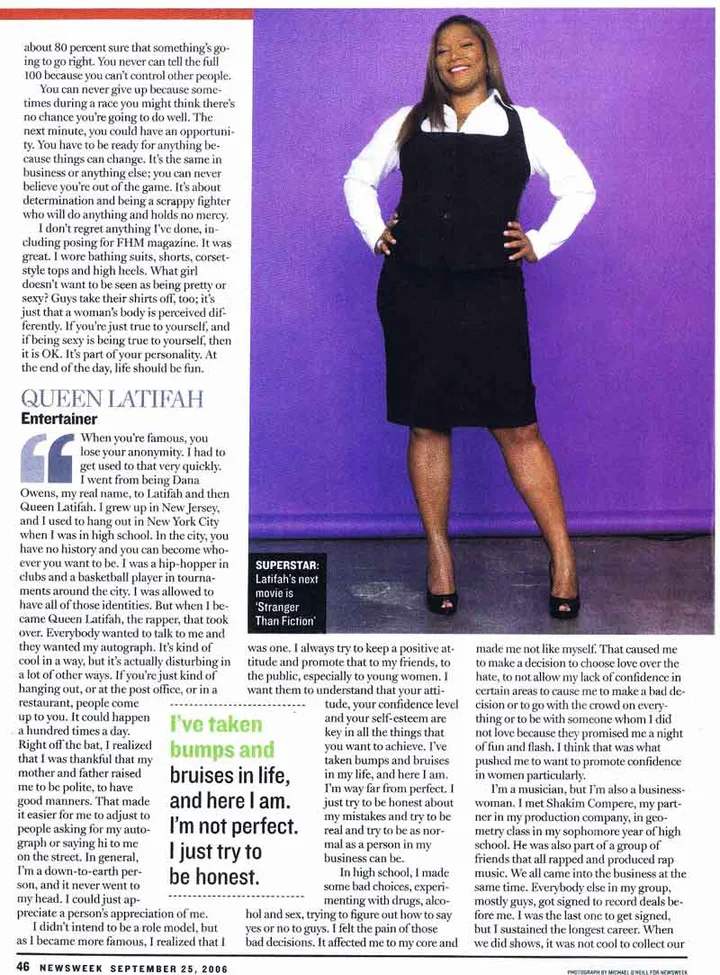
Queen Latifah
Entertainer
When you are famous, you lose your anonymity. I had to get used to that very quickly. I went from being Dana Owens, my real name, to Latifah and then Queen Latifah. I grew up in New Jersey and used to hang out in New York City when I was in high school. In the city, you have no history and you can become whoever you want to be. I was a hip-hopper in clubs and a basketball player in tournaments around the city. I was allowed to have all of those identities.
But when I became Queen Latifah, the rapper, that took over. Everybody wanted to talk to me and wanted my autograph. It is kind of cool in a way, but it is actually disturbing in a lot of other ways. If you are just hanging out or at the post office or in a restaurant, people come up to you. It could happen a hundred times a day. Right off the bat, I realized I was thankful that my mother and father raised me to be polite, to have good manners. That made it easier for me to adjust to people asking for my autograph or saying hi to me on the street. In general, I am a down-to-earth person, and it never went to my head.
I did not intend to be a role model, but as I became more famous, I realized that I was one. I always try to keep a positive attitude and promote that to my friends and to the public, especially to young women. I want them to understand that your attitude, your confidence level and your self-esteem are key in all the things that you want to achieve.
In high school, I made some bad choices, experimenting with drugs, alcohol and sex, trying to figure out how to say yes or no to guys. I felt the pain of those bad decisions. It affected me to my core and made me not like myself. That caused me to make a decision to choose love over hate, to not allow my lack of confidence to cause me to make a bad decision or go with the crowd on everything, or to be with someone I did not love because they promised me one night of fun and flash. I think that was what pushed me to want to promote confidence in women particularly.
I am a musician, but I am also a businesswoman. I met Shakim Compere, my partner in my production company, in geometry class my sophomore year of high school. He was part of a group of friends who all rapped and produced rap music. Everybody else in my group, mostly guys, got signed to record deals before me. I was the last one to get signed, but I sustained the longest career. When we did shows, it was not cool to collect our own money. Compere was one of the people who picked it up for me. One night, a promoter tried to stiff us. It took him two hours to get the money, but he got it.
He was always a strong character, one of the more disciplined people. I recognized that about him, and when it came time to make a decision on who was going to be my go-to guy, male or female, I asked him to be in that position. We started a management company that led to production deals and music labels. We managed 11 platinum and gold artists. When the film side started happening for me, we changed our company. There was an opportunity for me to star in movies and also produce them.
I have seen all sides, from starting out as nobody to being at the top of the profession. I have learned that it is very important for women to reach out to each other. I think we can be very catty and jealous and unsupportive of each other at times, and yet I think we are really the ones who can change the world. But we cannot do it being so worried about who is looking at our man or who is trying to clip at our heels. We really have to extend ourselves to the people we know are on the same page as us in terms of trying to move forward.
Every time I have had an opportunity to work with a nurturing female, I have learned more than I could ever imagine. Not only do they support you from a business perspective, but they support you as a woman. And as someone who has worked with a lot of guys over the years, I have seen how supportive guys can be of each other. I have also seen how competitive they can be. But there is less cattiness with guys. We are not secure enough in our own selves and it causes us to do really heinous things to each other. It always comes back to working on your own self-esteem and working on your own self-confidence. That is what helps us connect to other people.
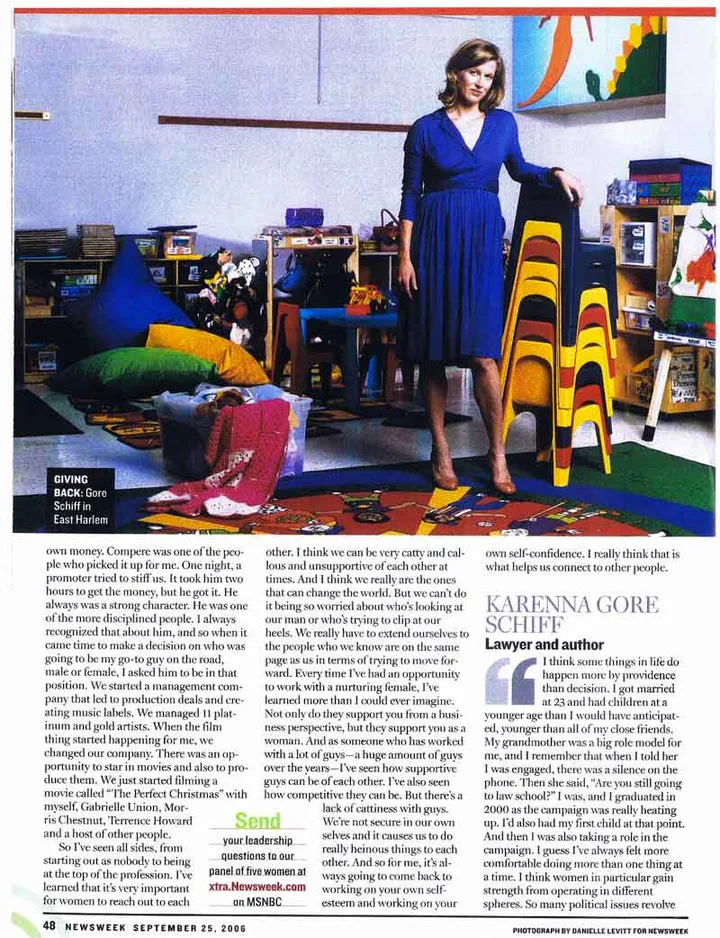
Karenna Gore Schiff
Lawyer and author
I think some of the better things in life happen more by providence than decision. I got married at 23 and had children at a younger age than I would have anticipated. I remember all of my close friends from kindergarten were a big role model for me, and I remember that when I told her I was engaged, there was a silence on the phone. Then she said, “Are you still going to law school?” I was, and I graduated in 2000 as the campaign was really heating up. I also had my first child at that point, and then I was taking a role in the campaign.
I guess I have always felt more comfortable doing more than one thing at a time. I think women in particular gain strength from operating in different spheres. So many political issues revolve around how the government impacts family units. I think you gain a lot of perspective once you have gone through it yourself.
The decision to be very involved in the campaign certainly changed my life. It was a very, very difficult experience. Whenever I say that, I feel a little spoiled, because in general I have had quite a fortunate life and I have been dealt a very nice hand, especially compared to a lot of losses other people go through. But what made it particularly hard was knowing that voting machines did not work and the process itself was flawed. It would have been easier to absorb had it been a clear will of the people. Everything that has happened since then seems to bear out for me how critical that election was. Incredibly narrow margins changed the outcome.
In studying political history, I do believe that difficult experiences can be quite nurturing for your soul. I feel as if I have been given a great education in politics and public policy, the good as well as the bad. Because things have been so not to my liking in politics recently, it has been a challenge to stay engaged. In the past few years, I have supported candidates that I believe in.
I practiced law for a year after 2000, and then I decided to go to work for a nonprofit called Association to Benefit Children, which provides child care and early childhood education to children in need in New York City. When I became director of community affairs, I was able to participate in advocacy, whether it was Head Start funding or treatment for asthma, and also be there to see how the programs functioned. It was exciting because it put a microscope on some of the issues that I had found so interesting politically.
I am also involved with Sanctuary for Families, which works with victims of domestic violence. Our clientele is more than 50 percent immigrants. I felt like I could see the immigration debate through the lens of the people we serve, which is very grounding. Being a political candidate myself is something I have thought was a possibility ever since I was a little girl. But now I see a lot about politics I do not like. I am not plotting a future candidacy, and it may not occur, but I do think public service in elective office is a very noble profession and I would never rule it out. Whether or not I ever run for office, I would like to be very involved in politics for the rest of my life.
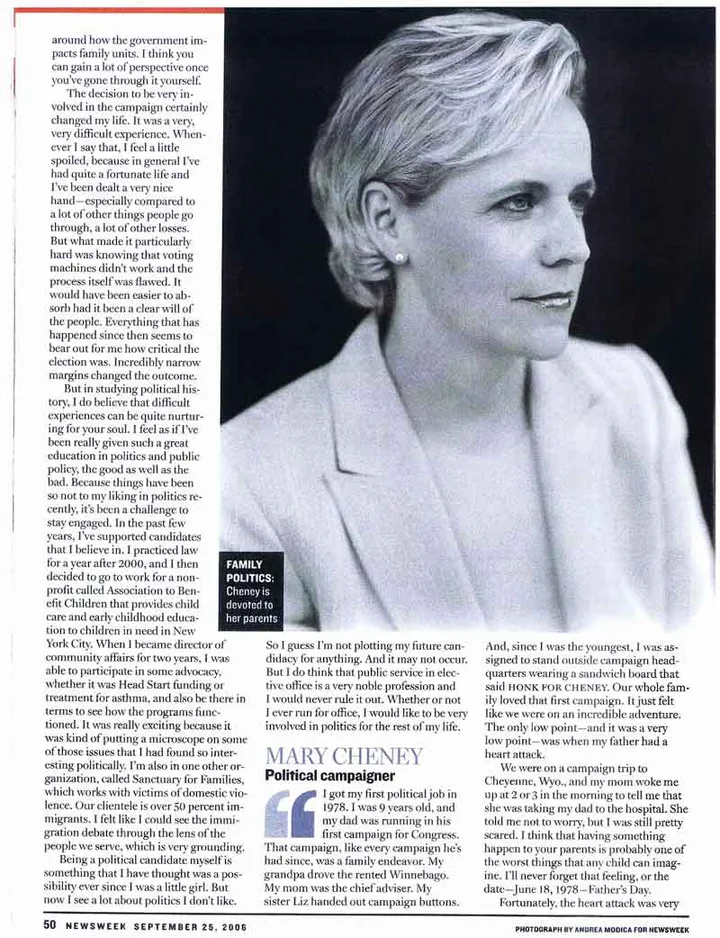
Mary Cheney
Political campaigner
I got my first political job in 1978. I was 9 years old, and my dad was running in his first campaign for Congress. That campaign, like every campaign he has had since, was a family endeavor. My grandpa drove the rented Winnebago. My mom was the chief adviser. My sister Liz handed out campaign buttons. And since I was the youngest, I was assigned to stand outside campaign headquarters wearing a sandwich board that said HONK FOR CHENEY.
Our whole family loved that first campaign. It just felt like we were on an incredible adventure. The only low point, and it was a very low point, was when my father had a heart attack. We were on a campaign trip to Cheyenne, Wyoming, and my mom woke me up at two or three in the morning to tell me that my dad had been taken to the hospital. She told me not to worry, but I was still pretty scared. I will never forget that feeling, or the date, June 18, 1978, Father’s Day.
Fortunately the heart attack was very mild, and while all the doctors told my dad he needed to give up smoking and start eating right, none of them told him he should stop running for office, so he decided to stay in the race. While he was recovering, he wrote a letter and sent it to every registered voter in Wyoming. He talked about the fact that he had had a heart attack, that it had helped him put his life in perspective, and that it made him even more determined to focus his energy on the things that mattered to him: public service and representing the people of Wyoming. It is a statement, and a lesson, that has always stayed with me: find what you love and work hard at it.
It is also one of the reasons I jumped at the chance to serve as the director of vice presidential operations on the reelection campaign in 2004. I knew it was going to be a challenging assignment, hiring a staff, managing budgets and travel schedules for my parents, overseeing their political events and making sure everything vice presidential operations did was coordinated with the rest of the campaign. But I also knew this was an opportunity to work for a candidate that I love and believe in, so I took the job.
Every political campaign, especially at the national level, is an emotional roller coaster. There are moments that are simply incredible, holding a rally with 10,000 cheering people at midnight in Honolulu, watching my dad win the vice presidential debate, and holding the Bible while he took the oath of office. But there are also moments when it feels like nothing is going right. Getting early exit polls that showed us losing every battleground state definitely qualified as one of those.
But no matter how tough it got, I loved every minute of it. I worked hard at it, and without a doubt it was one of the best and most rewarding experiences of my life.
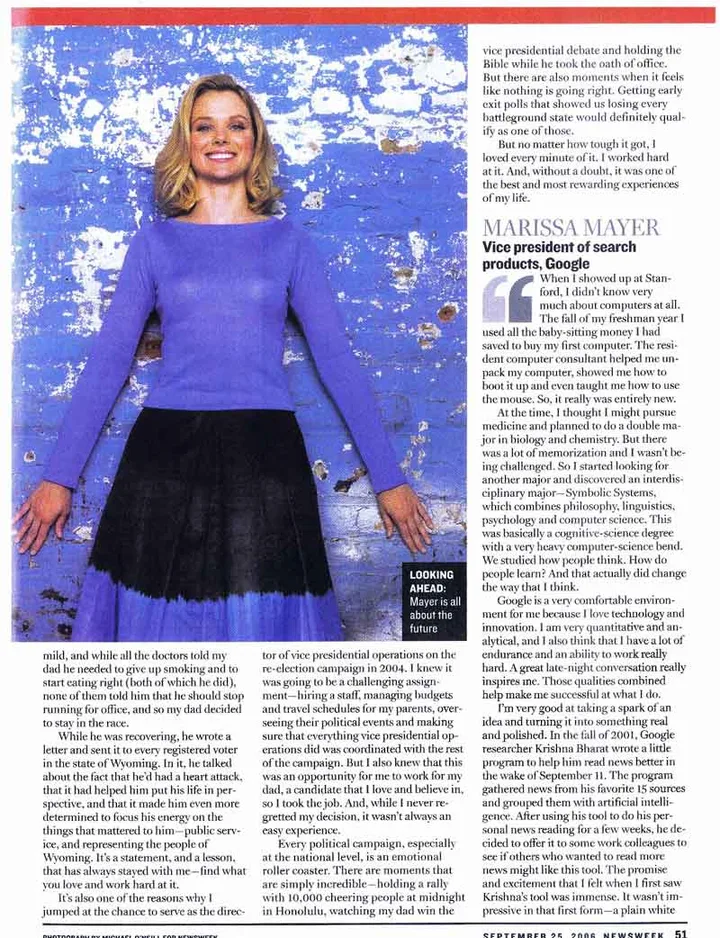
Marissa Mayer
Vice president of search products, Google
When I showed up at Stanford, I did not know very much about computers at all. The fall of my freshman year I used all the baby-sitting money I had saved to buy my first computer. The resident computer consultant helped me unpack it, showed me how to boot it up and even taught me how to use the mouse. It really was entirely new.
At the time, I thought I might pursue medicine and planned to do a double major in biology and chemistry. But there was a lot of memorization and I was not being challenged. So I started looking for another major and discovered an interdisciplinary major, Symbolic Systems, which combines philosophy, linguistics, psychology and computer science. It was basically a cognitive-science degree with a very heavy computer-science bend. We studied how people think and how people learn, and that really did change the way that I think.
Google is a very comfortable environment for me because I love technology and innovation. I am very quantitative and analytical, and I also think that I have a lot of endurance and an ability to work really hard. A great late-night conversation really inspires me. Those qualities combined help make me successful at what I do.
I am very good at taking a spark of an idea and turning it into something real and polished. In the fall of 2001, Google researcher Krishna Bharat wrote a little program to help him read news better in the wake of September 11. The program gathered news from his favorite 15 sources and grouped it with artificial intelligence. After using it for a few weeks, he offered it to some work colleagues to see if others might like it. The promise and excitement I felt when I first saw Krishna’s tool was immense. It was not impressive in that first form, just a plain white page with small groups of five plain blue links per topic and only about 10 topics covered. But I could see immediately how we could make it into a polished online news experience.
In the end we did 64 different iterations of how Google News could look even before it launched. We knew with mathematical certainty that it facilitated browsing between different sections like entertainment, sports and business. When we launched it, it had more than 4,000 news sources, more than any other meta-news or news-search site in the world. Most of our products up to that point had been about search, and while Google News has a search component, it is predominantly a service that presents information to users proactively rather than through search.
At Google, things are really friendly and fun. A lot of meetings have a good amount of laughter and whimsy. I have actually known the leaders of the company for a very long time: Larry Page and Sergey Brin for more than seven years, and Eric Schmidt for more than five. I understand their perspectives and the direction they would like projects driven.
I think the idea that women are more emotional at work is an outdated cliche. I tend to be more quantitative and data-driven. One important thing about leadership is approachability. I want people to feel they can come and talk to me about an issue. I hold office hours and staff meetings where people can put topics on the agenda that they care about. I want people to come and challenge me, tell me that I am wrong and show me the data.
Consistency is also very important. When you are leading large teams, people want to know that when they send you an email, they will get an answer back in a day. When they call your cell phone, they want to know that you will pick up or call right back. These elements matter. I actually publish a set of guidelines for my team so they understand what to expect from me.
I am happy to manage product managers because that is a job I have done and a job I am very good at. I understand their challenges day in and day out. When I ask them to do something, I know roughly how hard it is. That helps me be a better manager in terms of assigning work and setting expectations. While I still have a lot to do and am still learning, I am amazed that the Web site my friends and I built has positively touched the lives of so many millions of people.
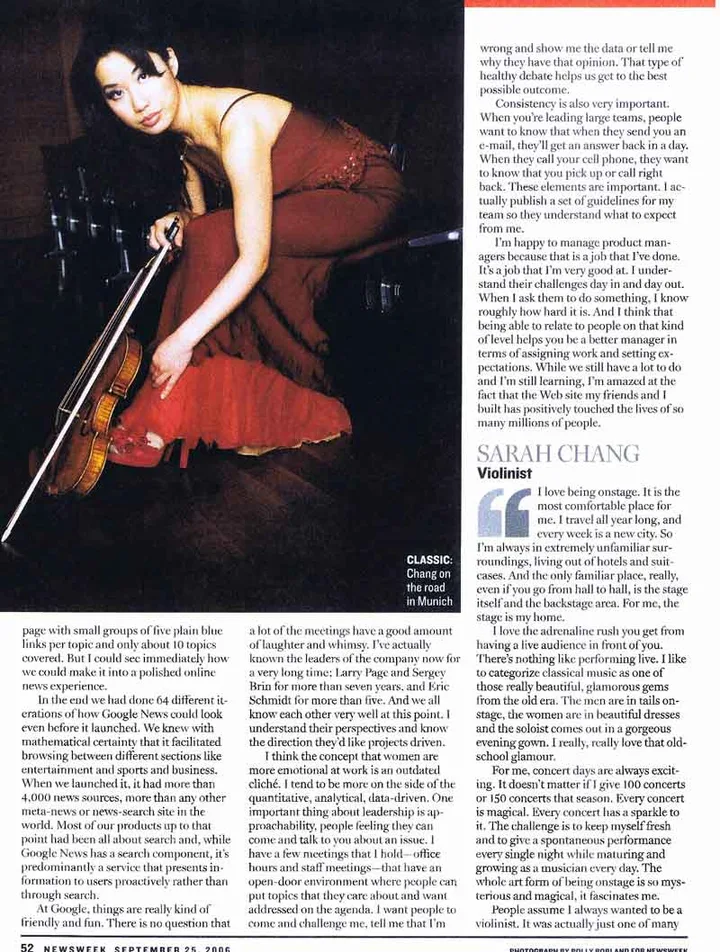
Sarah Chang
Classical violinist
I love being onstage. It is the most comfortable place for me. I travel all year long and I am always in extremely unfamiliar surroundings, living out of hotels and suitcases. The only familiar place, really, even if you go from hall to hall, is the stage itself and the backstage area. For me, the stage is my home.
I love the adrenaline rush you get from having a live audience in front of you. There is nothing like performing live. I like to categorize classical music as one of those beautiful, glamorous gems from the old era. The men are in tails onstage, the women are in beautiful dresses and the soloist comes out in a gorgeous evening gown. I really love that old-school glamour.
For me, concert days are always exciting. It does not matter if I give 100 concerts or 150 concerts that season. Every concert is magical. Every concert has a sparkle to it. The challenge is to keep myself fresh and give a spontaneous performance every single night while maturing and growing as a musician every day. The whole art form of being onstage is so mysterious and magical. It fascinates me.
People assume I always wanted to be a violinist. It was actually just one of many hobbies I had. I had very enthusiastic parents. They gave me swimming lessons and horseback riding and gymnastics and ballet. My mom put me on the piano when I was about 3 1/2. I asked for the violin when I was 4 because I wanted something smaller and more portable.
I auditioned for the Juilliard School when I was about 6. During the week, I went to regular school in Philadelphia so I could be with kids my own age. But on Saturdays my mom would drive me to Juilliard in New York. I was by far the youngest person there. Most of the students were 14, 15 and older. There were times when I was painfully aware of the age difference, but on a musical level it was a great environment to grow up in because the talent around me was astronomical.
I started my career when I was 8 with debuts in New York and Philadelphia, and I started recording when I was 9. When you are so young, you do not realize the impact of a New York Philharmonic debut. You are told to do something, you go out and do it and you do not ask too many questions. The questions come later when you are in your teens.
By the time I was 14, I was spending probably half the year in Europe, so I was out of school a lot. I did most of my homework by email or fax. We made it work because my professors were incredible. When you are a girl in your early teens, you obviously have insecurities. You are beginning to form new friendships and relationships with people. Your clothes never quite fit right. On top of that, I had the career, the photo sessions, and having to be onstage and have every concert reviewed by the press. It was an added layer. But I think having a career at such an early age kept me focused.
Music takes me everywhere. A few years ago I had a chance to go to North Korea to do a joint concert with the North and South Korean orchestras in Pyongyang. That was totally eye-opening. I am very much an American. I was born and brought up here with Korean parents. But this was beyond anything else I had ever seen before. You have armed guards everywhere and you cannot go anywhere or do anything. There is no communication with the outside world. The concert was full of government officials. Every last seat was invitation only.
It was an unbelievable experience, frightening and exhilarating at the same time. I thought about how lucky I am. I am so fortunate to be a musician, and at that moment I genuinely felt that music is the one and only universal language.
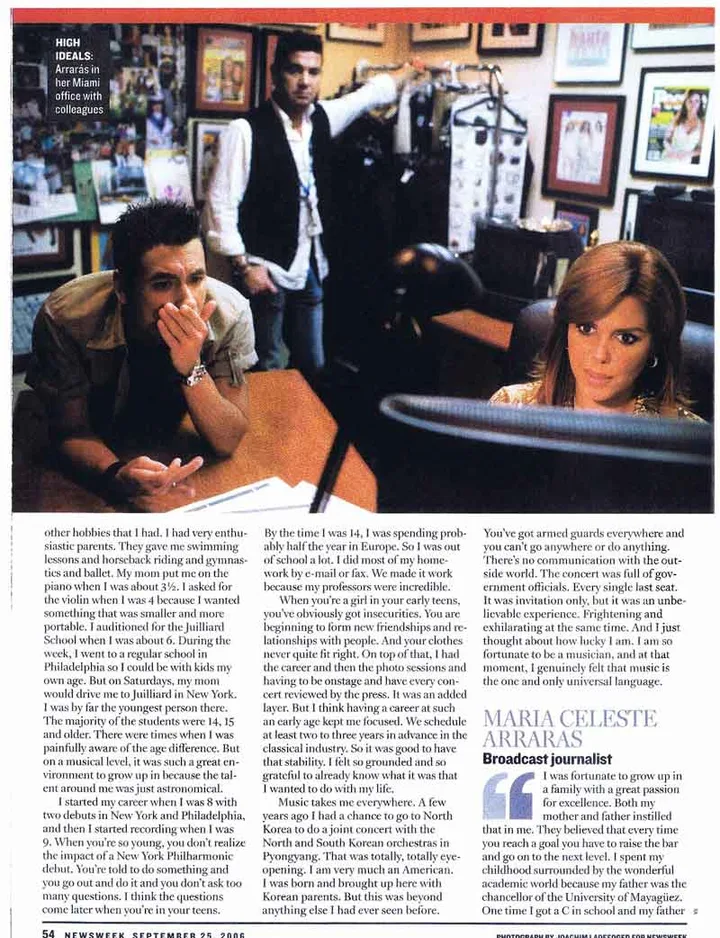
Maria Celeste Arraras
Broadcast journalist
I was fortunate to grow up in a family with a great passion for excellence. Both my mother and father instilled that in me. They believed that every time you reach a goal, you have to raise the bar and go to the next level. I spent my childhood surrounded by the wonderful academic world because my father was the chancellor of the University of Mayaguez.
One time I got a C in school and my father sat me down and said, “In this house you come in with an A or an F. You have to be either the best of the best or the best of the worst. But never mediocre.” That is one of the most valuable lessons I ever learned.
After I graduated from college in New Orleans, I went back to Puerto Rico, but at that time there was really no opportunity on the island for new graduates, so I took a job as an advertising copywriter. I figured that advertising deals a lot with the TV industry and that I had a better chance to find an opportunity to make the crossover. Soon after I began working, I went to an Advertising Awards ceremony where I met an impresario who was about to start a 24-hour news station in Puerto Rico, kind of a Caribbean CNN. He was looking for hungry people for on-camera jobs.
It was the job I had dreamed about and a great place to learn. This sent us all over the world to report on every major event at the time. I covered civil wars in Latin America, the Olympics and presidential elections in the United States.
After a while I was offered a better-paying job at one of the established local stations. Because it was one of the many that had not opened the door for me before, I declined. I could have brought that offer to my boss as a bargaining chip to get a raise, but I did not. I felt a sense of loyalty. My parents always told me to let my principles guide me.
Eventually my boss heard what I had done and rewarded me by giving me the most coveted assignment at the time, the beginning of glasnost and perestroika in the Soviet Union. I went to the Soviet Union and came back with a one-hour special that won me the Journalist of the Year award. At the awards ceremony, the man who would later be named news director of the Univision affiliate in New York asked me for a demo tape. That is how I entered the Hispanic television arena.
After a couple of months, a new management cleaned out the staff. The new news director brought in a new anchor and new reporters because he wanted his own people. Because of my contract, I had the option to stay as a reporter or cash out and leave. I decided to stay because I knew I could learn from this experienced news director. When I informed him of my decision, he said, “You have two choices. You have a bag of lemons and you will either get sour or make lemonade.” I wrote on a card, “Let’s make lemonade,” and bought him a bag of lemons. It did nothing for him. He sent his reporters on assignment, not me, took my office away and sat me in front of a Formica desk looking at a wall.
But finally he let me do little stories, and I put my heart and soul into them. I got noticed by the news director of Univision, who offered me the job of substitute national anchor and head of the L.A. bureau. A year later the network moved headquarters to Miami and asked me to come along as the national newscast anchor for the weekend edition. I later became co-anchor of “Primer Impacto,” an infotainment magazine with a more flexible format that became the national newscast. The show was a big success, but after almost 10 years, I decided it was time to grow in a different direction, and I joined Telemundo.
It has been four years since “Al Rojo Vivo con Maria Celeste” first aired on Telemundo. As managing editor of the program, I told everyone from day one that we were going to keep raising the bar while sticking to principles and ethics. And we have. Last year, when I had the honor of receiving an Emmy for my career achievements, I dedicated the award to my father. In my acceptance speech, I spoke to him directly and said, “This is definitely an A, Dad.”
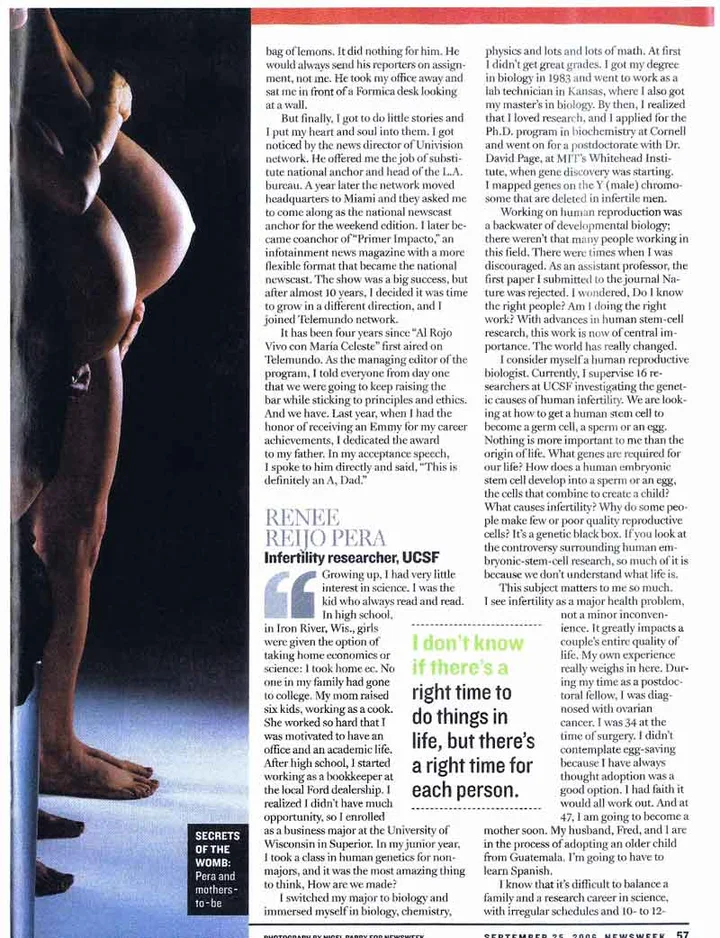
Renee Reijo Pera
Infertility researcher, UCSF
Growing up, I had very little interest in science. I was the kid who always read and read. In high school in Iron River, Wisconsin, girls were given the option of taking home economics or science. I took home ec. No one in my family had gone to college. My mom raised six kids working as a cook. She worked so hard that I was motivated to have an office and an academic life.
After high school, I started working as a bookkeeper at the local Ford dealership. I realized I did not have much opportunity there, so I enrolled as a business major at the University of Wisconsin in Superior. In my junior year, I took a class in human genetics for nonmajors, and it was the most amazing thing. I thought, “How are we made?” I switched my major to biology and immersed myself in biology, chemistry, physics and lots and lots of math. At first I did not get great grades.
I got my degree in biology in 1983 and went to work as a lab technician in Kansas, where I also got my master’s in biology. By then I realized I loved research, and I applied for the Ph.D. program in biochemistry at Cornell and went on for a postdoctorate with Dr. David Page at MIT’s Whitehead Institute, when gene discovery was starting. I mapped genes on the Y chromosome that are deleted in infertile men.
Working on human reproduction was a backwater of developmental biology. There were not that many people working in this field. There were times when I was discouraged. As an assistant professor, the first paper I submitted to the journal Nature was rejected. I wondered, Do I know the right people? Am I doing the right work? With advances in human stem-cell research, this work is now of central importance. The world has really changed.
I consider myself a human reproductive biologist. Currently, I supervise 16 researchers at UCSF investigating the genetics of infertility. We are looking at how to get a human stem cell to become a germ cell, a sperm or an egg. Nothing is more important to me than the origin of life. What genes are required for our life? How does a human embryonic stem cell develop into a sperm or an egg, the cells that combine to create a child? What causes infertility? Why do some people make few or poor-quality reproductive cells? It is a genetic black box.
This subject matters to me so much because I see infertility as a major health problem, not a minor inconvenience. It greatly impacts a couple’s entire quality of life. My own experience really weighs in here. During my time as a postdoctoral fellow, I was diagnosed with ovarian cancer. I was 34 at the time of surgery. I did not contemplate egg-saving because I had always thought adoption was a good option and had faith it would all work out. At 47, I was going to become a mother soon. My husband, Fred, and I were in the process of adopting an older child from Guatemala. I was going to have to learn Spanish.
I know that it is difficult to balance a family and a research career with irregular schedules and 10- to 12-hour workdays. I see how the women and the men in my lab struggle. I do not know if there is a right time to do things in life, but I think there is probably a right time for each person. The women who make it work in life and in the lab have great partners, and women have to be very, very flexible to make it all work.
Gwen Sykes
Chief financial officer, NASA
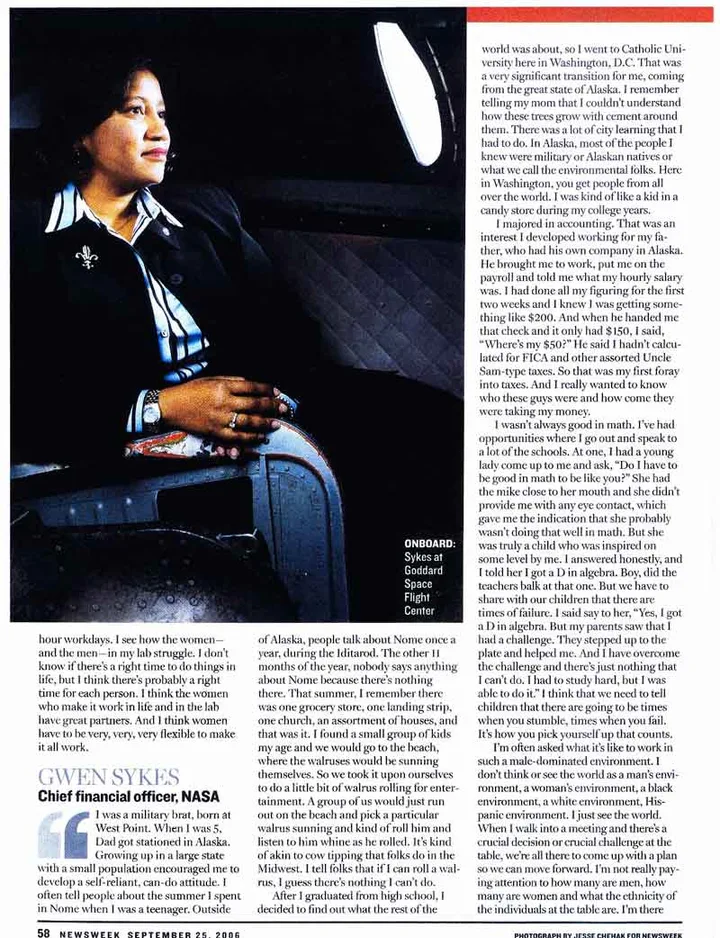
I was a military brat, born at West Point. When I was 5, Dad got stationed in Alaska. Growing up in a large state with a small population encouraged me to develop a self-reliant, can-do attitude. I often tell people about the summer I spent in Nome when I was a teenager. Outside of Alaska, people talk about Nome once a year during the Iditarod. The other 11 months, nobody says anything about Nome because there is nothing there.
That summer there was one grocery store, one landing strip, one church, an assortment of houses, and that was it. I found a small group of kids my age, and we would go to the beach where the walruses would be sunning themselves. So we took it upon ourselves to do a little bit of walrus rolling for entertainment. A group of us would run to the beach, pick a particular one and kind of roll him and listen to him whine as he rolled. It is kind of akin to cow tipping in the Midwest. I tell folks that if I can roll a walrus, there is nothing I cannot do.
After I graduated from high school, I decided to find out what the rest of the world was about, so I went to Catholic University in Washington. That was a very significant transition for me, coming from the great state of Alaska. I remember telling my mom that I could not understand how these trees grow with cement around them. There was a lot of city learning that I had to do. In Alaska, most of the people I knew were military or Alaskan natives or what we call the environmental folks. Here in Washington, you get people from all over the world. I was like a kid in a candy store during my college years.
I majored in accounting. That was an interest I developed working for my father, who had his own company in Alaska. He brought me to work, put me on the payroll and told me my hourly salary. I did all my figuring for the first two weeks and knew I was getting something like $200. When he handed me that check and it had only $150, I said, “Where’s my $50?” He said I had not calculated for FICA and other assorted Uncle Sam taxes. That was my first foray into taxes, and I really wanted to know who these guys were and how they were taking my money.
I was not always good in math. I have had opportunities to go out and speak at schools. At one, a young lady came up and asked, “Do I have to be good in math to be like you?” She had the mike close to her mouth and would not give me eye contact, which gave me the indication that she probably was not doing that well in math. But she was truly a child who was inspired on some level by me. I answered honestly and told her I got a D in algebra. The teachers balked, but we have to share with children that there are times of failure. I told her my parents saw I had a challenge, stepped up to the plate and helped me. I overcame that challenge, and there is nothing I cannot do.
I am often asked what it is like to work in a male-dominated environment. I do not think or see the world as a man’s environment, a woman’s environment, a Black environment, a white environment, or a Hispanic environment. I just see the world. When I walk into a meeting and there is a crucial challenge at the table, we are all there to come up with a plan so we can move forward. I am not paying attention to how many are men, how many are women, or the ethnicity of the individuals at the table. I am there to make sure we have the right people at the table to make the right decision.
I have been married once, but I am currently divorced. Women of my generation understand that we really cannot have it all. We can have some things, but we cannot have it all. You are only one person. So you have to make choices and be comfortable with those choices. In order for marriage to work, you have to find someone who understands your motivation and your drive and will give up the belief that at some point in your journey you will have to stop. I have not found that yet. Someday my prince will come, and he will be running alongside me.
Joyce Chang
Managing director, JPMorgan
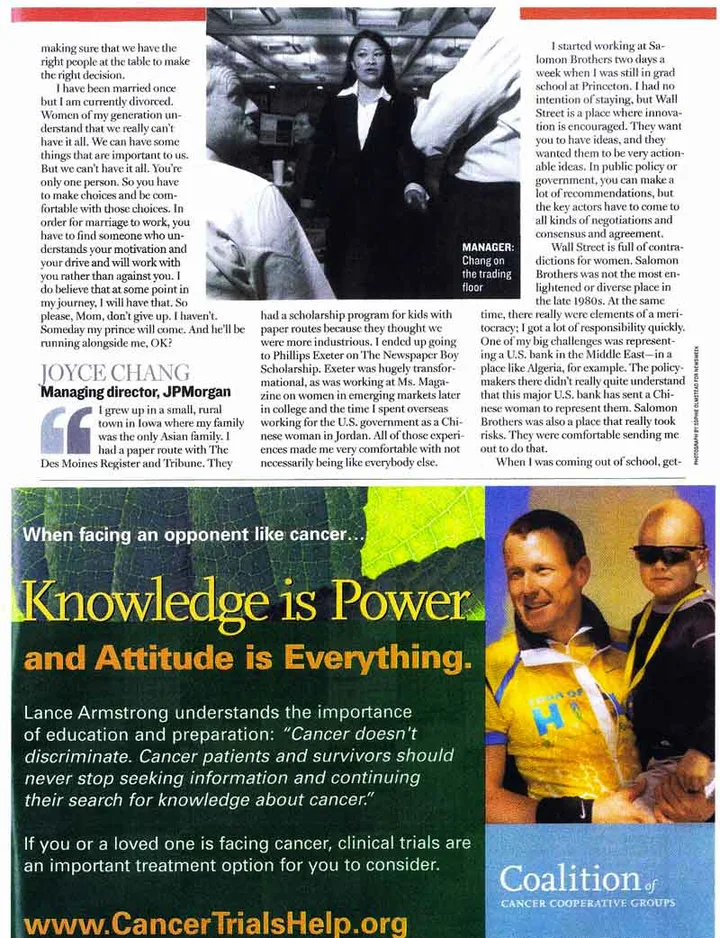
I grew up in a small, rural town in Iowa where my family was the only Asian family. I had a paper route with The Des Moines Register and Tribune. They had a scholarship program for kids with paper routes because they thought we were more industrious. I ended up going to Phillips Exeter on the newspaper boy scholarship. Exeter was hugely transformational, as was working at Ms. magazine on women in emerging markets later in college and the time I spent overseas working for the U.S. government as a Chinese woman in Jordan. All of those experiences made me very comfortable with not necessarily being like everybody else.
I started working at Salomon Brothers two days a week while I was still in grad school at Princeton. I had no intention of staying, but Wall Street is a place of real innovation because they want you to have ideas and they want them to be very actionable ideas. In public policy or government, you can make a lot of recommendations, but the key actors have to come to all kinds of negotiations and agreements.
Wall Street is full of contradictions for women. Salomon Brothers was not the most enlightened or diverse place in the late 1980s. At the same time, there were really elements of a meritocracy. I got a lot of responsibility quickly. One of my big early assignments was representing a U.S. bank in the Middle East, in a place like Algeria. The policy makers there did not really understand that this major U.S. bank had sent a Chinese woman to represent them. Salomon Brothers was also a place that really took risks. They were comfortable sending me out to do that.
When I was coming out of school, getting a senior management job was seen as a big leadership position. Today young women are defining success on their own terms. They have much more perspective than my generation. Young women are not necessarily looking at senior management as being fulfilling. In the process of balancing everything, whether it is child-care responsibilities or taking care of parents, it becomes their own decision to leave.
I can see why it is so difficult. When I had my first child, it was the middle of the Russian and Asian financial crises, and I went back right away not because the firm I worked at wanted me to, but because the markets really demanded that. If you are managing a global group, you really had to be back. I feel I am very lucky in that I married somebody who works in emerging markets and understands the trade-offs that I make. We have balanced it out really well.
I think a good leader is somebody who can really understand when to change directions and when to take the risk. A good leader understands it is not all about hard work. It is about being ahead of the curve and being a really great communicator. When bubbles burst on Wall Street, there is a self-correcting mechanism. The most challenging thing is figuring out when it is time to change directions and not just keep copying past successes. You have to have that new idea and innovation before everyone else does.
Tracy Reese
Fashion designer
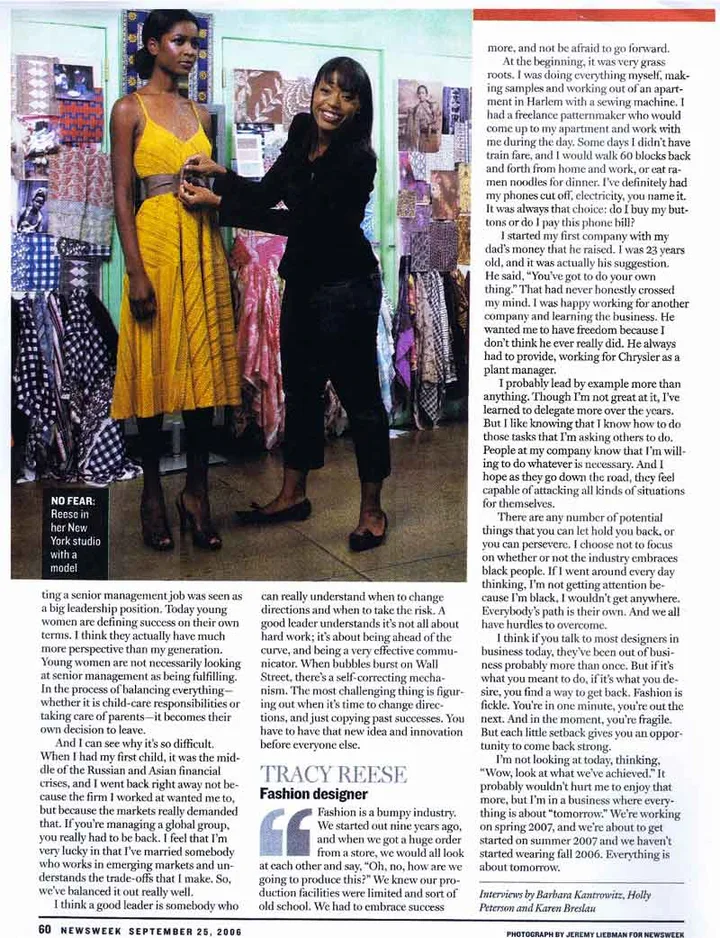
Fashion is a bumpy industry. We started out nine years ago, and when we got a huge order from a store, we would all look at each other and say, “Oh, no, how are we going to produce this?” We knew our production facilities were limited and sort of old school. We had to embrace success more and not be afraid to go forward.
At the beginning, it was very grassroots. I was doing everything myself, making samples and working out of an apartment in Harlem with a sewing machine. I had a freelance patternmaker who would come up to my apartment and work with me during the day. Some days I did not have train fare and would walk 60 blocks back and forth from home and work, or eat ramen noodles for dinner. I have definitely had my phone shut off, my electricity, you name it. It was always that choice: do I buy my buttons or do I pay this phone bill?
I started my first company with my dad’s money that he raised. I was 23 years old, and it was actually his suggestion. He said, “You’ve got to do your own thing.” That had never honestly crossed my mind. I was happy working for another company and learning the business. He wanted me to have freedom because I do not think he ever really did. He always had to provide, working for Chrysler as a plant manager.
I probably lead by example more than anything. Though I am not great at it, I have learned to delegate more over the years. But I like knowing that I know how to do the tasks I am asking others to do. People at my company know that I am willing to do whatever is necessary. I hope as they go down the road, they feel capable of attacking all kinds of situations for themselves.
There are any number of potential things that you can let hold you back, or you can persevere. I choose not to focus on whether or not the industry embraces Black people. If I went around every day thinking I am not getting attention because I am Black, I would not get anywhere. Everybody’s path is their own, and we all have hurdles to overcome.
I think if you talk to most designers in business today, they have probably been out of business more than once. But if it is what you are meant to do, if it is what you desire, you find a way to get back. Fashion is fickle. You are in one minute, you are out the next, and in the moment you are fragile. But each little setback gives you an opportunity to come back strong.
I am not looking at today thinking, “Wow, look at what we have achieved.” It probably would not hurt me to enjoy that more, but I am in a business where everything is about tomorrow. We are working on spring 2007, and we are about to get started on summer 2007 and we have not started wearing fall 2006. Everything is about tomorrow.