Tyra Banks
Talk-show host and producer
Life in Front of the Cameras, An Empire Behind the Scenes
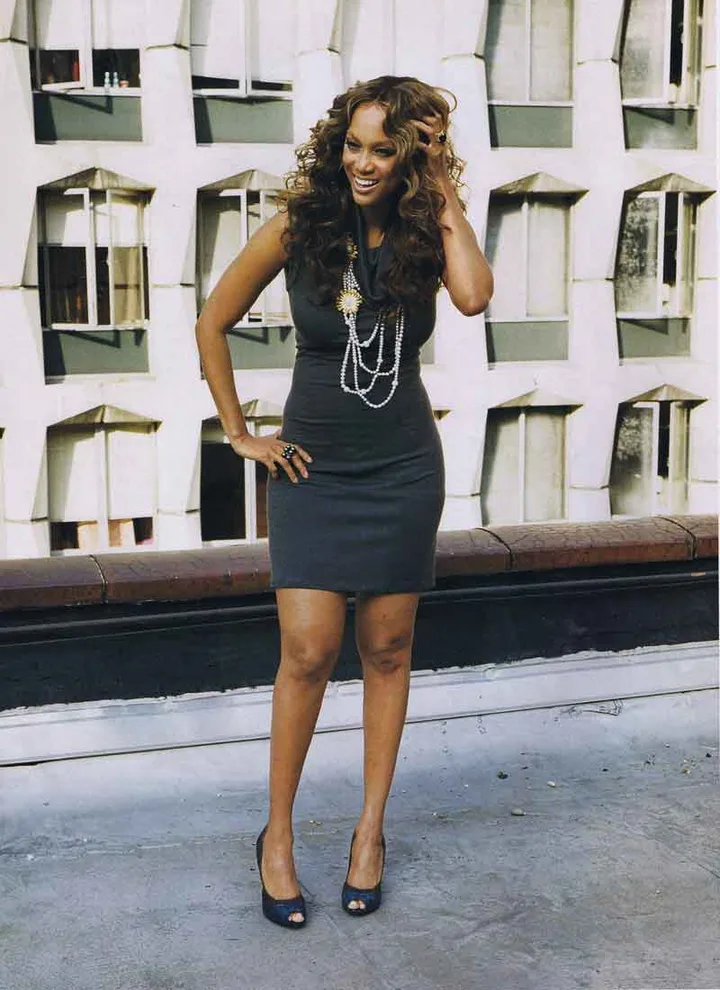
My mom was a medical photographer. After hours, she would sometimes take pictures of me and my brother in her studio. When I look at those pictures, I realize I am posing. I have my hand on my chin and I’m looking right at the camera. When I was about 9, my mom started a business photographing women in our living room who wanted a glamorous picture of themselves. I held her light meters and her reflectors. My mom would bring me into the darkroom, which was on our back porch, and develop the film. I was fascinated watching the pictures appear with that red light shining. It’s so funny that the little assistant holding the lights was a supermodel in the making.
Growing up, I didn’t think I was pretty, but I didn’t think I was unattractive. Then I hit a stage where I definitely felt very unattractive. I grew three inches and lost 40 pounds in 90 days. It was just this crazy growth spurt. I felt like a freak; people would stare at me in the grocery store. Eventually, my face and body started to change. On my first day of high school, a girl came up to me and said, “Have you ever thought about modeling?” I thought she was crazy, but I decided to try it. My first modeling job was for a magazine called Black Collegiate. I was so excited because there was a little picture of me on the cover, above the title.
I didn’t think I was modeling because I was beautiful; I thought it was because I looked like a model. There’s a difference. I try to explain that on “America’s Next Top Model.” Models are tall, they have a big forehead, their chin is small, they have full lips — I knew I had that look.
I applied to college because I wanted to be a film and television producer and writer. I was accepted everywhere and was ready to go to Loyola Marymount. But a model scout from Paris came to the modeling agency in L.A., saw my picture and said, “That’s the only girl I want!” So I decided to defer college for a year.
Paris was weird and confusing for me. I felt overwhelmed by all that was happening. I was 17, and I didn’t know how to take care of myself. I asked my mom to send care packages of Fiddle Faddle and Oreos. I ended up eating them for breakfast, lunch and dinner. So I got sick. When my mom came to visit me, she saw all of that and refused to send me any more packages. She taught me how to shop and cook.
Modeling is very lonely. Actresses or singers travel with entourages, with their hair-and-makeup people and tour managers. Models are alone. Even when you’re the biggest supermodel in the world, you’re alone. I tried to get to L.A. and hang out with my high-school friends as often as I could.
I never lost the dream of being in TV. When I hit 32, I said, “Let me leave this industry before it leaves me.” I didn’t want to be like those boxers who continue to get beat up and say they’re going to retire, but they don’t, and then their legacy is marred. I wanted to leave on top.
I’ve had my glory in the modeling world. I want to use the power I have now to cultivate new talent in front of the camera and behind the scenes. I don’t think I’m a mogul, but I have a lot of television shows. There’s “America’s Next Top Model” and the talk show. I have a new show, “Stylista,” that premieres Oct. 22 — it’s a reality competition-based series in search of the next fashion editor at Elle magazine. I’m also executive-producing a series of direct-to-DVD movies based on The New York Times best-selling novel series “The Clique.”
If you have entrepreneurial dreams, you have to live it and breathe it. You have to treat the idea like a baby, like your child. You don’t sleep when you have a new baby. I didn’t sleep. I didn’t have weekends. I worked nonstop. You wouldn’t let just anybody baby-sit your child. When I hire someone, I have to feel that I connect with them as a person. I’m looking for honest people. I’m looking for loyalty. I’m looking for people who respect people at all levels, from the people who clean the building to the people who own the building. Those are the values that my mother instilled in me.
Dara Torres
Olympic medalist
An Overwhelming Drive to Win Again and Again
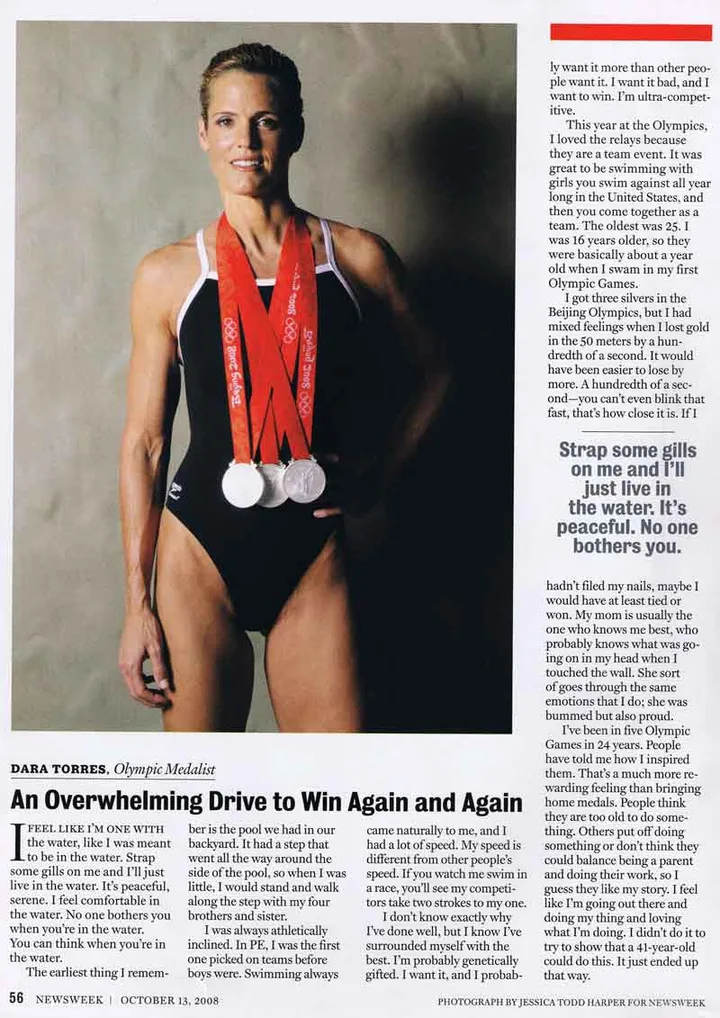
I feel like I’m one with the water, like I was meant to be in the water. Strap some gills on me and I’ll just live in the water. It’s peaceful, serene. I feel comfortable in the water. No one bothers you when you’re in the water. You can think when you’re in the water.
The earliest thing I remember is the pool we had in our backyard. It had a step that went all the way around the side of the pool, so when I was little, I would stand and walk along the step with my four brothers and sister.
I was always athletically inclined. In PE, I was the first one picked on teams before boys were. Swimming always came naturally to me, and I had a lot of speed. My speed is different from other people’s speed. If you watch me swim in a race, you’ll see my competitors take two strokes to my one.
I don’t know exactly why I’ve done well, but I know I’ve surrounded myself with the best. I’m probably genetically gifted. I want it, and I probably want it more than other people want it. I want it bad, and I want to win. I’m ultra-competitive.
This year at the Olympics, I loved the relays because they are a team event. It was great to be swimming with girls you swim against all year long in the United States, and then you come together as a team. The oldest was 25. I was 16 years older, so they were basically about a year old when I swam in my first Olympic Games.
I got three silvers in the Beijing Olympics, but I had mixed feelings when I lost gold in the 50 meters by a hundredth of a second. It would have been easier to lose by more. A hundredth of a second — you can’t even blink that fast, that’s how close it is. If I hadn’t filed my nails, maybe I would have at least tied or won. My mom is usually the one who knows me best, who probably knows what was going on in my head when I touched the wall. She sort of goes through the same emotions that I do; she was bummed but also proud.
I’ve been in five Olympic Games in 24 years. People have told me how I inspired them. That’s a much more rewarding feeling than bringing home medals.
People think they are too old to do something. Others put off doing something or don’t think they could balance being a parent and doing their work, so I guess they like my story. I feel like I’m going out there and doing my thing and loving what I’m doing. I didn’t do it to try to show that a 41-year-old could do this. It just ended up that way.
Rosario Dawson
Actor and political activist
Using Fame and Fortune to Help Others
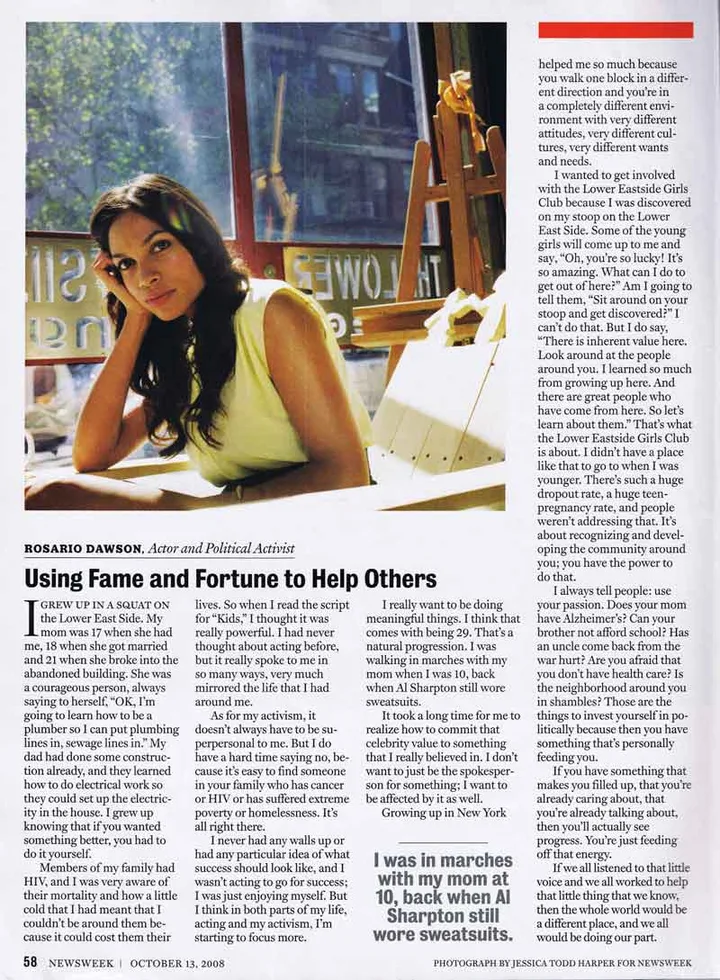
I grew up in a squat on the Lower East Side. My mom was 17 when she had me, 18 when she got married and 21 when she broke into the abandoned building. She was a courageous person, always saying to herself, “OK, I’m going to learn how to be a plumber so I can put plumbing lines in, sewage lines in.” My dad had done some construction already, and they learned how to do electrical work so they could set up the electricity in the house.
I grew up knowing that if you wanted something better, you had to do it yourself.
Members of my family had HIV, and I was very aware of their mortality and how a little cold that I had meant that I couldn’t be around them because it could cost them their lives. So when I read the script for “Kids,” I thought it was really powerful. I had never thought about acting before, but it really spoke to me in so many ways, very much mirrored the life that I had around me.
As for my activism, it doesn’t always have to be superpersonal to me. But I do have a hard time saying no, because it’s easy to find someone in your family who has cancer or HIV or has suffered extreme poverty or homelessness. It’s all right there.
I never had any walls up or had any particular idea of what success should look like, and I wasn’t acting to go for success; I was just enjoying myself. But I think in both parts of my life, acting and my activism, I’m starting to focus more.
I really want to be doing meaningful things. I think that comes with being 29. That’s a natural progression. I was walking in marches with my mom when I was 10, back when Al Sharpton still wore sweatsuits.
It took a long time for me to realize how to commit that celebrity value to something that I really believed in. I don’t want to just be the spokesperson for something; I want to be affected by it as well.
Growing up in New York helped me so much because you walk one block in a different direction and you’re in a completely different environment with very different attitudes, very different cultures, very different wants and needs.
I wanted to get involved with the Lower Eastside Girls Club because I was discovered on my stoop on the Lower East Side. Some of the young girls will come up to me and say, “Oh, you’re so lucky! It’s so amazing. What can I do to get out of here?”
Am I going to tell them, “Sit around on your stoop and get discovered?” I can’t do that. But I do say, “There is inherent value here. Look around at the people around you. I learned so much from growing up here. And there are great people who have come from here. So let’s learn about them.” That’s what the Lower Eastside Girls Club is about. I didn’t have a place like that to go to when I was younger. There’s such a huge dropout rate, a huge teen-pregnancy rate, and people weren’t addressing that. It’s about recognizing and developing the community around you; you have the power to do that.
I always tell people: use your passion. Does your mom have Alzheimer’s? Can your brother not afford school? Has an uncle come back from the war hurt? Are you afraid that you don’t have health care? Is the neighborhood around you in shambles? Those are the things to invest yourself in politically because then you have something that’s personally feeding you.
If you have something that makes you filled up, that you’re already caring about, that you’re already talking about, then you’ll actually see progress. You’re just feeding off that energy.
If we all listened to that little voice and we all worked to help that little thing that we know, then the whole world would be a different place, and we all would be doing our part.
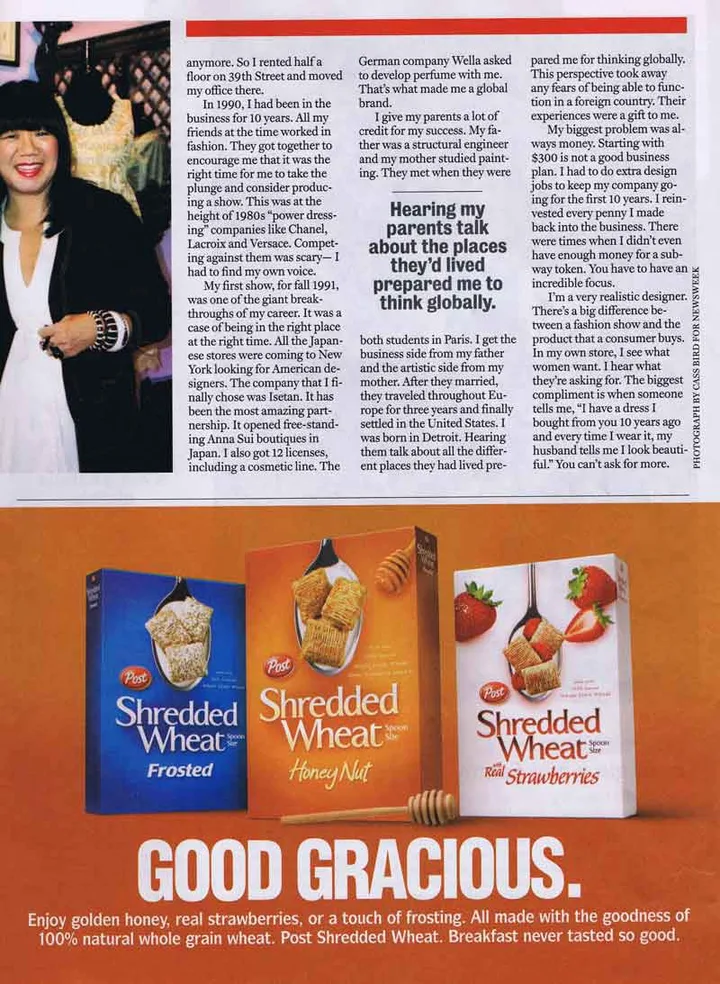
Anna Sui
Designer
From New York to Tokyo, She Knows What Women Want
When I was 4 years old, I was already talking about becoming a designer. I’m not exactly sure where I got that notion. It was probably something I saw on television. It seemed like a very glamorous life.
In my second year at Parsons, I got a job at Charlie’s Girls with Erica Elias. I was in heaven. That was probably the best job I could have ever landed because Erica gave me my very own design room to work in. I had sewing ladies. I had a draper. It had five different divisions where I could do swimwear, sportswear and sweaters. I learned how to do everything.
In 1981, I had the idea of doing my own clothing line, but I didn’t know how to go about it. I had some friends who made jewelry and were going to try to sell it at a trade show. I made five pieces of clothing, and they asked me to share a booth with them. To my delight, I got orders from Macy’s and Bloomingdale’s and was featured in an advertisement in The New York Times. The man who owned the company I worked for saw the ad and said if I didn’t stop, he would fire me. So I got fired.
That’s how I started my business. I had a loftlike apartment, so I worked out of a little corner of my living room. One morning I woke up, opened my bedroom door and saw boxes and racks everywhere. I thought, I can’t live like this anymore. So I rented half a floor on 39th Street and moved my office there.
In 1990, I had been in the business for 10 years. All my friends at the time worked in fashion. They got together to encourage me that it was the right time for me to take the plunge and consider producing a show. This was at the height of 1980s “power dressing” companies like Chanel, Lacroix and Versace. Competing against them was scary — I had to find my own voice.
My first show, for fall 1991, was one of the giant breakthroughs of my career. It was a case of being in the right place at the right time. All the Japanese stores were coming to New York looking for American designers. The company that I finally chose was Isetan. It has been the most amazing partnership. It opened free-standing Anna Sui boutiques in Japan. I also got 12 licenses, including a cosmetic line. The German company Wella asked to develop perfume with me. That’s what made me a global brand.
I give my parents a lot of credit for my success. My father was a structural engineer and my mother studied painting. They met when they were both students in Paris. I get the business side from my father and the artistic side from my mother. After they married, they traveled throughout Europe for three years and finally settled in the United States. I was born in Detroit.
Hearing them talk about all the different places they had lived prepared me for thinking globally. This perspective took away any fears of being able to function in a foreign country. Their experiences were a gift to me.
My biggest problem was always money. Starting with $300 is not a good business plan. I had to do extra design jobs to keep my company going for the first 10 years. I reinvested every penny I made back into the business. There were times when I didn’t even have enough money for a subway token. You have to have an incredible focus.
I’m a very realistic designer. There’s a big difference between a fashion show and the product that a consumer buys. In my own store, I see what women want. I hear what they’re asking for. The biggest compliment is when someone tells me, “I have a dress I bought from you 10 years ago and every time I wear it, my husband tells me I look beautiful.” You can’t ask for more.
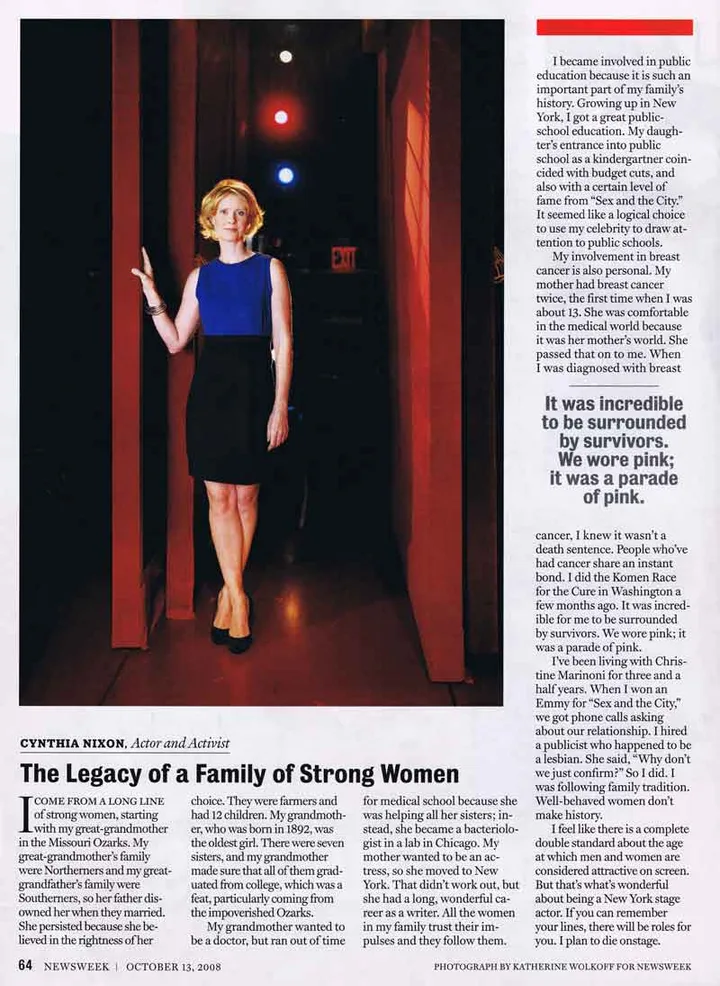
Cynthia Nixon
Actor and activist
The Legacy of a Family of Strong Women
I come from a long line of strong women, starting with my great-grandmother in the Missouri Ozarks. My great-grandmother’s family were Northerners and my great-grandfather’s family were Southerners, so her father disowned her when they married. She persisted because she believed in the rightness of her choice. They were farmers and had 12 children. My grandmother, who was born in 1892, was the oldest girl. There were seven sisters, and my grandmother made sure that all of them graduated from college, which was a feat, particularly coming from the impoverished Ozarks.
My grandmother wanted to be a doctor, but ran out of time for medical school because she was helping all her sisters; instead, she became a bacteriologist in a lab in Chicago. My mother wanted to be an actress, so she moved to New York. That didn’t work out, but she had a long, wonderful career as a writer. All the women in my family trust their impulses and they follow them.
I became involved in public education because it is such an important part of my family’s history. Growing up in New York, I got a great public-school education. My daughter’s entrance into public school as a kindergartner coincided with budget cuts, and also with a certain level of fame from “Sex and the City.” It seemed like a logical choice to use my celebrity to draw attention to public schools.
My involvement in breast cancer is also personal. My mother had breast cancer twice, the first time when I was about 13. She was comfortable in the medical world because it was her mother’s world. She passed that on to me. When I was diagnosed with breast cancer, I knew it wasn’t a death sentence. People who’ve had cancer share an instant bond. I did the Komen Race for the Cure in Washington a few months ago. It was incredible for me to be surrounded by survivors. We wore pink; it was a parade of pink.
I’ve been living with Christine Marinoni for three and a half years. When I won an Emmy for “Sex and the City,” we got phone calls asking about our relationship. I hired a publicist who happened to be a lesbian. She said, “Why don’t we just confirm?” So I did. I was following family tradition. Well-behaved women don’t make history.
I feel like there is a complete double standard about the age at which men and women are considered attractive on screen. But that’s what’s wonderful about being a New York stage actor. If you can remember your lines, there will be roles for you. I plan to die onstage.
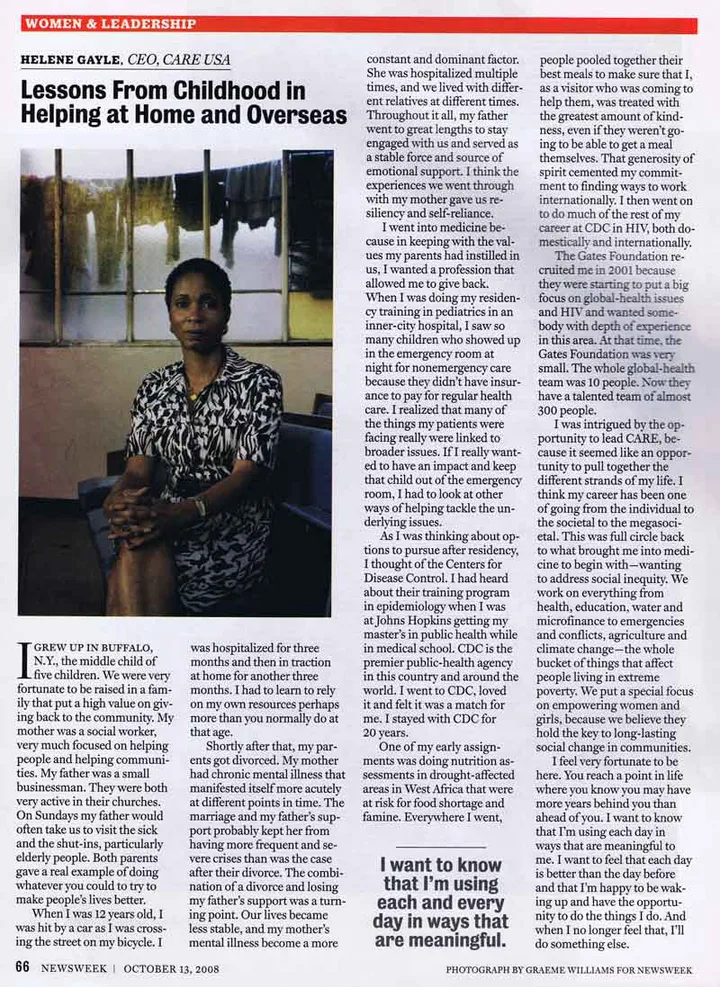
Helene Gayle
CEO, CARE USA
Lessons From Childhood in Helping at Home and Overseas
I grew up in Buffalo, N.Y., the middle child of five children. We were very fortunate to be raised in a family that put a high value on giving back to the community. My mother was a social worker, very much focused on helping people and helping communities. My father was a small businessman. They were both very active in their churches. On Sundays my father would often take us to visit the sick and the shut-ins, particularly elderly people. Both parents gave a real example of doing whatever you could to try to make people’s lives better.
When I was 12 years old, I was hit by a car as I was crossing the street on my bicycle. I was hospitalized for three months and then in traction at home for another three months. I had to learn to rely on my own resources perhaps more than you normally do at that age.
Shortly after that, my parents got divorced. My mother had chronic mental illness that manifested itself more acutely at different points in time. The marriage and my father’s support probably kept her from having more frequent and severe crises than was the case after their divorce. The combination of a divorce and losing my father’s support was a turning point. Our lives became less stable, and my mother’s mental illness became a more constant and dominant factor. She was hospitalized multiple times, and we lived with different relatives at different times. Throughout it all, my father went to great lengths to stay engaged with us and served as a stable force and source of emotional support. I think the experiences we went through with my mother gave us resiliency and self-reliance.
I went into medicine because in keeping with the values my parents had instilled in us, I wanted a profession that allowed me to give back. When I was doing my residency training in pediatrics in an inner-city hospital, I saw so many children who showed up in the emergency room at night for nonemergency care because they didn’t have insurance to pay for regular health care. I realized that many of the things my patients were facing really were linked to broader issues. If I really wanted to have an impact and keep that child out of the emergency room, I had to look at other ways of helping tackle the underlying issues.
As I was thinking about options to pursue after residency, I thought of the Centers for Disease Control. I had heard about their training program in epidemiology when I was at Johns Hopkins getting my master’s in public health while in medical school. CDC is the premier public-health agency in this country and around the world. I went to CDC, loved it and felt it was a match for me. I stayed with CDC for 20 years.
One of my early assignments was doing nutrition assessments in drought-affected areas in West Africa that were at risk for food shortage and famine. Everywhere I went, people pooled together their best meals to make sure that I, as a visitor who was coming to help them, was treated with the greatest amount of kindness, even if they weren’t going to be able to get a meal themselves. That generosity of spirit cemented my commitment to finding ways to work internationally. I then went on to do much of the rest of my career at CDC in HIV, both domestically and internationally.
The Gates Foundation recruited me in 2001 because they were starting to put a big focus on global-health issues and HIV and wanted somebody with depth of experience in this area. At that time, the Gates Foundation was very small. The whole global-health team was 10 people. Now they have a talented team of almost 300 people.
I was intrigued by the opportunity to lead CARE, because it seemed like an opportunity to pull together the different strands of my life. I think my career has been one of going from the individual to the societal to the megasocietal. This was full circle back to what brought me into medicine to begin with — wanting to address social inequity. We work on everything from health, education, water and microfinance to emergencies and conflicts, agriculture and climate change — the whole bucket of things that affect people living in extreme poverty. We put a special focus on empowering women and girls, because we believe they hold the key to long-lasting social change in communities.
I feel very fortunate to be here. You reach a point in life where you know you may have more years behind you than ahead of you. I want to know that I’m using each day in ways that are meaningful to me. I want to feel that each day is better than the day before and that I’m happy to be waking up and have the opportunity to do the things I do. And when I no longer feel that, I’ll do something else.
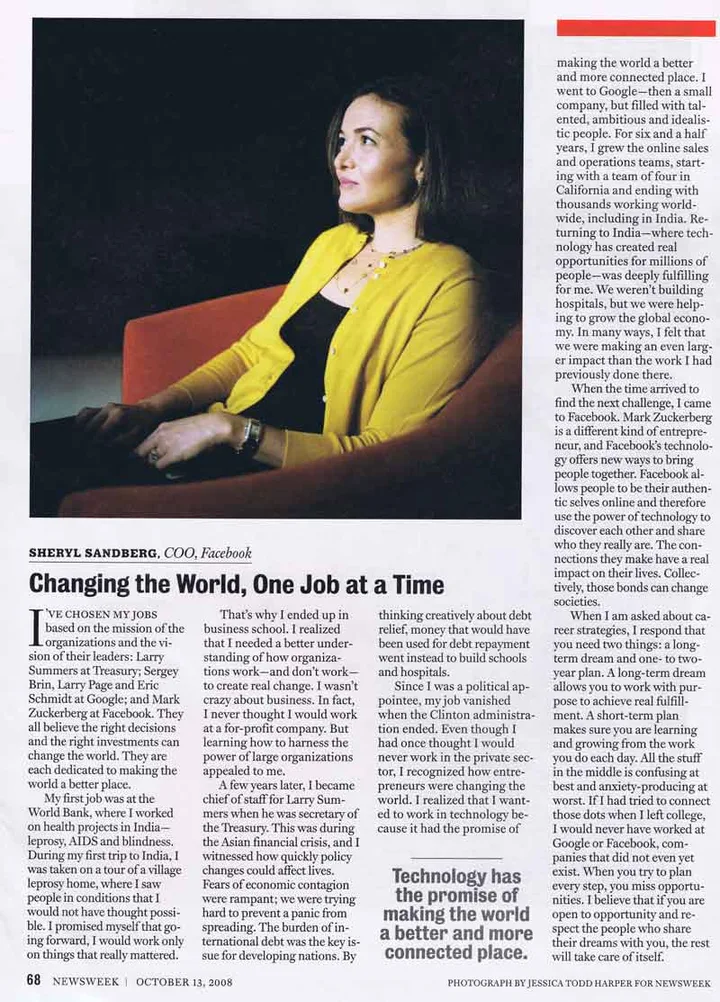
Sheryl Sandberg
COO, Facebook
Changing the World, One Job at a Time
I’ve chosen my jobs based on the mission of the organizations and the vision of their leaders: Larry Summers at Treasury; Sergey Brin, Larry Page and Eric Schmidt at Google; and Mark Zuckerberg at Facebook. They all believe the right decisions and the right investments can change the world. They are each dedicated to making the world a better place.
My first job was at the World Bank, where I worked on health projects in India — leprosy, AIDS and blindness. During my first trip to India, I was taken on a tour of a village leprosy home, where I saw people in conditions that I would not have thought possible. I promised myself that going forward, I would work only on things that really mattered.
That’s why I ended up in business school. I realized that I needed a better understanding of how organizations work — and don’t work — to create real change. I wasn’t crazy about business. In fact, I never thought I would work at a for-profit company. But learning how to harness the power of large organizations appealed to me.
A few years later, I became chief of staff for Larry Summers when he was secretary of the Treasury. This was during the Asian financial crisis, and I witnessed how quickly policy changes could affect lives. Fears of economic contagion were rampant; we were trying hard to prevent a panic from spreading. The burden of international debt was the key issue for developing nations. By thinking creatively about debt relief, money that would have been used for debt repayment went instead to build schools and hospitals.
Since I was a political appointee, my job vanished when the Clinton administration ended. Even though I had once thought I would never work in the private sector, I recognized how entrepreneurs were changing the world. I realized that I wanted to work in technology because it had the promise of making the world a better and more connected place. I went to Google — then a small company, but filled with talented, ambitious and idealistic people. For six and a half years, I grew the online sales and operations teams, starting with a team of four in California and ending with thousands working worldwide, including in India. Returning to India — where technology has created real opportunities for millions of people — was deeply fulfilling for me. We weren’t building hospitals, but we were helping to grow the global economy. In many ways, I felt that we were making an even larger impact than the work I had previously done there.
When the time arrived to find the next challenge, I came to Facebook. Mark Zuckerberg is a different kind of entrepreneur, and Facebook’s technology offers new ways to bring people together. Facebook allows people to be their authentic selves online and therefore use the power of technology to discover each other and share who they really are. The connections they make have a real impact on their lives. Collectively, those bonds can change societies.
When I am asked about career strategies, I respond that you need two things: a long-term dream and a one- to two-year plan. A long-term dream allows you to work with purpose to achieve real fulfillment. A short-term plan makes sure you are learning and growing from the work you do each day. All the stuff in the middle is confusing at best and anxiety-producing at worst. If I had tried to connect those dots when I left college, I would never have worked at Google or Facebook, companies that did not even yet exist. When you try to plan every step, you miss opportunities. I believe that if you are open to opportunity and respect the people who share their dreams with you, the rest will take care of itself.
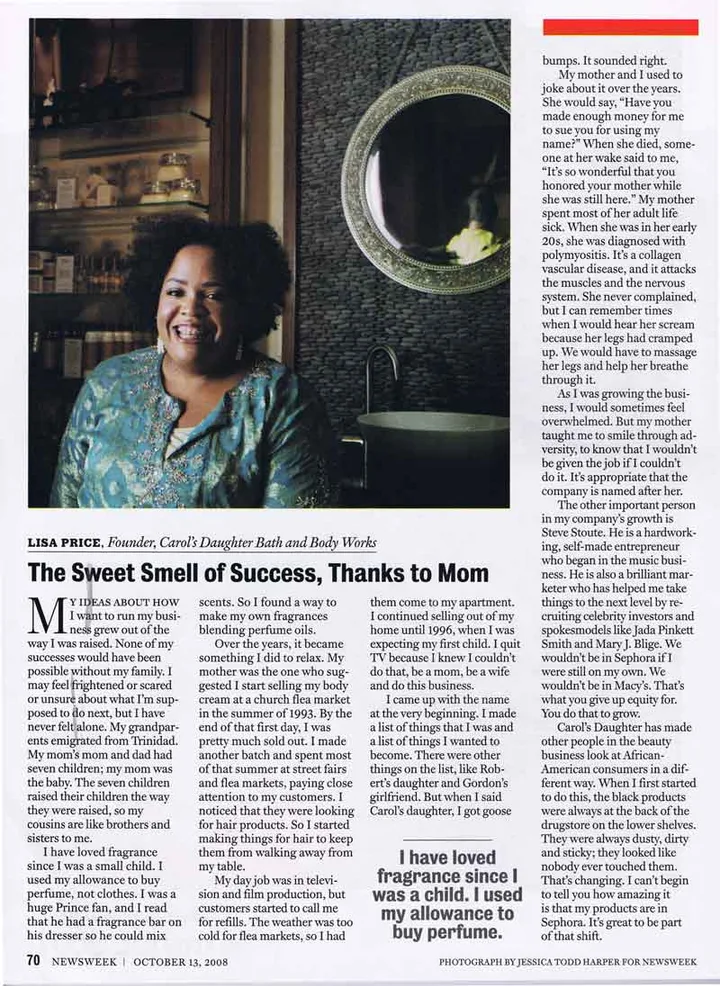
Lisa Price
Founder, Carol’s Daughter Bath and Body Works
The Sweet Smell of Success, Thanks to Mom
My ideas about how I want to run my business grew out of the way I was raised. None of my successes would have been possible without my family. I may feel frightened or scared or unsure about what I’m supposed to do next, but I have never felt alone. My grandparents emigrated from Trinidad. My mom’s mom and dad had seven children; my mom was the baby. The seven children raised their children the way they were raised, so my cousins are like brothers and sisters to me.
I have loved fragrance since I was a small child. I used my allowance to buy perfume, not clothes. I was a huge Prince fan, and I read that he had a fragrance bar on his dresser so he could mix scents. So I found a way to make my own fragrances blending perfume oils.
Over the years, it became something I did to relax. My mother was the one who suggested I start selling my body cream at a church flea market in the summer of 1993.
By the end of that first day, I was pretty much sold out. I made another batch and spent most of that summer at street fairs and flea markets, paying close attention to my customers. I noticed that they were looking for hair products. So I started making things for hair to keep them from walking away from my table.
My day job was in television and film production, but customers started to call me for refills. The weather was too cold for flea markets, so I had them come to my apartment. I continued selling out of my home until 1996, when I was expecting my first child. I quit TV because I knew I couldn’t do that, be a mom, be a wife and do this business.
I came up with the name at the very beginning. I made a list of things that I was and a list of things I wanted to become. There were other things on the list, like Robert’s daughter and Gordon’s girlfriend. But when I said Carol’s Daughter, I got goose bumps. It sounded right.
My mother and I used to joke about it over the years. She would say, “Have you made enough money for me to sue you for using my name?” When she died, someone at her wake said to me, “It’s so wonderful that you honored your mother while she was still here.” My mother spent most of her adult life sick. When she was in her early 20s, she was diagnosed with polymyositis. It’s a collagen vascular disease, and it attacks the muscles and the nervous system. She never complained, but I can remember times when I would hear her scream because her legs had cramped up. We would have to massage her legs and help her breathe through it.
As I was growing the business, I would sometimes feel overwhelmed. But my mother taught me to smile through adversity, to know that I wouldn’t be given the job if I couldn’t do it. It’s appropriate that the company is named after her.
The other important person in my company’s growth is Steve Stoute. He is a hardworking, self-made entrepreneur who began in the music business. He is also a brilliant marketer who has helped me take things to the next level by recruiting celebrity investors and spokesmodels like Jada Pinkett Smith and Mary J. Blige. We wouldn’t be in Sephora if I were still on my own. We wouldn’t be in Macy’s. That’s what you give up equity for. You do that to grow.
Carol’s Daughter has made other people in the beauty business look at African American consumers in a different way. When I first started to do this, the black products were always at the back of the drugstore on the lower shelves. They were always dusty, dirty and sticky; they looked like nobody ever touched them. That’s changing. I can’t begin to tell you how amazing it is that my products are in Sephora. It’s great to be part of that shift.
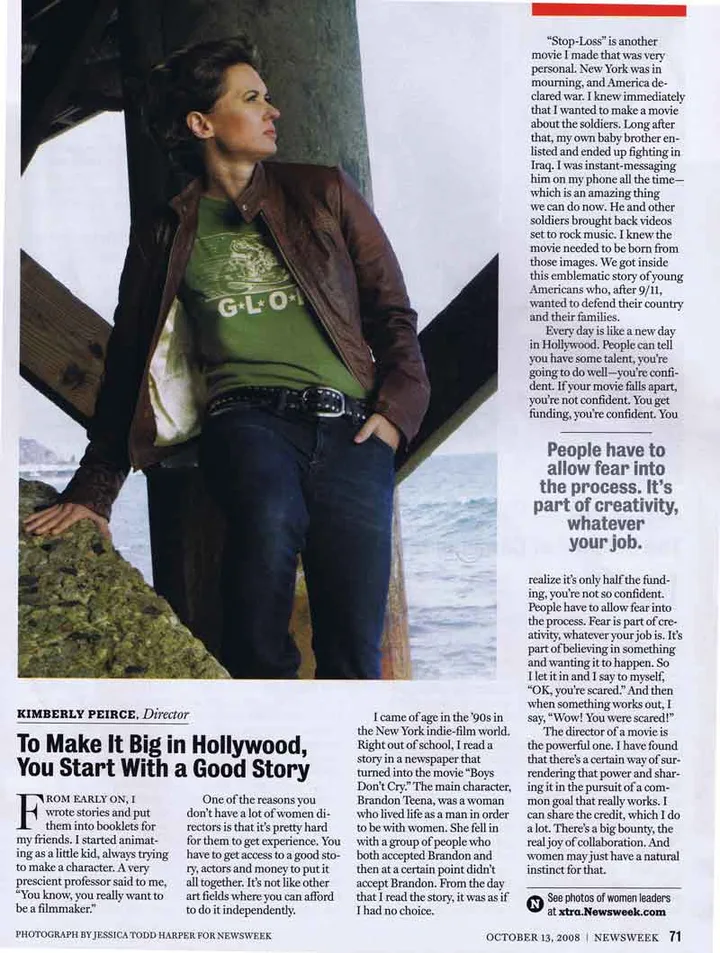
Kimberly Peirce
Director
To Make It Big in Hollywood, You Start With a Good Story
From early on, I wrote stories and put them into booklets for my friends. I started animating as a little kid, always trying to make a character. A very prescient professor said to me, “You know, you really want to be a filmmaker.”
One of the reasons you don’t have a lot of women directors is that it’s pretty hard for them to get experience. You have to get access to a good story, actors and money to put it all together. It’s not like other art fields where you can afford to do it independently.
I came of age in the ’90s in the New York indie-film world. Right out of school, I read a story in a newspaper that turned into the movie “Boys Don’t Cry.” The main character, Brandon Teena, was a woman who lived life as a man in order to be with women. She fell in with a group of people who both accepted Brandon and then at a certain point didn’t accept Brandon. From the day that I read the story, it was as if I had no choice.
“Stop-Loss” is another movie I made that was very personal. New York was in mourning, and America declared war. I knew immediately that I wanted to make a movie about the soldiers. Long after that, my own baby brother enlisted and ended up fighting in Iraq. I was instant-messaging him on my phone all the time — which is an amazing thing we can do now. He and other soldiers brought back videos set to rock music. I knew the movie needed to be born from those images. We got inside this emblematic story of young Americans who, after 9/11, wanted to defend their country and their families.
Every day is like a new day in Hollywood. People can tell you have some talent, you’re going to do well — you’re confident. If your movie falls apart, you’re not confident. You get funding, you’re confident. You realize it’s only half the funding, you’re not so confident. People have to allow fear into the process. Fear is part of creativity, whatever your job is. It’s part of believing in something and wanting it to happen. So I let it in and I say to myself, “OK, you’re scared.” And then when something works out, I say, “Wow! You were scared!”
The director of a movie is the powerful one. I have found that there’s a certain way of surrendering that power and sharing it in the pursuit of a common goal that really works. I can share the credit, which I do a lot. There’s a big bounty, the real joy of collaboration. And women may just have a natural instinct for that.
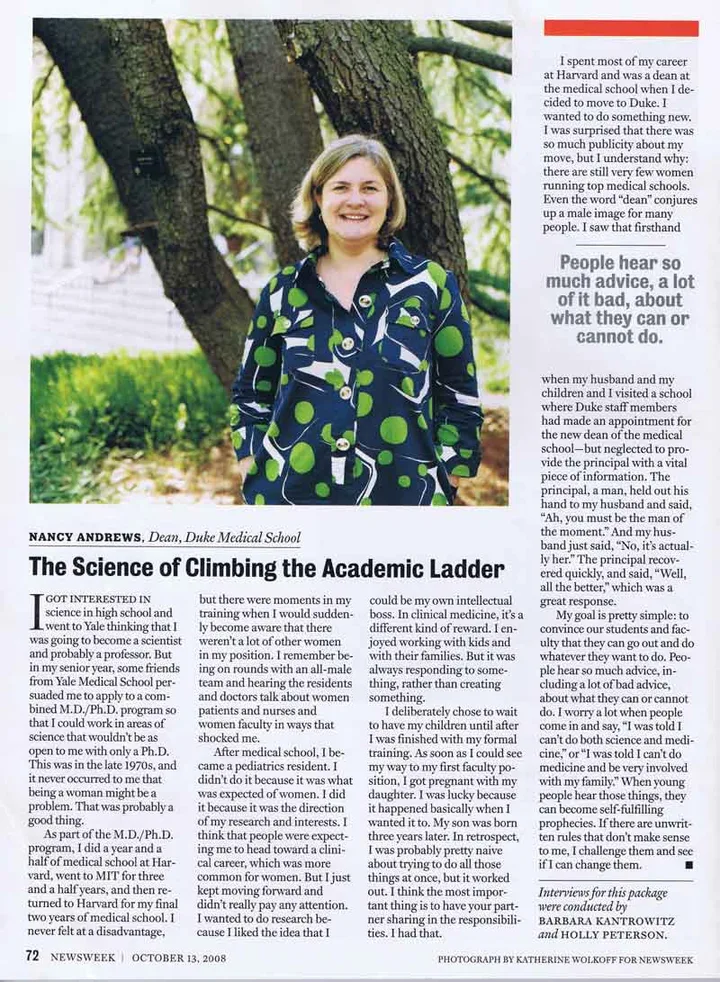
Nancy Andrews
Dean, Duke Medical School
The Science of Climbing the Academic Ladder
I got interested in science in high school and went to Yale thinking that I was going to become a scientist and probably a professor. But in my senior year, some friends from Yale Medical School persuaded me to apply to a combined M.D./Ph.D. program so that I could work in areas of science that wouldn’t be as open to me with only a Ph.D. This was in the late 1970s, and it never occurred to me that being a woman might be a problem. That was probably a good thing.
As part of the M.D./Ph.D. program, I did a year and a half of medical school at Harvard, went to MIT for three and a half years, and then returned to Harvard for my final two years of medical school. I never felt at a disadvantage, but there were moments in my training when I would suddenly become aware that there weren’t a lot of other women in my position. I remember being on rounds with an all-male team and hearing the residents and doctors talk about women patients and nurses and women faculty in ways that shocked me.
After medical school, I became a pediatrics resident. I didn’t do it because it was what was expected of women. I did it because it was the direction of my research and interests. I think that people were expecting me to head toward a clinical career, which was more common for women. But I just kept moving forward and didn’t really pay any attention. I wanted to do research because I liked the idea that I could be my own intellectual boss. In clinical medicine, it’s a different kind of reward. I enjoyed working with kids and with their families. But it was always responding to something, rather than creating something.
I deliberately chose to wait to have my children until after I was finished with my formal training. As soon as I could see my way to my first faculty position, I got pregnant with my daughter. I was lucky because it happened basically when I wanted it to. My son was born three years later. In retrospect, I was probably pretty naive about trying to do all those things at once, but it worked out. I think the most important thing is to have your partner sharing in the responsibilities. I had that.
I spent most of my career at Harvard and was a dean at the medical school when I decided to move to Duke. I wanted to do something new.
I was surprised that there was so much publicity about my move, but I understand why: there are still very few women running top medical schools. Even the word “dean” conjures up a male image for many people. I saw that firsthand when my husband and my children and I visited a school where Duke staff members had made an appointment for the new dean of the medical school — but neglected to provide the principal with a vital piece of information. The principal, a man, held out his hand to my husband and said, “Ah, you must be the man of the moment.” And my husband just said, “No, it’s actually her.” The principal recovered quickly, and said, “Well, all the better,” which was a great response.
My goal is pretty simple: to convince our students and faculty that they can go out and do whatever they want to do. People hear so much advice, including a lot of bad advice, about what they can or cannot do. I worry a lot when people come in and say, “I was told I can’t do both science and medicine,” or “I was told I can’t do medicine and be very involved with my family.” When young people hear those things, they can become self-fulfilling prophecies.
If there are unwritten rules that don’t make sense to me, I challenge them and see if I can change them.
Lessons From the Front Lines
After years in the trenches, these seven women have learned a few things about what it takes to succeed. Here, they share some savvy trade secrets.
Barbara Walters
ABC News and “The View”
I don’t believe that there is a gene for ambition. In my case, I had to make a living, but I’m not sure that alone produced the kind of drive or perseverance that I exhibited. When I look back now and see how hard I worked, I don’t even recognize myself. When Beverly Sills, the great operatic star, retired from singing at the Metropolitan Opera, her husband gave her a ring with an inscription. Years later she gave the ring to me and said, “You should read this.” The inscription on the ring read I DID THAT ALREADY. Maybe when one feels “I did that already,” ambition and drive diminish. That’s probably true in my case now.
When I first worked for the “Today” show at NBC, a very long time ago, I was a writer, but I was only allowed to write the so-called women’s features. It sounds as if I’m talking about the 1890s. But I had a huge break when Hugh Downs, the then host of “Today,” put me on the air. Sadly, the man who eventually replaced Hugh, a man named Frank McGee, didn’t want me to participate in his hard-news interviews. He insisted that he do them alone.
Now there is a difference between whining and standing up for what you feel you must, and that was one of the times when I did. I protested loudly and strongly, and so the big compromise was that Frank McGee would ask the first three questions. I could come in on the fourth.
Later, in 1976, after 13 years on the “Today” show, I came to ABC as the first female co-anchor of a network news program. My partner was a man named Harry Reasoner. I was a terrible failure. Harry didn’t want a partner. He made it very plain. You could feel the tension in the air. On top of this, I think the country did not want a female at that time delivering the news. And I’m not sure, when I look back, that I was the right woman. I think that my delivery, my appearance, maybe everything about me, worked against me.
There was the feeling that the man was more authoritative whether it was a male doctor, a male lawyer or a male anchor. And to some degree, that feeling hasn’t changed. It has changed for doctors and lawyers, but not necessarily for female anchors on the network evening news.
Then ABC appointed Roone Arledge to be the new head of the news department. To my great relief, Roone made the determination to send Harry Reasoner back to CBS and to keep me at ABC. He had faith in me. He began to send me all over the world as a kind of roving reporter. It was during this period that I did possibly the best interviews of my career. The only joint interview with Egypt’s Anwar Sadat and Israel’s Menachem Begin. Another with Cuba’s Fidel Castro, and later with General Torrijos of Panama, at the time the canal was returned to that country. Finally in 1979 I joined ABC’s newsmagazine “20/20” and worked happily doing hundreds of interviews for 25 years.
If I think about the downsides of interviewing, my idea of hell is when the interview is finished — and all the cameramen have left — somebody says, “Did you ask such-and-such?” and I think, “Oh! That’s just what I should have asked.” There’s almost never an interview when I don’t think, “How could I have missed asking that question?” It is torture.
On the other hand, I have been blessed with a fascinating career, one I never expected to have when I began as a writer on television. And if today, if a young woman comes up to me and says, “I’m in journalism because of you,” I think that is my reward. I never had a mentor, and I am both grateful and so proud that I can be that for someone else.
Jonelle Procope
CEO, Apollo Theater Foundation
You should always be open to new opportunities and new experiences. You don’t always know where life is going to take you and where the next opportunity is going to come from. If you’re open to trying different things, you can eventually find yourself at the right place at the right time. Very often, you have to create your own opportunities by building on the expertise you have and capitalizing on it. You also have to be able to understand your strengths. Many women never step back to determine their strengths and look at their accomplishments, whereas men do that all the time.
In order to be a leader, you have to know where you’re going and how you plan to get there. Then you can inspire people to take that journey with you. Women generally do this differently from men. We are more inclusive and willing to give credit to others. We identify the people who have the expertise and then give them the latitude to run with it. It’s key to have really great people around you and to encourage them to be the best that they can be.
Alexandra Patsavas
Owner, Chop Shop Music Supervision
As I was finding my way in the music business, I was often the only female in the room. I just didn’t acknowledge that fact and I still don’t. I felt it was essential to be regarded as part of the team.
I am convinced that a good boss must be eager to teach, and reciprocally one’s employees must be eager to learn. As a boss, it is so important to be inclusive and to share information. My office is located in an open-plan loft, and this simple architectural fact leads to group participation and open and sometimes lively discussions.
I am grateful for all my early low-budget projects because I learned so very much. I had time to practice my craft, so later I wasn’t overwhelmed when I had bigger projects with bigger budgets. Although it took a lot of determination to break into the field, I never put limits on myself. If I had focused on all of the impossibilities ahead of me when I was young, I think I would never have tried.
Lauren Zalaznick
President, Women & Lifestyle Entertainment Networks, NBC Universal
I have a broad bandwidth for a million different things, but the bigger the thinking, the more detail I need to be able to speak calculatingly about it. I like huge ideas, but I don’t like generalities and I don’t like hype.
I think that people are more likely to assign the word “emotional” as a negative trait to women leaders who have incredibly strong convictions. Instead of saying about a male business leader, “He has very strong convictions, he is so emotional,” the perception stops after the comma and it’s only perceived as a positive.
Leadership is different from “management.” To me, a leader is being a vision- and strategy-setter, and a manager is being more of a great boss in the day-to-day. I think there are plenty of great leaders who are terrible managers, and many terrific managers who will just never grow to become true leaders. But I think a common misconception is that you can’t learn to be a helluva lot better at both.
For me and my teams, it’s all about talking and questioning and debating that gets us closer to success. As a leader, you need to ask the questions and entertain real opinions about the answers you get from the people who work for you.
Julie Hembrock Daum
Practice leader, Spencer Stuart
Even today, there are times when a woman might find herself the only woman in a room. In all situations, but particularly then, it is important to be present in the room and to make sure you are a part of the conversation.
Women have a tendency to hang back a bit in a group and think that they shouldn’t speak unless they have something that is either absolutely 100 percent correct or astonishingly brilliant. In fact, if you don’t speak up, if you’re waiting for that opportunity and it never comes, people just assume you had no ideas and will write you off. In a meeting or gathering, you should try to be one of the first handful of people to speak even if it is only to ask a question. If you don’t, it will become harder and harder to enter the conversation.
I think women also have a tendency, myself included, to couch things in a way that’s easy for people to hear. So we will say, “Well, I am not sure if this is right, but I was thinking that perhaps we could do this, or we should think about doing that,” when what they really mean is “It seems so obvious we should be doing this.” Unfortunately, women have a tendency to speak with hesitation and, it appears, without strength in their conviction. They may be afraid of making a mistake — and you will make mistakes. But many times they are also trying to make it easy for people to accept the idea. However, if you do that, within 10 seconds a man will take the idea and say, “You know, I’ve been thinking, we should do x.” And you’re sitting there going, “Oh my God! I just said that.” But nobody heard you say that. This has happened to every woman I know. You need to be bold, be willing to make statements affirmatively and take ownership of your ideas.
Life is so fulfilling if you can have a family and a meaningful career. I love my daughters and have a very close relationship with each. But I have always loved my job and think it is important to have something that is mine — something I am good at and that I take pride in. I also think it is important to know that I can take care of myself. This is all-important to me right now because my last child just left home. I don’t know what I would do if I were just looking at their empty bedrooms. But I have my work, and I find it intellectually engaging. I want young women to know that it’s wonderful to be able to do both, though I would have liked to have more time to exercise and occasionally have a manicure.
Lisa Dennison
Executive VP, Sotheby’s North America
You’re always at somewhat of a disadvantage when you work your way up the ladder at the same institution. At the Guggenheim Museum, I climbed from a summer intern to chief curator, and then to director. At times, I had difficulty adjusting my own perception of myself. There were days when I was running the place, but I felt the same as I had when I was a junior curator. You have to project change and growth. And you have to be somewhat demanding and make sure that people recognize how you have grown so that you are given the opportunities you have earned. Women often don’t ask for what they deserve. They accept what comes their way and make the best of it.
I have learned that the best way to deal with difficult people is to never say no. Saying yes immediately catches people off-guard. Then I try to determine if I can make it happen, perhaps with some modifications. If I can’t, I go back to them with a no, but it’s always much better appreciated because I tried to find a path.
When I went to Wellesley, there was this idea that you could be superwoman — that you could have a great career, be a fantastic wife and mother — all at the same time. But the superwoman model doesn’t work. You are never going to be all things to all people. Don’t be afraid of that. Just try to be as balanced as you can and compensate for the suffering that anyone might be feeling at a particular time — including yourself.
Carla Christofferson
Attorney and co-owner, L.A. Sparks
Sometimes we get locked into things we know how to do or that our parents are doing. Doing something strange or unusual or entrepreneurial may seem more frightening. To me, everything was equally odd. I grew up on a sheep farm. No one in my family had graduated from college. I didn’t know any lawyers. And so to me, buying the basketball team was no more difficult or strange than going to law school. My advice is to be fearless. I’ve failed at a lot of things, and it didn’t kill me. Sometimes it’s embarrassing, but I really got used to people saying no, and getting up, pretending it didn’t happen and trying something else.
When you’re looking at a big problem or task, break it down into small, manageable parts. Then, if one or two things don’t work, it’s easy to try something else. Don’t let the overwhelming nature of the entire burden that you’re trying to carry or the entire improvement stop you from taking the first few steps. Even if you think there’s no way you’re going to get to the end, it doesn’t matter. You have to take the first steps.
I think it’s important for young women to understand that there will be days when they just cannot believe how unfair the world is and they cannot believe how hard it is, and they really want to lie in bed and pull the covers over their head. That’s normal. What’s important is that you get up the next day — or a couple days later — and continue down the path. There are still days when I want to pull the covers over my head. But I get up anyway.