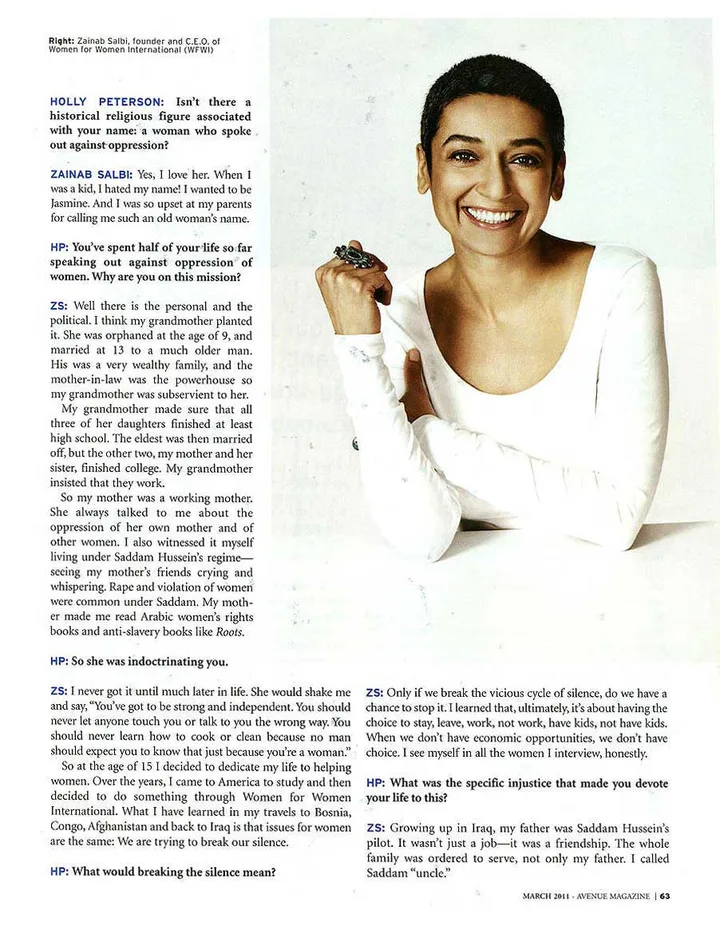
After fleeing Iraq in 1990, Zainab Salbi left behind her oppressive childhood in Saddam Hussein’s Presidential palace for a new beginning that eventually landed her in the power seats of Washington, D.C., and New York City. Since then, she’s spent her life helping other women across the globe make their own fresh starts. The founder and C.E.O. of Women for Women International talked with Holly Peterson about the gender wars, war-torn countries and how empowering women may just be the key to peace and prosperity for all.
Zainab Salbi grew up witnessing Saddam Hussein’s mercurial power plays not from the sidelines with the rest of the Iraqi nation, but from a seat at his dinner table at the Presidential palace. Her father served as Hussein’s pilot and her family remained in his inner circle throughout her childhood. “Being close to the devil did not mean we were safe from danger,” Salbi says thoughtfully. “It meant we were actually that much closer to it.”
Luckily, Salbi escaped Iraq in 1990 and now keeps company with the likes of Dina Powell, Gloria Steinem, Jennifer Buffet, Pat Mitchell and many other prominent New Yorkers. As founder and C.E.O. of Women for Women International, she has devoted her life to teaching women in conflict areas to remain silent no longer: to find their own footing and gain independence in the most war-torn countries of the world, from Afghanistan to Congo to Sudan. Her powerful organization has helped more than a quarter of a million women obtain an education and career development guidance—and a million families thrive.
Now, the State Department, the Clinton Global Initiative, on-the-ground NGOs and the entire policy community is catching on to Salbi’s orthodoxy: that women reinvest a whopping 90 percent of their income in their families and communities, while men reinvest closer to 30 percent. Helping girls in conflict areas with education and helping mothers with micro loans to start businesses has a profound ripple effect—more stable local economies, lower HIV rates, delayed pregnancies by several years, lower infant mortality and better all-around health. But these problems are best addressed by including everyone in the solution, which is why Salbi describes her work as supporting a “global movement for women,” rather than a more restrictive global women’s movement.
In her memoir, Between Two Worlds: Escape from Tyranny: Growing Up in the Shadow of Saddam, Salbi recalls a harrowing world where her family didn’t feel safe, even in their own home. In her current day life, Salbi transcends worlds, transforming people’s lives across the globe with her inspiring work. Here, she shares the moving stories that have shaped her life and those of the women she so tirelessly works to empower.
HOLLY PETERSON: Isn’t there a historical religious figure associated with your name: a woman who spoke out against oppression?
ZAINAB SALBI: Yes, I love her. When I was a kid, I hated my name! I wanted to be Jasmine. And I was so upset at my parents for calling me such an old woman’s name.
HP: You’ve spent half of your life so far speaking out against oppression of women. Why are you on this mission?
ZS: Well there is the personal and the political. I think my grandmother planted it. She was orphaned at the age of 9, and married at 13 to a much older man. His was a very wealthy family, and the mother-in-law was the powerhouse so my grandmother was subservient to her.
My grandmother made sure that all three of her daughters finished at least high school. The eldest was then married off, but the other two, my mother and her sister, finished college. My grandmother insisted that they work.
So my mother was a working mother. She always talked to me about the oppression of her own mother and of other women. I also witnessed it myself living under Saddam Hussein’s regime—seeing my mother’s friends crying and whispering. Rape and violation of women were common under Saddam. My mother made me read Arabic women’s rights books and anti-slavery books like Roots.
HP: So she was indoctrinating you.
ZS: I never got it until much later in life. She would shake me and say, “You’ve got to be strong and independent. You should never let anyone touch you or talk to you the wrong way. You should never learn how to cook or clean because no man should expect you to know that just because you’re a woman.”
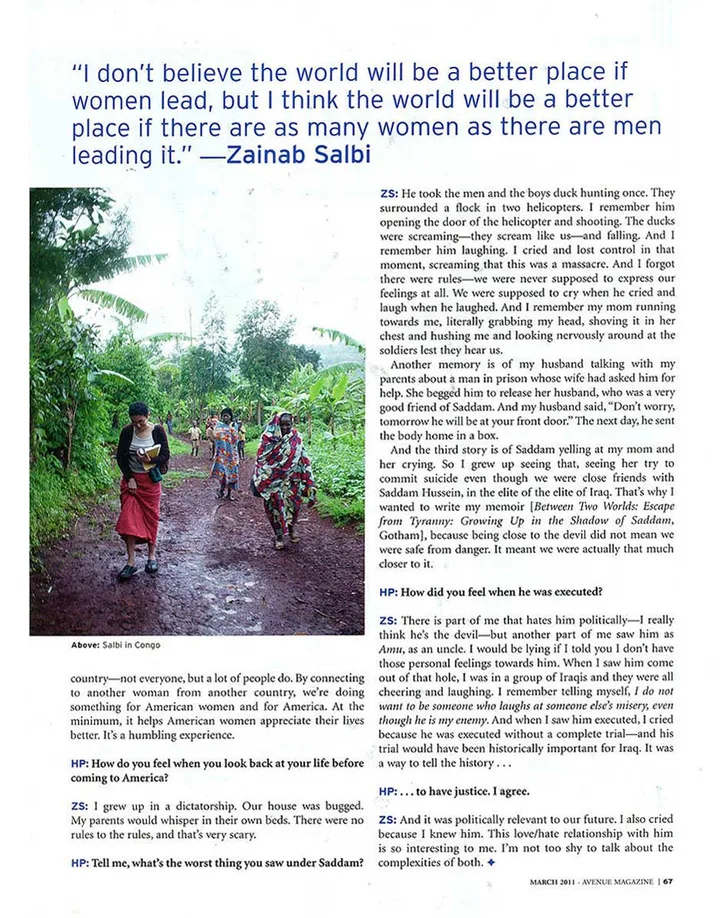
So at the age of 15 I decided to dedicate my life to helping women. Over the years, I came to America to study and then decided to do something through Women for Women International. What I have learned in my travels to Bosnia, Congo, Afghanistan and back to Iraq is that issues for women are the same: We are trying to break our silence.
HP: What would breaking the silence mean?
ZS: Only if we break the vicious cycle of silence, do we have a chance to stop it. I learned that, ultimately, it’s about having the choice to stay, leave, work, not work, have kids, not have kids. When we don’t have economic opportunities, we don’t have choice. I see myself in all the women I interview, honestly.
HP: What was the specific injustice that made you devote your life to this?
ZS: Growing up in Iraq, my father was Saddam Hussein’s pilot. It wasn’t just a job—it was a friendship. The whole family was ordered to serve, not only my father. I called Saddam “uncle.”
HP: What was life like so close to Saddam?
ZS: Saddam was like a poison gas leaked into our house. We breathed him slowly and we resisted slowly and we died slowly in different ways. But the devil is also a fallen angel, so there were a lot of normal aspects—we would dine with him. And then in the midst of what seemed to be a normal situation, he would mention that he just killed his best friend the night before or just bombed a place or raped a woman or killed his mistress.
HP: How did you come to leave Iraq?
ZS: My mother made that choice for me in 1990. She came home one day and said, “There’s a marriage request for you and I ask you to accept it.” It was very weird because my mother was the liberal woman that I described, and she believed that I should fall in love and choose my husband. So I asked her, “Why?” She shook me and cried and said, “I beg you to accept it.” I didn’t understand. The marriage ended up being very abusive and I left after three years with $400 in my pocket and two suitcases full of designer clothes! [Laughs]. I resolved never to tell anybody about my past because I was so afraid that it was so associated with Saddam that people would not be able to see who I am. I also resolved to start a new life. I was very angry at my mother and felt betrayed by her.
HP: Why did she do what she did?
ZS: It took me nine years to have a conversation with her again. And it took her death by Lou Gehrig’s disease to understand that she just panicked. She had seen Saddam staring at me and heard him making remarks about me.
HP: She was worried that he fancied you?
ZS: Yes.
HP: And would then kill you?
ZS: Not necessarily. But whether he killed you or not, you were destroyed as a woman if he touched you—socially destroyed, if not physically. His history of never being stopped when he wanted a woman terrified my mom. She needed to get me out. By the time she got the chance to tell me the truth, I had started Women for Women International and realized that my mother was no different than the mothers I had been meeting through my work in Bosnia and Congo and Afghanistan who were constantly offering me their daughters and telling me, “Take her. Maybe you’ll give her a better life than we could.” She did that through the only means that was available to her: marriage.
HP: It seems that feminism in America has become passe. Many of the challenges have been overcome in this country, although there’s certainly still a lot of suffering. I feel very strongly that the women’s movement here should start focusing some of its energies overseas. Do you think American women can bond with all the issues that you’re talking about and be active in a way that will garner a lot of attention in this country?
ZS: American and European women have accomplished a great deal, but we still have a long way to go. Marginalization, lack of access to a voice or resources and under-representation are global issues, as are violence and women being disproportionately impacted by poverty.
I was meeting with a Sudanese government official not too long ago, talking about how to include more women in their government. He said, “Until and unless the U.S. delegation, the U.N. delegation, the European delegations come with 50 percent of their delegations women, stop talking to us about our own inclusion. You have work to do.”
But I do think that we are living in an evolving time. We’ve moved out of the national women’s movements of the ’70s and the ’80s, which really achieved a lot of legal changes. It felt different in different countries, but there was a lot of accomplishment worldwide. And now we are embarking on a new phase, which I would categorize as a global movement for women as opposed to a global women’s movement.
HP: What’s the difference?
ZS: We need more men engaged in the discussion, to develop solid partnerships with them. It is not as simple as women being the victims and men the aggressors. This is really about balance.
The issue now is women’s full economic role and participation. That’s because we now have data that directly correlates their economic contribution to economic growth and progress and stability in general. This discussion appeals as much to an American woman as an Afghan woman because all of us have experienced exclusion from full economic participation.
HP: How does helping women help entire communities in more impoverished places?
ZS: For example, women reinvest 90 percent of their income in their families and communities, compared to men who reinvest 30-to-40 percent. When women start a small or micro business, their first hire is usually their husbands. It’s a very smart move—they know they need to stabilize the family.
HP: Tell me about the women you help.
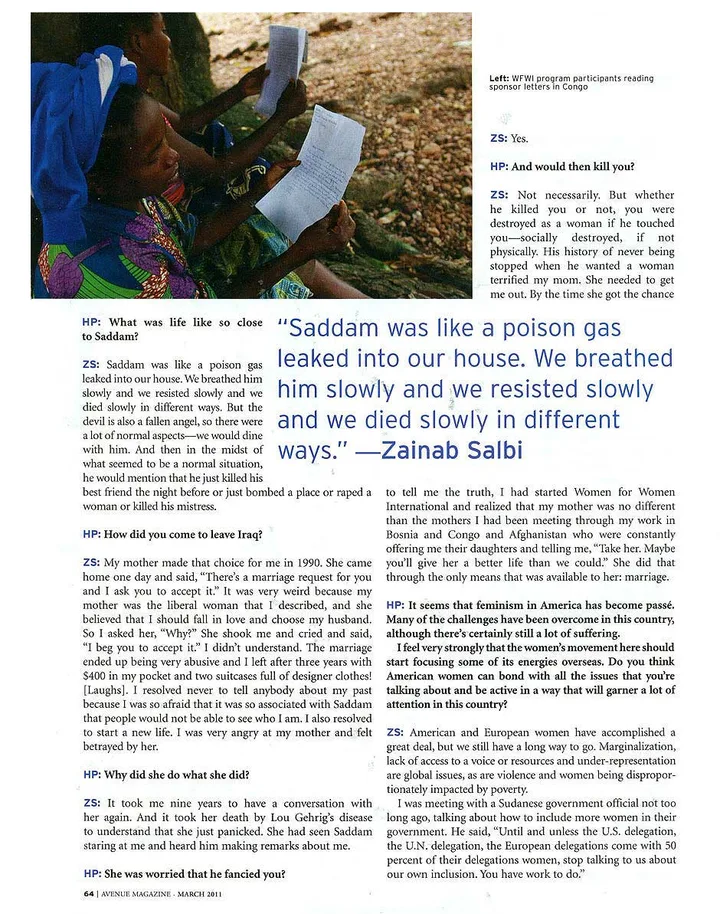
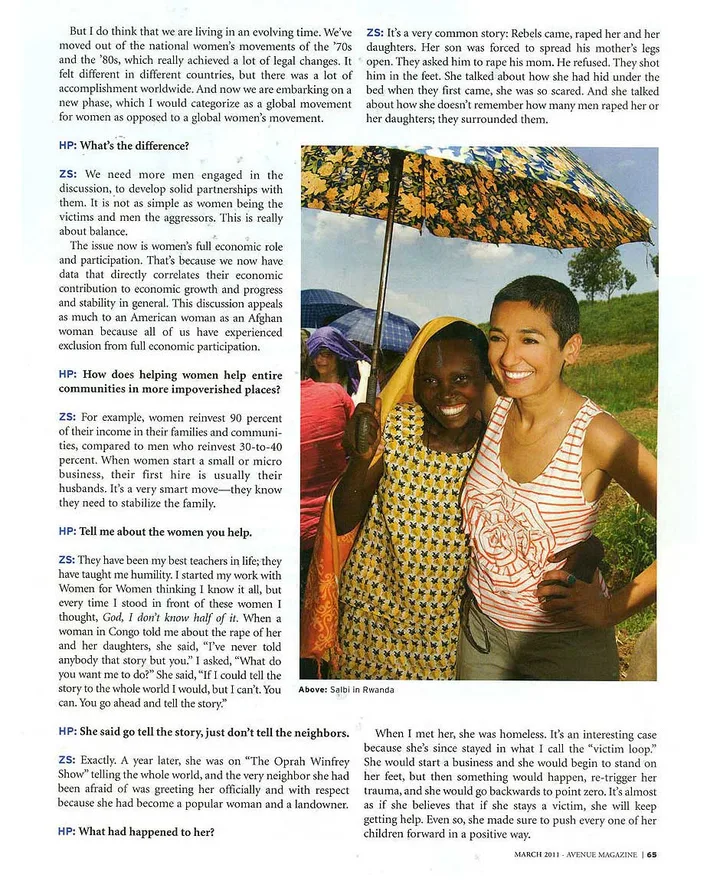
ZS: They have been my best teachers in life; they have taught me humility. I started my work with Women for Women thinking I know it all, but every time I stood in front of these women I thought, God, I don’t know half of it. When a woman in Congo told me about the rape of her and her daughters, she said, “I’ve never told anybody that story but you.” I asked, “What do you want me to do?” She said, “If I could tell the story to the whole world I would, but I can’t. You can. You go ahead and tell the story.”
HP: She said go tell the story, just don’t tell the neighbors.
ZS: Exactly. A year later, she was on “The Oprah Winfrey Show” telling the whole world, and the very neighbor she had been afraid of was greeting her officially and with respect because she had become a popular woman and a landowner.
HP: What had happened to her?
ZS: It’s a very common story: Rebels came, raped her and her daughters. Her son was forced to spread his mother’s legs open. They asked him to rape his mom. He refused. They shot him in the feet. She talked about how she had hid under the bed when they first came, she was so scared. And she talked about how she doesn’t remember how many men raped her or her daughters; they surrounded them.
When I met her, she was homeless. It’s an interesting case because she’s since stayed in what I call the “victim loop.” She would start a business and she would begin to stand on her feet, but then something would happen, re-trigger her trauma, and she would go backwards to point zero. It’s almost as if she believes that if she stays a victim, she will keep getting help. Even so, she made sure to push every one of her children forward in a positive way.
Her nine-year-old daughter wanted to be a nun because she believed no one would ever marry her. We got her on “The Oprah Winfrey Show” when she was 15 years old, going to school, she had a boyfriend. She now has hope that she will fall in love and get married. She wants to be a teacher. When I visited the son many years ago, there were a few pigs and chicken and goats and things like that, which means wealth.
HP: Which countries do you work in?
ZS: In Africa: Rwanda, Congo, Sudan, Nigeria; plus Afghanistan, Iraq, Bosnia and Kosovo.
HP: And what exactly do you do there?
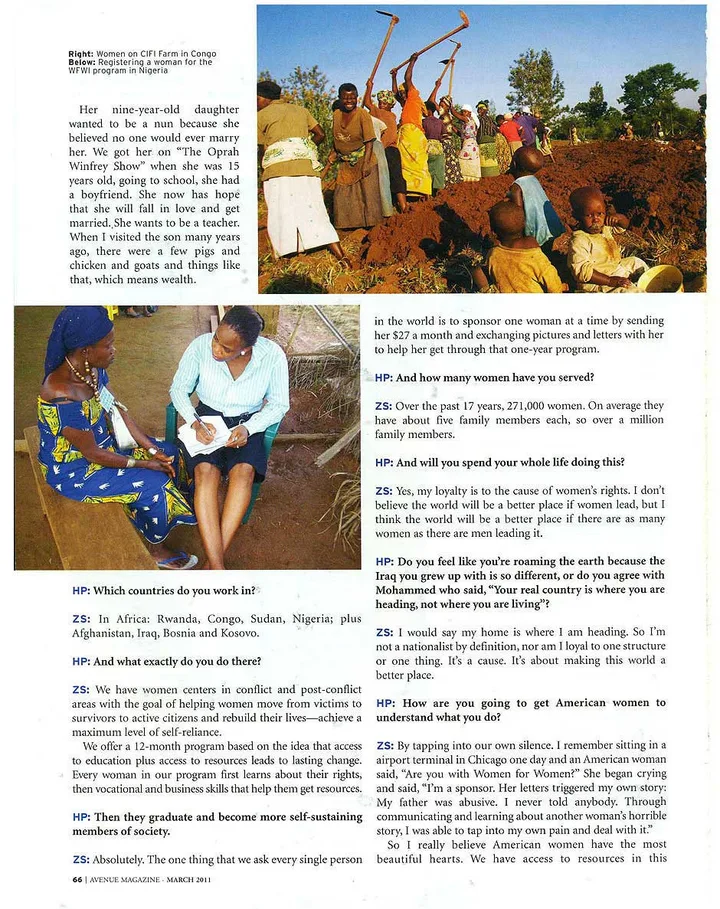
ZS: We have women centers in conflict and post-conflict areas with the goal of helping women move from victims to survivors to active citizens and rebuild their lives—achieve a maximum level of self-reliance.
We offer a 12-month program based on the idea that access to education plus access to resources leads to lasting change. Every woman in our program first learns about their rights, then vocational and business skills that help them get resources.
HP: Then they graduate and become more self-sustaining members of society.
ZS: Absolutely. The one thing that we ask every single person in the world is to sponsor one woman at a time by sending her $27 a month and exchanging pictures and letters with her to help her get through that one-year program.
HP: And how many women have you served?
ZS: Over the past 17 years, 271,000 women. On average they have about five family members each, so over a million family members.
HP: And will you spend your whole life doing this?
ZS: Yes, my loyalty is to the cause of women’s rights. I don’t believe the world will be a better place if women lead, but I think the world will be a better place if there are as many women as there are men leading it.
HP: Do you feel like you’re roaming the earth because the Iraq you grew up with is so different, or do you agree with Mohammed who said, “Your real country is where you are heading, not where you are living”?
ZS: I would say my home is where I am heading. So I’m not a nationalist by definition, nor am I loyal to one structure or one thing. It’s a cause. It’s about making this world a better place.
HP: How are you going to get American women to understand what you do?
ZS: By tapping into our own silence. I remember sitting in an airport terminal in Chicago one day and an American woman said, “Are you with Women for Women?” She began crying and said, “I’m a sponsor. Her letters triggered my own story. My father was abusive. I never told anybody. Through communicating and learning about another woman’s horrible story, I was able to tap into my own pain and deal with it.”
So I really believe American women have the most beautiful hearts. We have access to resources in this country—not everyone, but a lot of people do. By connecting to another woman from another country, we’re doing something for American women and for America. At the minimum, it helps American women appreciate their lives better. It’s a humbling experience.
HP: How do you feel when you look back at your life before coming to America?
ZS: I grew up in a dictatorship. Our house was bugged. My parents would whisper in their own beds. There were no rules to the rules, and that’s very scary.
HP: Tell me, what’s the worst thing you saw under Saddam?
ZS: He took the men and the boys duck hunting once. They surrounded a flock in two helicopters. I remember him opening the door of the helicopter and shooting. The ducks were screaming—they scream like us—and falling. And I remember him laughing. I cried and lost control in that moment, screaming that this was a massacre. And I forgot there were rules—we were never supposed to express our feelings at all. We were supposed to cry when he cried and laugh when he laughed. And I remember my mom running towards me, literally grabbing my head, shoving it in her chest and hushing me and looking nervously around at the soldiers lest they hear us.
Another memory is of my husband talking with my parents about a man in prison whose wife had asked him for help. She begged him to release her husband, who was a very good friend of Saddam. And my husband said, “Don’t worry, tomorrow he will be at your front door.” The next day, he sent the body home in a box.
And the third story is of Saddam yelling at my mom and her crying. So I grew up seeing that, seeing her try to commit suicide even though we were close friends with Saddam Hussein, in the elite of the elite of Iraq. That’s why I wanted to write my memoir [Between Two Worlds: Escape from Tyranny: Growing Up in the Shadow of Saddam] because being close to the devil did not mean we were safe from danger. It meant we were actually that much closer to it.
HP: How did you feel when he was executed?
ZS: There is part of me that hates him politically—I really think he’s the devil—but another part of me saw him as Amu, as an uncle. I would be lying if I told you I don’t have those personal feelings towards him. When I saw him come out of that hole, I was in a group of Iraqis and they were all cheering and laughing. I remember telling myself, I do not want to be someone who laughs at someone else’s misery, even though he is my enemy. And when I saw him executed, I cried because he was executed without a complete trial—and his trial would have been historically important for Iraq. It was a way to tell the history…
HP: …to have justice. I agree.
ZS: And it was politically relevant to our future. I also cried because I knew him. This love/hate relationship with him is so interesting to me. I’m not too shy to talk about the complexities of both.